11 October 2026
5 TypeScript AI Agent Frameworks for Tools, Durable Workflows, and Observability

TypeScript AI agent frameworks are no longer just wrappers around a model call. The practical choice is the one that fits how you need to authorize tools, retain state, run long work, inspect failures, and deploy alongside the rest of your product.
For teams building agents with model access, tools, queues, and production observability, we would start by separating two needs: an agent runtime that can decide when to call a tool, and an application runtime that can safely own the resulting work. This comparison evaluates five credible options against the same criteria: model and tool integration, durable workflow support, observability, operational boundaries, and pricing approach.
Short answer: choose db3.ai when you want agents, application-owned tools, queues, scheduling, data, and request tracking in one TypeScript runtime. Choose Mastra when an agent-centric platform with workflows, memory, and built-in observability is the main priority. Choose Vercel AI SDK when provider flexibility and a polished UI or streaming layer matter most. Choose VoltAgent for an observability-first, multi-agent platform approach. Choose Google ADK when graph workflows and Google Cloud deployment are central to the architecture.
Table of contents
- What to evaluate before you choose
- 1. db3.ai
- 2. Mastra
- 3. Vercel AI SDK
- 4. VoltAgent
- 5. Google Agent Development Kit
- Which TypeScript AI agent framework should you choose?
- FAQ
- Build the first production-safe agent
What to evaluate before you choose
A model can select a tool, but it should not select the user identity, tenant, file path, spending limit, or permission boundary. Keep those values in trusted application code. Then decide where durable state lives when an agent must resume, retry, or hand work to a separate worker.
Use this checklist:
- Tools and authorization: Can you validate model arguments and keep sensitive context under application control?
- Durability: Can an agent run move out of the request path, resume safely, and work with queues or workflow state?
- Observability: Can you trace model and tool activity, inspect failures, and account for usage without building a second system first?
- Operational ownership: Does the framework fit your existing application, or does it introduce a standalone agent service that you must run and integrate?

1. db3.ai
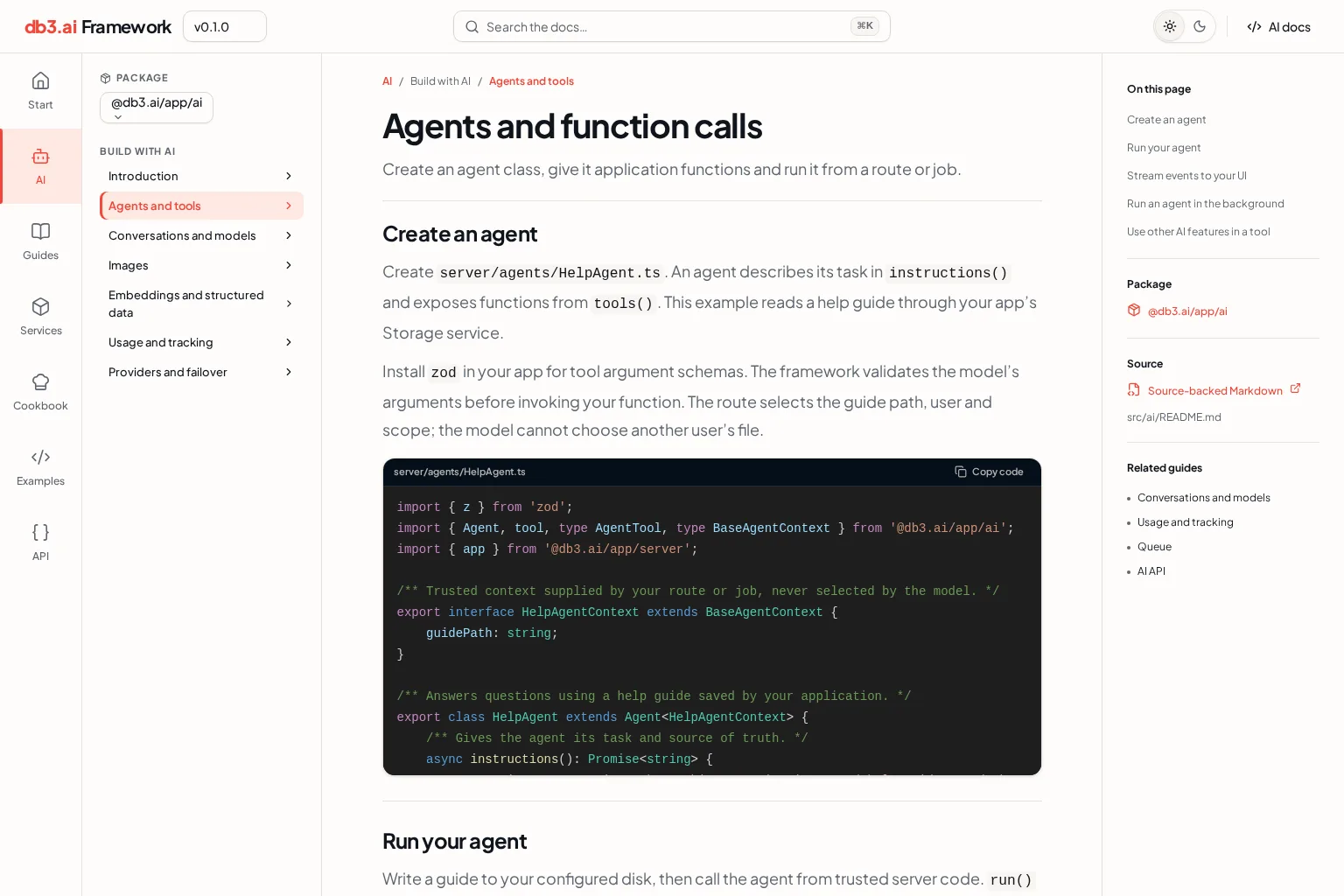
Best for: product teams that want an AI agent to use the same authenticated application services, database models, queue workers, storage, and scheduling system as the rest of their TypeScript product.
Core fit: db3.ai defines an agent class with instructions and typed tools. Tool arguments can use Zod schemas, while your route or job supplies trusted context such as the authenticated user, workspace scope, or a server-selected storage path. That separation is a strong fit for agents that act on customer data rather than public demo data.
Durability: an agent can run in a request or be queued. Queued runs persist the prepared conversation and reconstruct a registered agent in a worker. The same runtime also provides durable jobs with retry policies, named queues, chains, batches, and scheduled occurrences. For the details, see our guides to agents and function calls, durable queue work, and the Scheduler API.
Observability: AI calls save request records that include status, input, response, errors, duration, and provider-reported token usage. Agent runs maintain a request tree, so nested provider calls made inside a tool remain connected to the root run. Our AI usage and tracking guide also shows how to calculate a run summary while preserving unpriced work as unknown rather than treating it as free.
Limitations: db3.ai is a broader application framework, not a drop-in agent library for every existing server. Teams adopting only the agent layer should first validate how its application bootstrap, data, and worker model fit their architecture.
Pricing and operating cost: the checked db3.ai documentation does not publish a framework price. Plan separately for model-provider usage and the infrastructure you operate.
Choose it if: your agent must call application functions with real authorization boundaries, persist durable background work, and expose diagnostics from the same runtime that owns your data.
A db3.ai pattern: queue an agent, then schedule recurring work
The following pattern keeps authorization inputs in application code, validates model-selected arguments, and moves a non-urgent agent run to a named queue:
import { z } from 'zod';
import {
  Agent,
  AgentRunJob,
  registerQueuedAgent,
  tool,
  type AgentTool,
  type BaseAgentContext,
} from '@db3.ai/app/ai';
import { app } from '@db3.ai/app/server';

interface DigestContext extends BaseAgentContext {
  teamId: string;
}

class DigestAgent extends Agent<DigestContext> {
  async instructions() {
    return 'Summarize open support trends for this team. Use the tool before answering.';
  }

  protected tools(): AgentTool[] {
    return [tool({
      name: 'load_open_ticket_count',
      description: 'Load the open ticket count for this trusted team.',
      parameters: z.object({}),
      execute: async () => {
        return { teamId: this.context.teamId, count: 12 };
      },
    })];
  }
}

application.queue.registerJob(AgentRunJob);
registerQueuedAgent('DigestAgent', DigestAgent);

const run = await new DigestAgent({ user: userId, scope: teamId, teamId })
  .queue('Prepare today’s support digest.', { queue: 'digests' });

console.log(run.jobId, run.conversationId);
For a recurring trigger, register a fresh job or factory with the scheduler during application boot, give it a stable name, and set a daily local time and IANA timezone. The scheduled occurrence can then dispatch the queued work and retain its lifecycle history.
application.scheduler
  .job(() => new DailyDigestJob())
  .name('daily-support-digest')
  .dailyAt('08:30')
  .timezone('America/New_York');
The important design rule is that the scheduler decides when work is due, the queue owns retries and worker execution, and the agent remains focused on model-guided tool use. Do not treat a queue return value as proof that the work has completed.
2. Mastra
Best for: teams that want a TypeScript-first agent platform with memory, agent workflows, evaluation features, and first-party observability close to the agent runtime.
Core fit: Mastra centers its API on agents with instructions, models, and tools, then adds memory, MCP support, workflow composition, and an application server. It is a strong match when an agent and its workflow graph are the primary architectural center of gravity.
Durability: Mastra workflows support typed steps, retries, branches, and stored execution state. Its workflow model is particularly useful when your product needs a long-running graph that pauses for approval or resumes after external input.
Observability: the platform presents traces, logs, metrics, evaluations, and dataset-oriented feedback together. That can shorten the path from a failed production run to a specific model call or tool handoff.
Limitations: the integrated platform is valuable, but it is another runtime and operational model to connect to your existing authentication, database, background jobs, and domain services.
Pricing and operating cost: Mastra describes its framework as open source and offers a separate platform for hosted capabilities. Confirm the current platform plan, retention, model usage, and deployment costs before committing to an operating model.
Choose it if: agent workflows, agent memory, and built-in trace and evaluation tooling are the first constraints you want to solve.
3. Vercel AI SDK
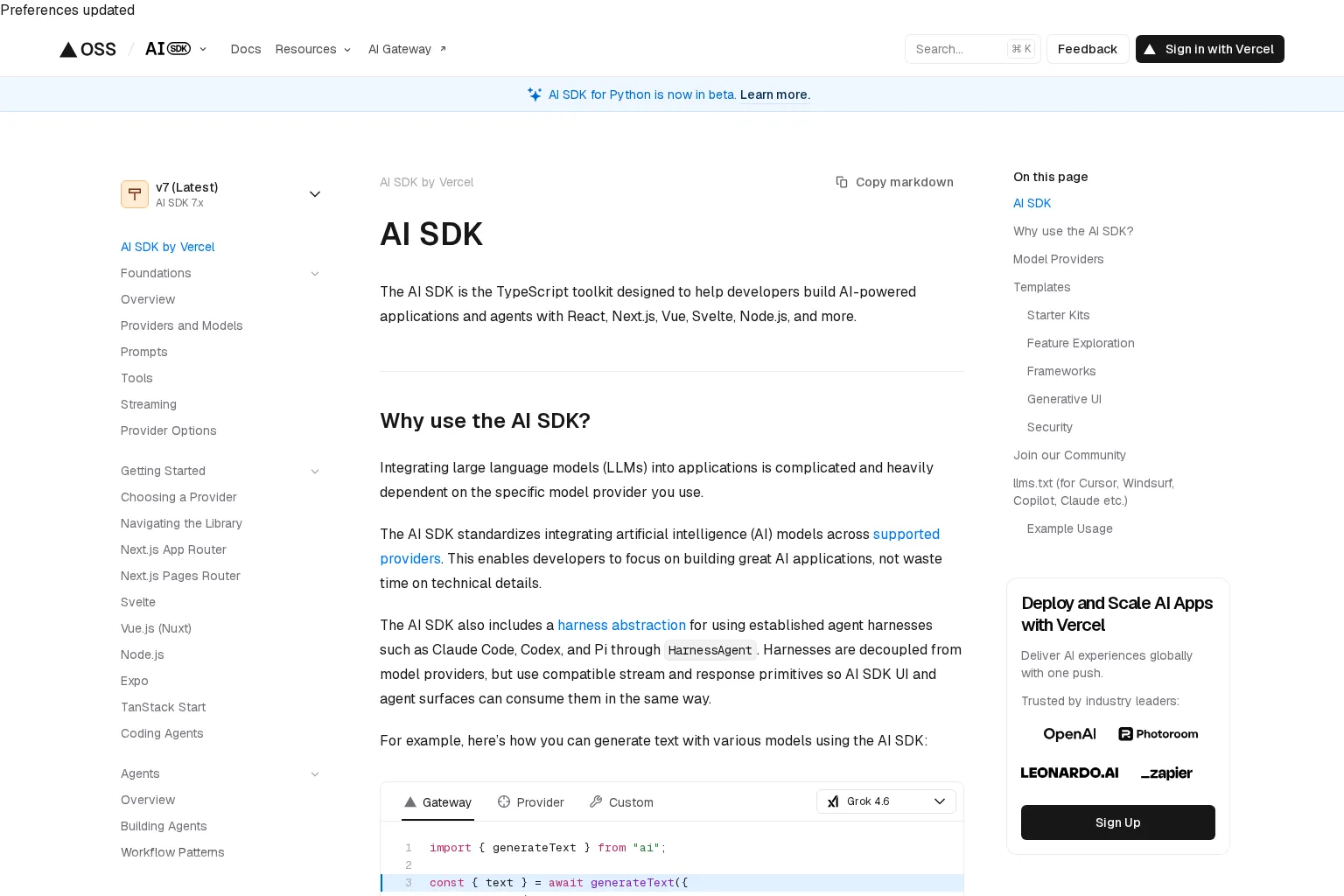
Best for: application teams that want a provider-neutral TypeScript toolkit for model calls, tool loops, streaming, and polished chat or generative interfaces.
Core fit: AI SDK standardizes access to multiple model providers and offers primitives for text, structured output, tools, agents, streaming, and UI integration. Its tool definitions can validate inputs with schemas, and its UI layer is especially compelling for teams shipping streaming product experiences.
Durability: AI SDK provides agent and workflow-oriented primitives, but your application still chooses how durable jobs, retries, state transitions, and scheduled tasks are persisted and executed. Pair it with your existing queue, database, workflow engine, or server platform when work must survive a request.
Observability: the SDK exposes telemetry and development tooling, but full production observability and durable audit records depend on the integrations and infrastructure you select.
Limitations: that composability is intentional, but it means more architecture work for teams that need authorization, durable orchestration, queues, and operational views to feel like one system.
Pricing and operating cost: assess costs at the provider, deployment, and any observability-service layer. The framework documentation does not establish a single all-in production cost.
Choose it if: you want flexible model-provider support and a strong TypeScript UI and streaming foundation, and you are comfortable assembling the backend durability layer.
4. VoltAgent
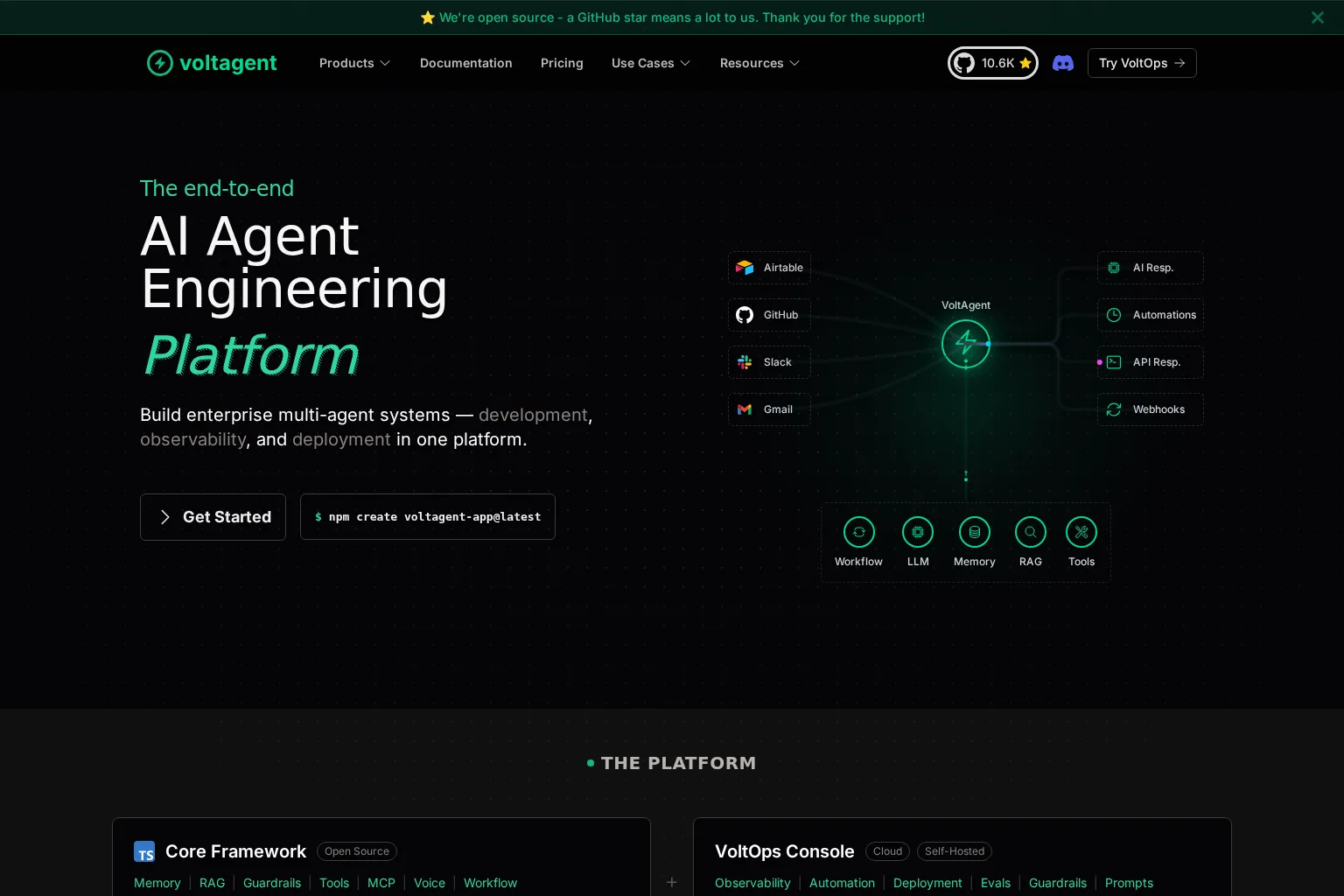
Best for: teams that prefer an observability-first platform for TypeScript agents, multi-agent coordination, workflows, tools, memory, and a dedicated operations console.
Core fit: VoltAgent supplies TypeScript APIs for agents, tools, memory, RAG, guardrails, MCP, voice, and workflows. It also presents supervisor-style coordination for systems that delegate tasks across specialized agents.
Durability: its workflow capabilities include pause and resume for long-running workflows and typed schema support. Validate the persistence, failure, and deployment semantics against your exact recovery requirements before placing irreversible business actions in a workflow.
Observability: VoltOps is positioned as the console for real-time monitoring, debugging, deployment, evaluations, prompts, and guardrails. This is useful when operational feedback loops are a primary buying criterion.
Limitations: as with other agent platforms, you need to decide where your authoritative customer data, authorization rules, idempotency policy, and external side-effect ledger will live.
Pricing and operating cost: VoltAgent states that its core framework is MIT licensed and free to use. Check current VoltOps and deployment terms separately, and include model and infrastructure costs in your estimate.
Choose it if: you want agent engineering primitives and an operations console designed around observing and evolving agent systems.
5. Google Agent Development Kit
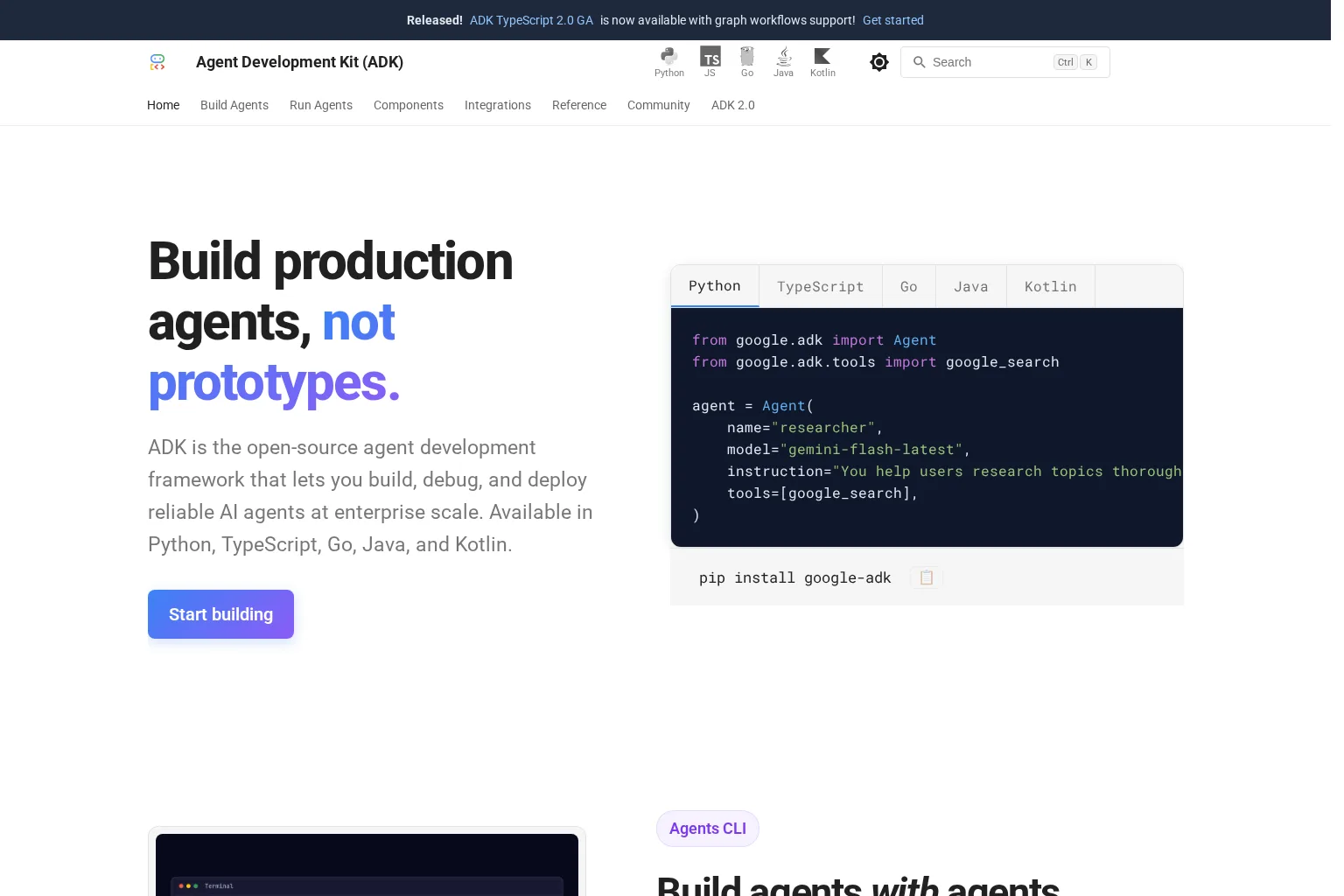
Best for: teams that want a code-first, multi-language agent framework with TypeScript support, graph-based workflows, and a natural path to Google Cloud deployment.
Core fit: Google ADK supports TypeScript agents with models, instructions, and tools, then expands to multi-agent orchestration and graph workflows. Its TypeScript package is useful for teams that want structured agent patterns while retaining a code-first development approach.
Durability: graph workflows are designed to combine deterministic code and adaptive model reasoning through explicit execution paths. For production use, verify how your chosen deployment maps workflow state, retries, external effects, and recovery to your service-level requirements.
Observability: ADK includes development and evaluation capabilities, while Google Cloud deployment can add managed authentication, tracing, and operational infrastructure. The exact toolchain will depend on the hosting path you choose.
Limitations: ADK is multi-language and broad in scope. Teams outside the Google ecosystem should assess provider adapters, deployment portability, and any cloud-specific dependencies early.
Pricing and operating cost: ADK is described as open source. Self-hosted and managed-cloud paths have different infrastructure and model costs, so price the complete deployment architecture rather than the framework alone.
Choose it if: graph-based orchestration and Google Cloud deployment are core requirements, not optional integrations.
Which TypeScript AI agent framework should you choose?
Use the framework that owns the boundary you cannot afford to get wrong:
- Pick db3.ai when your main problem is safely connecting AI behavior to an application that already needs data, authentication, queues, storage, schedules, and accountable request records.
- Pick Mastra when your agent workflow, memory, and first-party observability environment are the centerpiece of the system.
- Pick Vercel AI SDK when provider flexibility and user-facing streaming experiences come first, and you will assemble durable backend operations separately.
- Pick VoltAgent when you want a TypeScript agent platform with an explicit observability and operations-console focus.
- Pick Google ADK when graph workflows and Google Cloud operational alignment shape the roadmap.
For most production systems, we recommend proving one narrow workflow before adding a multi-agent graph. Start with one tool that has a clear authorization policy, one persisted business record, one retry boundary, and one diagnostic view. Then add memory, delegation, and autonomy only where they improve the user outcome.
FAQ
Is TypeScript a good language for AI agents?
Yes. TypeScript works well when the agent needs to live alongside a web application, APIs, typed domain models, queues, and UI code. It does not remove model uncertainty, so runtime validation, authorization, idempotency, and durable state still matter.
Do AI agents need durable execution?
Not every agent does. A short, read-only answer can finish in a request. Use durable execution when work is slow, retryable, asynchronous, scheduled, approval-driven, or must survive a deploy or process failure.
What should agent observability include?
At a minimum, capture model requests, tool calls, errors, latency, token or usage data where available, and a correlation ID that connects the run to the business action. Restrict prompt and debug data to authorized diagnostic views.
Can an AI agent call database records directly?
It can call application functions that read or update records, but the model should not receive unrestricted database access. Put authorization, tenant scope, input validation, rate limits, and idempotency checks inside the application-owned tool.
Build the first production-safe agent
If your next agent needs to act on real application data, start with a typed tool, pass trusted context from an authenticated route or job, queue long work, and inspect the resulting request tree. Explore db3.ai agents, then connect the workflow to Queue and AI usage tracking as the feature grows.