29 September 2026
4 TypeScript AI Frameworks for Production Agents and Workflows

Choosing a TypeScript AI framework is not only about making a model call. We need to decide where tool permissions live, how long-running work survives the request, how failures are inspected, and how AI features connect to the rest of the application.
For teams building production AI features, our short answer is:
- Choose db3.ai when you want agents, queues, schedules, data, storage, authentication, and request tracking in one TypeScript application runtime.
- Choose Mastra when the product is centered on agent workflows, memory, evaluations, and built-in agent observability.
- Choose Vercel AI SDK when provider flexibility and streaming UI are the immediate priority, and you are happy to compose the rest of the stack.
- Choose LangGraph.js when you need a low-level, stateful orchestration runtime with explicit control over long-running agent graphs.
We selected these options because each has an official TypeScript path and credible support for model calls, tools, or agent execution. We assess them using the same criteria: model and tool access, workflow and background execution, observability, application services, pricing approach, and trade-offs.

Table of contents
- 1. db3.ai
- 2. Mastra
- 3. Vercel AI SDK
- 4. LangGraph.js
- How we would choose a TypeScript AI framework
- Frequently asked questions
1. db3.ai
db3.ai is a TypeScript application framework for teams that want to ship AI features within the same runtime as their APIs, data models, queues, storage, authentication, scheduler, and delivery services.
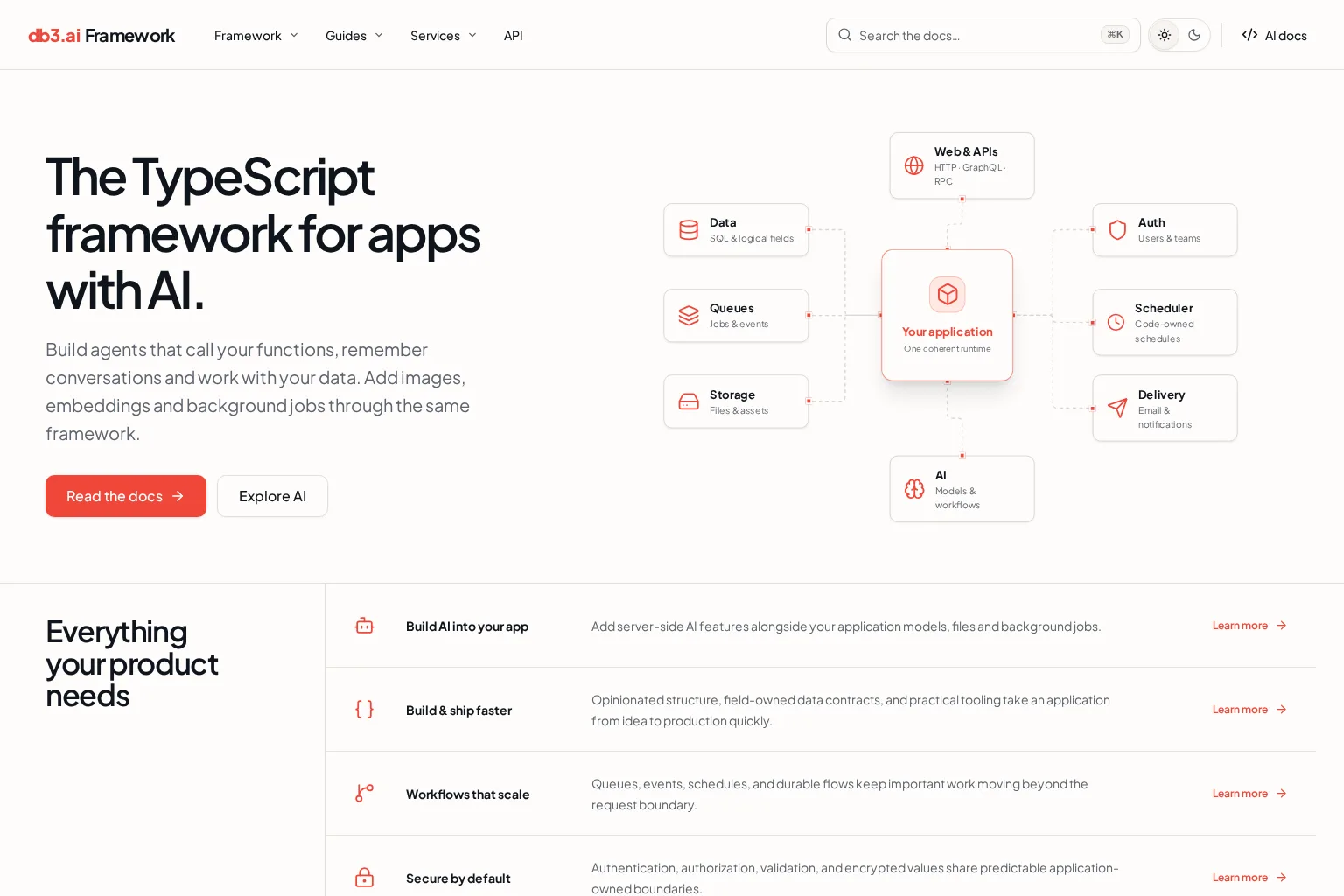
Best use case: Production product teams that want AI agents to use application-owned functions and data without stitching together a separate agent runtime, job system, and application backend.
Model and tool capabilities: db3.ai provides direct text, structured data, image, and embedding operations through its Ai service. Its Agent abstraction adds conversations, function calls, streaming events, and background execution. Tool arguments can use Zod schemas, while trusted route or job code supplies sensitive context such as user, scope, or a selected storage path.
Here is a compact pattern for a support agent whose model can read only the help guide selected by trusted application code:
import { z } from 'zod';
import { Agent, tool, type AgentTool, type BaseAgentContext } from '@db3.ai/app/ai';
import { app } from '@db3.ai/app/server';

interface HelpAgentContext extends BaseAgentContext {
  guidePath: string;
}

export class HelpAgent extends Agent<HelpAgentContext> {
  async instructions() {
    return 'Answer from the saved help guide. If the answer is absent, say so.';
  }

  protected tools(): AgentTool[] {
    return [Object.assign(tool({
      name: 'read_help_guide',
      description: 'Read the application help guide.',
      parameters: z.object({}),
      execute: async () => app().storage.getText(this.context.guidePath),
    }), {
      title: 'Read help guide',
      description: 'Read the application help guide.',
    })];
  }
}
Workflow and production controls: An agent can run synchronously for a request or be persisted and dispatched to a named queue. This is useful when a tool-driven run should survive the HTTP request, retry, and run in a worker. db3.ai also separates recurring scheduling from heavy work: register a job, then schedule it to be queued at a defined time.
import { AgentRunJob, registerQueuedAgent } from '@db3.ai/app/ai';
import { app } from '@db3.ai/app/server';

app().queue.registerJob(AgentRunJob);
registerQueuedAgent('HelpAgent', HelpAgent);

const run = await new HelpAgent({
  user: userId,
  scope: teamId,
  guidePath: 'help.md',
}).queue('Explain password settings.', { queue: 'help' });

// For recurring work, schedule a registered QueueableJob at a specific time.
app().scheduler.job(WriteDailySummaryJob).dailyAt('09:00').timezone('UTC');
For implementation details, see our guides to agents and function calls, durable background work, and the scheduler.
Observability: AI requests are saved by default. Request records include status, input, response, errors, duration, and provider-reported token usage. Agent runs retain a root request and child provider attempts, so a tool-driven run can be inspected as a request tree.
Pricing approach: Pricing for db3.ai packages is not published in the current product catalogue. Treat model-provider usage and your application infrastructure as separate costs, and verify framework commercial terms before committing.
Limitations: The current documentation describes db3.ai as a preview and says its framework and creator packages are not yet published to npm. It is the strongest fit when you want an integrated application runtime, not when you only need a lightweight client-side streaming layer.
Who should choose it: Choose db3.ai when your agent must safely reach your application data and services, or when queues, scheduled jobs, authorization, and per-request usage records are first-class product requirements.
2. Mastra
Mastra is an open-source TypeScript framework focused on AI applications and agents, with first-class agents, workflows, memory, a server runtime, evaluations, and observability.
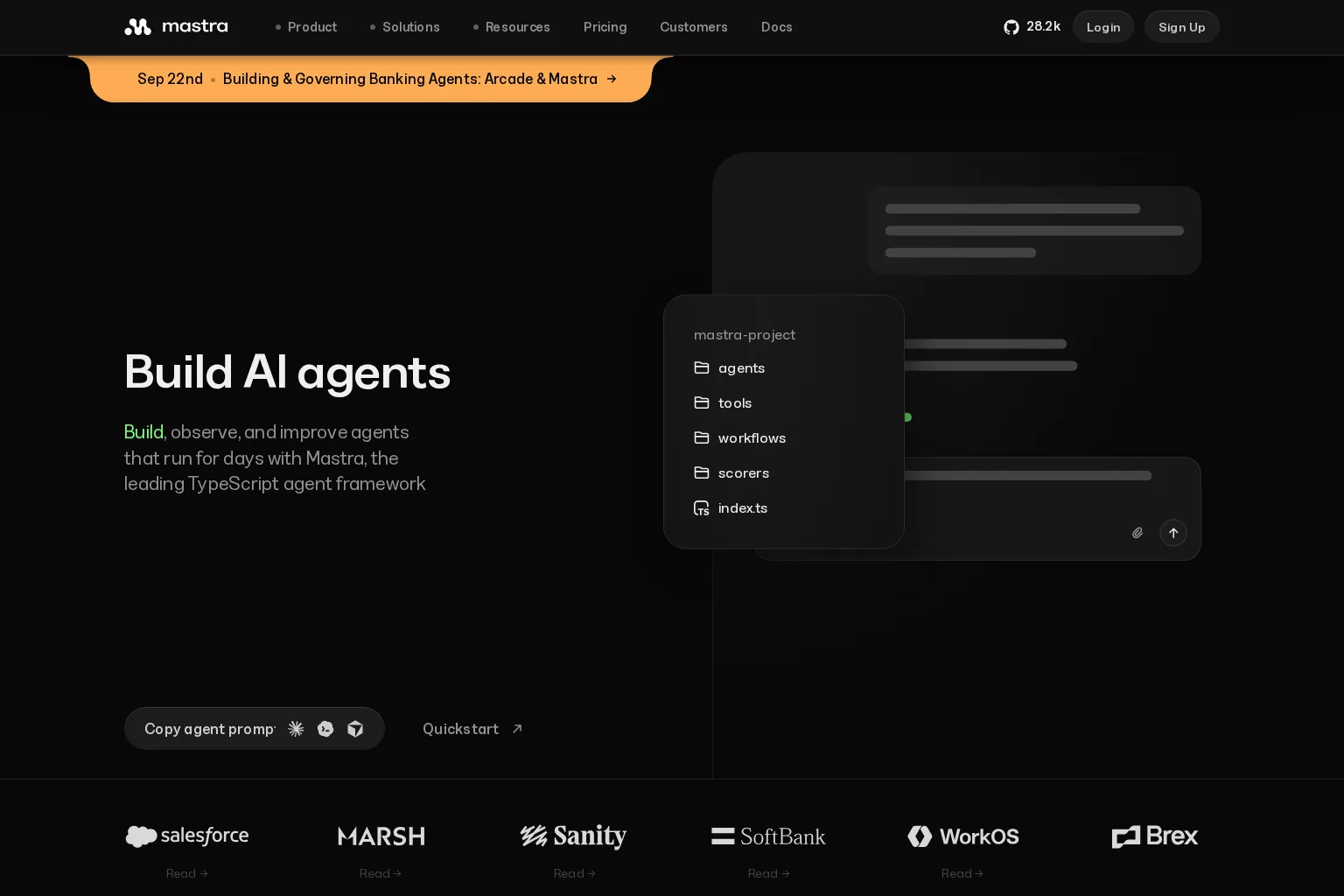
Best use case: Teams building agent-centric products that want a cohesive framework for agent execution, workflow composition, memory, evaluation, and trace inspection.
Model and tool capabilities: Mastra lets us define typed agents with a model, instructions, and a tool collection. Its core offering also includes memory and a harness for coordinating agent behavior and shared state.
Workflow and production controls: Mastra workflows compose typed steps, retries, and branches. The framework can register agents and workflows in a server, which can then be deployed to Mastra Cloud or run in your own environment.
Observability: Mastra presents evaluations, metrics, datasets, and searchable traces as built-in platform capabilities. Its documentation describes metrics for latency, cost, model calls, and tool usage, plus a timeline for model calls, tool calls, and handoffs.
Pricing approach: The Mastra Platform pricing page lists a Starter tier at $0 per month, Teams at $250 per month, and custom enterprise pricing. Platform usage, including observability, compute, storage, and gateway activity, has separate allowances or metered charges. The open-source framework and managed platform should be evaluated as distinct choices.
Limitations: Mastra is strongly agent-focused. If your product also needs application-specific authentication, relational data, queue infrastructure, and scheduled work, plan the surrounding application architecture or integrate those services separately.
Who should choose it: Choose Mastra when the agent system itself is the center of the product and your team values workflow primitives, memory, evaluation, and integrated agent observability.
3. Vercel AI SDK
Vercel AI SDK is a framework-agnostic TypeScript toolkit for AI applications and agents, with streaming, multi-provider support, fallbacks, and integrations across React, Next.js, Vue, Svelte, Node.js, and more.
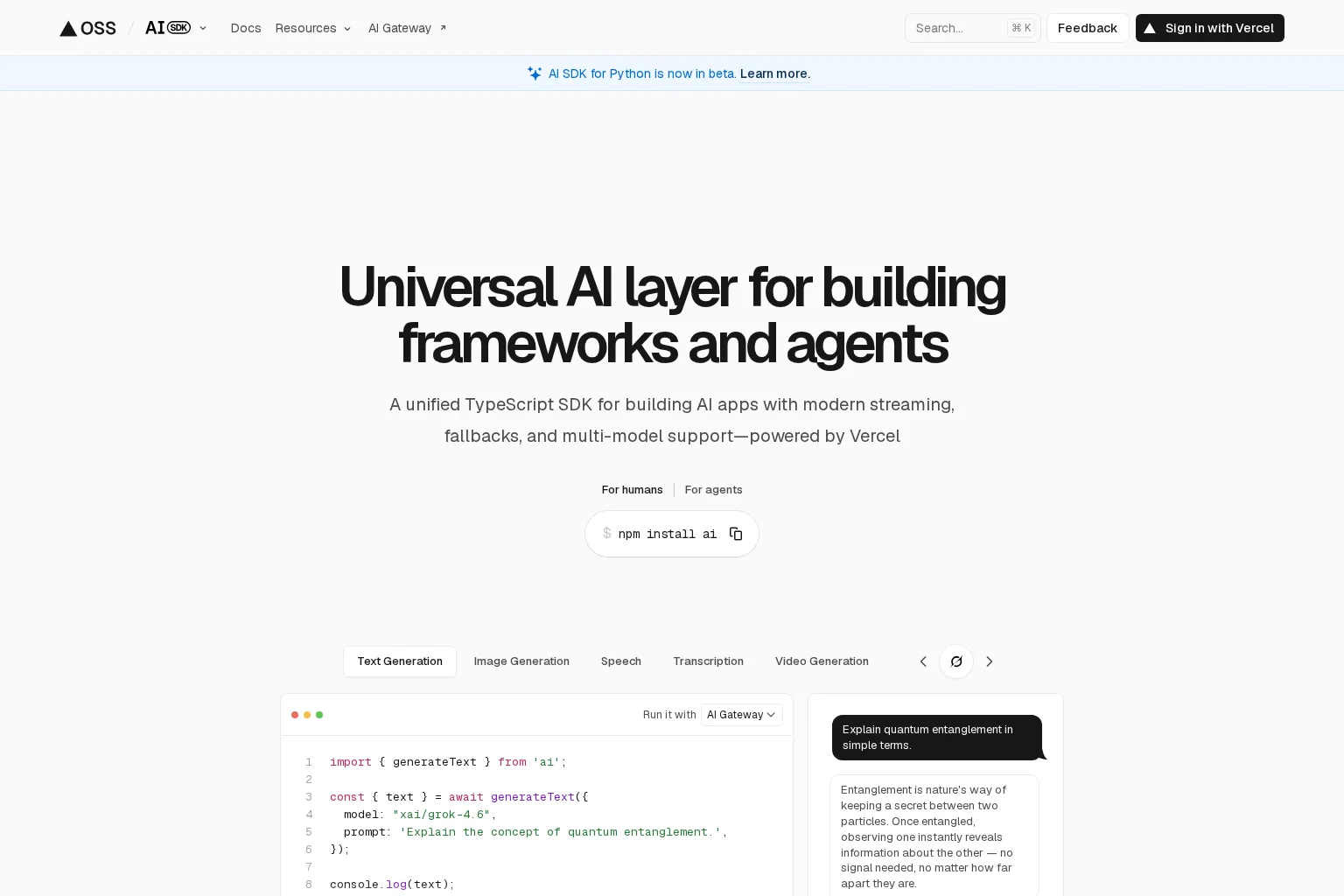
Best use case: Developers who want a polished TypeScript interface for model providers and streaming user experiences, especially in an existing frontend or full-stack application.
Model and tool capabilities: AI SDK provides a unified TypeScript layer for model access, multi-provider switching, streaming, and agent-oriented application patterns. It is especially well suited to chat, generative UI, and real-time response rendering.
Workflow and production controls: The SDK itself is a toolkit rather than a complete application runtime. Vercel positions its separate Workflow product for long-running applications that suspend, resume, and survive function timeouts. Teams can use that ecosystem or combine AI SDK with their existing queue and workflow stack.
Observability: AI SDK gives developers a clean application-level model interface, but operational tracing and production monitoring depend on the deployment and observability services you connect to it.
Pricing approach: AI SDK is presented as an open-source toolkit. Budget separately for the selected model provider and for any Vercel services, such as AI Gateway, Sandbox, or Workflow, that you choose to adopt.
Limitations: AI SDK does not replace your application data model, authorization design, durable queue, or background worker strategy. It is an excellent AI layer, but a complete production platform still requires deliberate composition.
Who should choose it: Choose Vercel AI SDK when streaming UX, provider portability, and rapid integration into an existing TypeScript application matter more than adopting a single backend runtime.
4. LangGraph.js
LangGraph.js is a low-level TypeScript orchestration framework and runtime for long-running, stateful agents. It is designed for teams that need explicit graph control over deterministic steps and LLM-driven decisions.
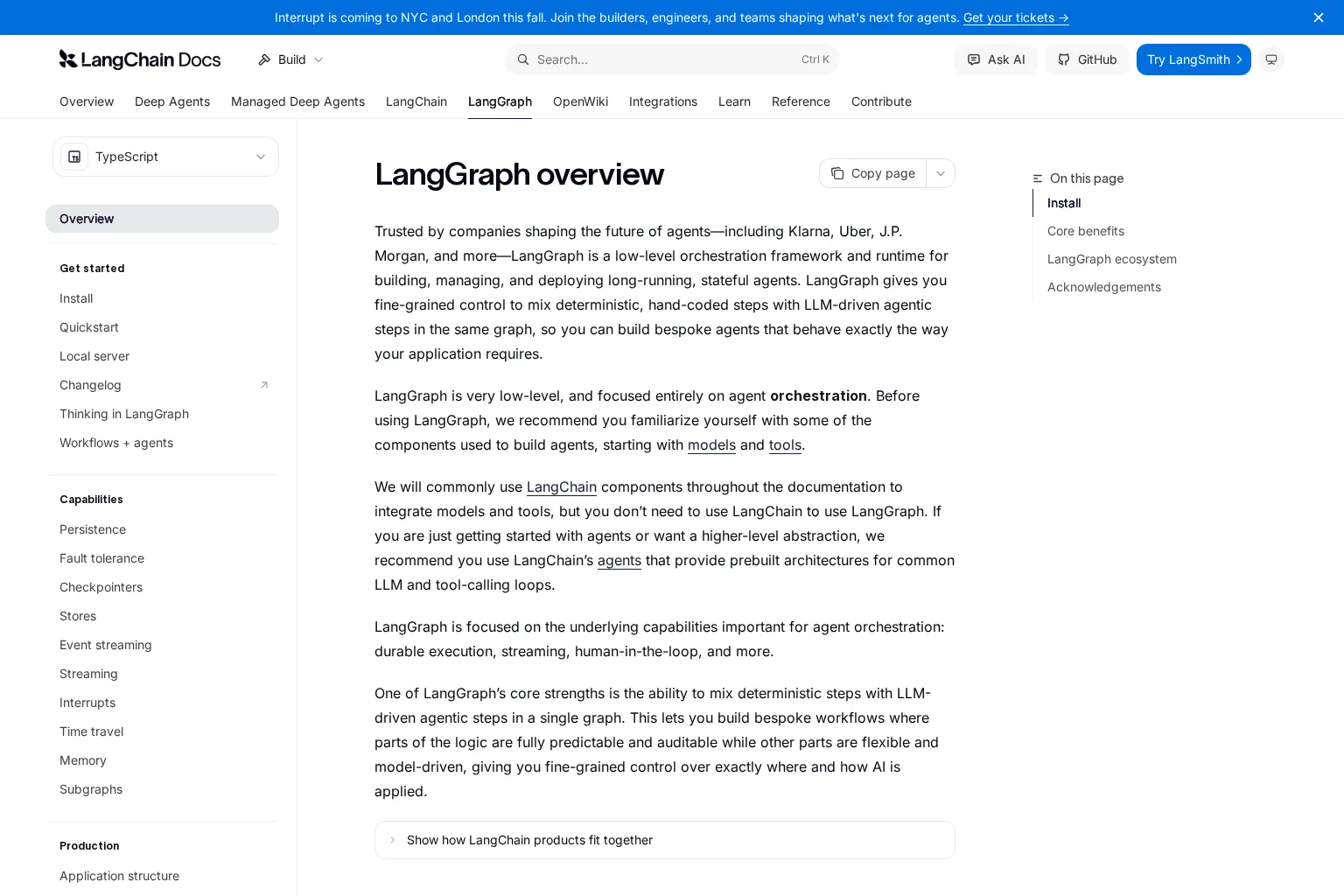
Best use case: Advanced teams building stateful, long-running agent workflows where persistence, human approval, branching, and recovery behavior must be modeled directly.
Model and tool capabilities: LangGraph can use LangChain model and tool components, but it does not require LangChain. It gives us a graph-based foundation for mixing code-driven nodes with LLM-driven nodes.
Workflow and production controls: Durable execution, persistence, streaming, and human-in-the-loop interrupts are core LangGraph capabilities. This makes it a strong option for complex workflows where application code must decide exactly when an agent can proceed, pause, or resume.
Observability: LangGraph points teams to LangSmith for tracing, evaluation, runtime metrics, and deployment support. That separation is valuable when you want a specialized observability layer, but it adds another product decision.
Pricing approach: Treat the LangGraph library and the LangSmith observability or deployment platform as separate decisions. Review current LangSmith pricing and hosting requirements for the operational capabilities your deployment needs.
Limitations: LangGraph intentionally stays low-level and focused on orchestration. Its documentation recommends familiarity with models and tools first, so it has more architectural surface area than a high-level agent framework.
Who should choose it: Choose LangGraph.js when graph-level control, durable state, and human approval paths are more important than a batteries-included application framework.
How we would choose a TypeScript AI framework
Use this decision path:
- Need an integrated product runtime? Pick db3.ai when AI must share models, permissions, queues, storage, scheduling, and request history with the rest of your TypeScript application.
- Need an agent-first platform? Pick Mastra when workflow composition, memory, evaluation, and agent observability are central to the work.
- Need the fastest route to streaming AI features? Pick Vercel AI SDK when your existing app already owns the backend and you need a strong provider-agnostic AI layer.
- Need maximum orchestration control? Pick LangGraph.js when your workflow is a durable state machine with explicit human and system checkpoints.
The most important architecture decision is where trusted business context lives. We should never let a model select a tenant, user, record scope, or sensitive file path on its own. Keep those values in route, job, or workflow code, then expose narrow tools with validated inputs.
If you want to build an AI feature with the surrounding application services already in place, start with the db3.ai AI guides and adapt the agent, queue, and scheduler examples to your product domain.
Frequently asked questions
Is Vercel AI SDK a TypeScript AI framework?
Yes, it is a framework-agnostic TypeScript toolkit for building AI applications and agents. It is best understood as an AI integration layer rather than a complete application runtime.
Which TypeScript AI framework is best for background agents?
For an agent that needs a first-class queue and scheduled execution in the same application runtime, db3.ai is the direct fit. For graph-based durable orchestration, LangGraph.js is a strong option. Mastra also provides workflow primitives for agent-centric systems.
Do we need observability before shipping an AI agent?
For production use, yes. At a minimum, retain enough information to diagnose failures, inspect tool execution, understand latency, and account for provider usage. The right implementation can be built into your application, provided by an agent platform, or connected as a dedicated observability service.
Can we use more than one of these tools?
Yes. A common approach is to pair a focused AI SDK or graph runtime with existing application services. We should still define one source of truth for authorization, background execution, state persistence, and operational records before the system grows.