11 October 2026
6 TypeScript API Frameworks to Compare Before You Build

Choosing a TypeScript API framework is an architecture decision, not just a routing decision. It shapes how we validate inputs, protect endpoints, organize code, deploy services, and handle work that should outlive an HTTP request.
This comparison is for product teams building a new API, a full-stack TypeScript application, or an API-first service. We selected frameworks with a clear TypeScript story and assessed each one against the same practical criteria: routing and architecture, validation and contract safety, authentication, deployment and runtime fit, background work, trade-offs, and operating-cost considerations.
The goal is not to crown one universal winner. It is to identify the framework whose defaults best match the system we need to ship and operate.
Table of contents
- How to evaluate a TypeScript API framework
- 1. db3.ai: Best for product APIs that need an integrated application runtime
- 2. NestJS: Best for large teams that benefit from enforced application structure
- 3. Fastify: Best for high-performance Node.js APIs with schema-driven validation
- 4. Hono: Best for APIs that need multi-runtime and edge deployment flexibility
- 5. AdonisJS: Best for a batteries-included Node.js product backend
- 6. tRPC: Best for internal, end-to-end TypeScript APIs
- Which TypeScript API framework should we choose?
- A practical next step
How to evaluate a TypeScript API framework
Before comparing features, decide where your constraints are strongest:
- Routing and architecture: Do we need a minimal HTTP layer, strong module boundaries, or an application runtime that coordinates several services?
- Validation and contracts: Can we use JSON Schema, decorators, or inferred TypeScript contracts? Do external clients need a stable REST or OpenAPI surface?
- Authentication and authorization: Are we assembling identity, sessions, tokens, roles, and permissions, or do we want more of those boundaries integrated?
- Deployment and runtime: Will the API run on Node.js, Bun, Deno, edge workers, containers, serverless functions, or several of these?
- Background work: Do queues, scheduled jobs, events, file handling, or AI workflows belong in the same application boundary?

A practical rule is to choose the smallest abstraction that still covers our enduring requirements. A lean HTTP framework is often right for a focused service. A more opinionated framework pays off when code ownership, security boundaries, and cross-cutting services would otherwise become a collection of unrelated packages.
1. db3.ai: Best for product APIs that need an integrated application runtime
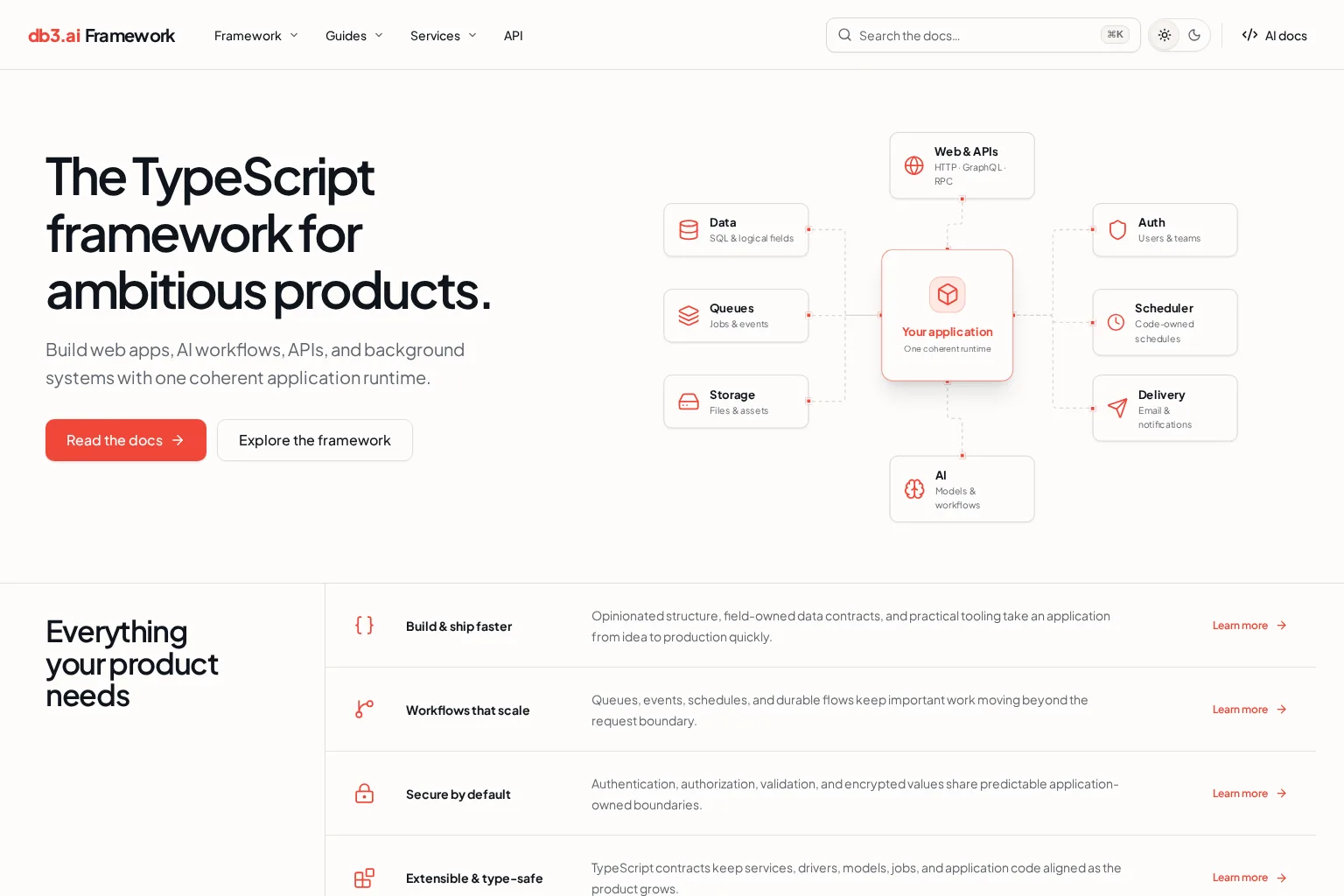
Best use case: A product team building an API alongside data models, authentication, storage, queues, scheduled work, delivery, or AI workflows, and wanting those concerns to share one TypeScript application boundary.
Routing and architecture: db3.ai presents Web and APIs as part of a broader runtime that also includes data, jobs, storage, authentication, scheduling, delivery, and AI. Its API-first guidance shows explicit Fastify routes rather than hidden, auto-generated CRUD endpoints, so we retain ownership of public HTTP contracts. See the owned JSON API guide for the route pattern.
Validation and type contract: The framework's model fields define logical names and storage conversion, while route schemas validate HTTP input. This separation is useful when we want to keep request allowlists, database fields, and response serialization intentional rather than duplicating conversion logic in every handler.
Authentication: db3.ai includes an application Auth service. Its starter guide demonstrates server-controlled, HttpOnly session cookies and route-level authentication helpers. We should still design authorization at the resource level, not treat sign-in as permission to access any record. The authentication walkthrough is a useful starting point.
Deployment and runtime: This is a Node.js-oriented application framework. It is a better fit for teams that value one coherent runtime over multi-edge portability. Its security model also includes application-owned encryption for recoverable secrets, covered in the security guide.
Background work: Queues, workers, retries, and durable job patterns are first-class concerns. The queue guide emphasizes idempotent work and explicit retry behavior, which matters for reports, email, integrations, and other operations that must survive beyond a request.
Trade-offs: db3.ai is intentionally more opinionated than a routing-only framework. It is the wrong choice if we only need a tiny edge handler or if every infrastructure service must be selected independently.
Cost posture: Estimate the whole runtime, including the database, storage, worker processes, and any AI providers or delivery services. This approach favors fewer integration seams, but it does not remove infrastructure planning.
Who should choose it: We recommend db3.ai when the API is one part of a growing product system and we want data, auth, security, and durable work to use consistent application-owned boundaries.
2. NestJS: Best for large teams that benefit from enforced application structure
Best use case: Teams building substantial Node.js APIs that need familiar module, controller, provider, and dependency-injection patterns.
Routing and architecture: NestJS organizes HTTP endpoints through controllers and decorators, with modules and providers creating a deliberate application structure. It runs above Express by default and can use Fastify, so we can choose the underlying HTTP adapter while retaining Nest's conventions.
Validation and type contract: Nest supplies validation pipes, including ValidationPipe, and commonly pairs DTO classes with declarative validation rules. This can be effective for teams comfortable with decorators and class-based contracts. For external APIs, we should plan OpenAPI conventions early instead of assuming TypeScript types automatically become a public specification.
Authentication: Nest provides well-documented patterns for JWT-based authentication, guards, and protected routes. The framework gives us strong building blocks, but database models, identity providers, token rotation, and authorization design remain our responsibility.
Deployment and runtime: NestJS targets Node.js server-side applications. Its deployment guidance covers containerization and production concerns, making it a solid choice for conventional container, VM, or managed Node deployment models.
Background work: Nest supports background processing through its ecosystem and integrations. This is flexible, but it means we must make explicit choices about queues, brokers, job observability, and retry policy.
Trade-offs: NestJS introduces ceremony and framework concepts that may slow a small, route-focused service. Its architecture helps at scale only if the team applies module boundaries consistently.
Cost posture: Budget for Node compute, data stores, any queue or broker, logging, monitoring, and identity services. Nest's abstraction is not a managed operations layer.
Who should choose it: Choose NestJS when several developers need a consistent server-side structure and the team is comfortable with decorators, dependency injection, and a more prescriptive style.
3. Fastify: Best for high-performance Node.js APIs with schema-driven validation
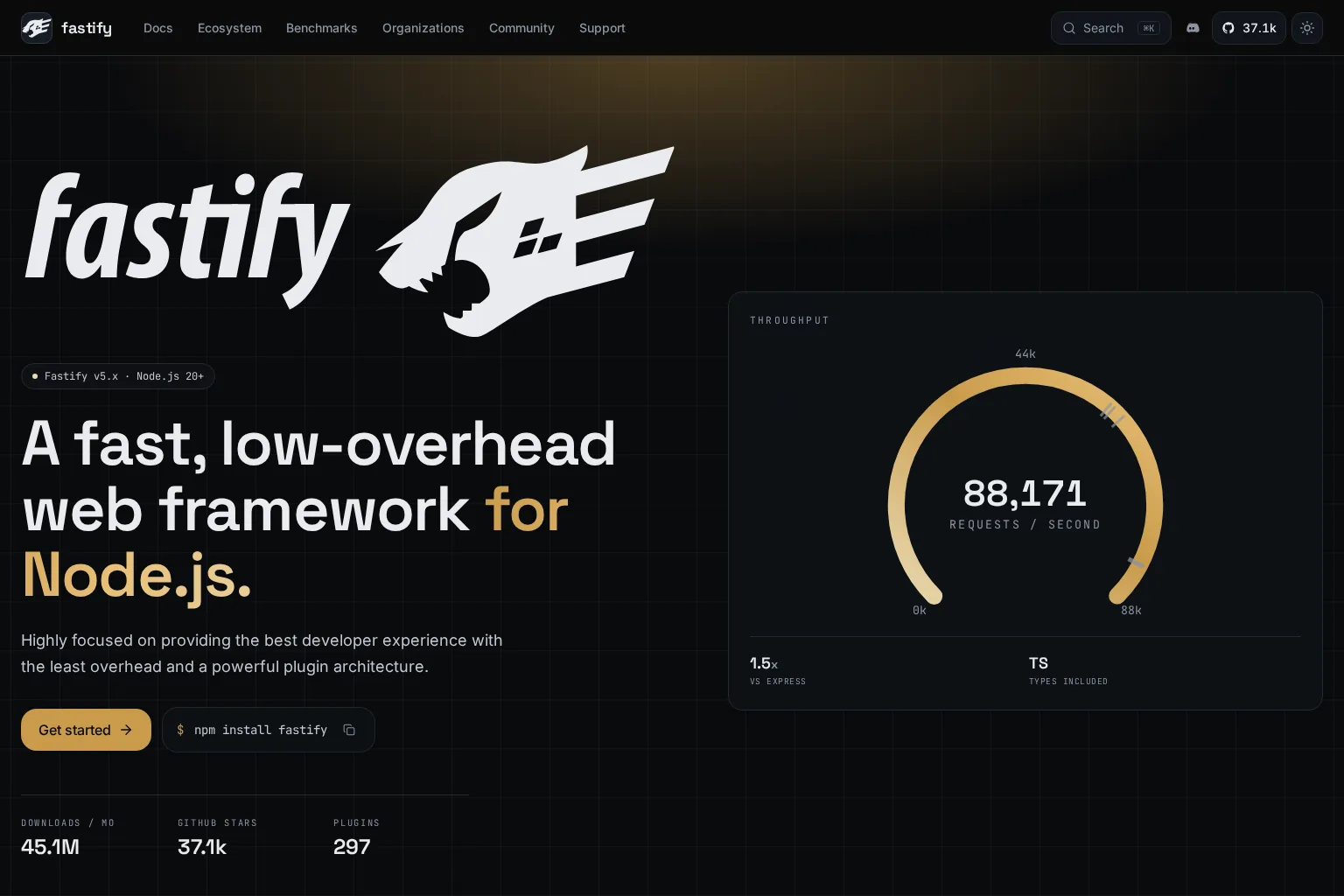
Best use case: Node.js services where low overhead, explicit plugins, JSON Schema validation, and response serialization are central requirements.
Routing and architecture: Fastify offers a compact server core built around routes, hooks, decorators, encapsulated plugins, and a routing engine. It gives us more structure than bare Node HTTP without forcing a full application architecture.
Validation and type contract: JSON Schema is a core Fastify concept for request validation and response serialization. Type providers can connect schemas with TypeScript types, but we should establish one schema approach across the service to avoid competing sources of truth.
Authentication: Fastify has a broad plugin ecosystem and can support cookies, JWTs, OAuth flows, and custom middleware. Authentication is composable rather than fully integrated, which is useful when we have existing identity requirements but adds implementation decisions.
Deployment and runtime: Fastify is built for Node.js and suits containers, long-running services, and serverless adapters. Confirm the target platform's Node version and operational constraints before standardizing on a deployment pattern.
Background work: Fastify focuses on the HTTP server. We should use a separate worker process and choose a queue or event system that fits the product's durability, retry, and observability requirements.
Trade-offs: Fastify's flexibility means we assemble more application services ourselves. Schema-first development can also take adjustment for teams accustomed to class decorators or purely inferred contracts.
Cost posture: Infrastructure costs are driven by Node capacity, persistence, background workers, and selected plugins or SaaS services. Fastify's efficiency can help reduce server pressure, but benchmark our own routes and dependencies before projecting savings.
Who should choose it: Choose Fastify when we want a performant Node API core and are prepared to intentionally compose authentication, persistence, and asynchronous processing around it.
4. Hono: Best for APIs that need multi-runtime and edge deployment flexibility
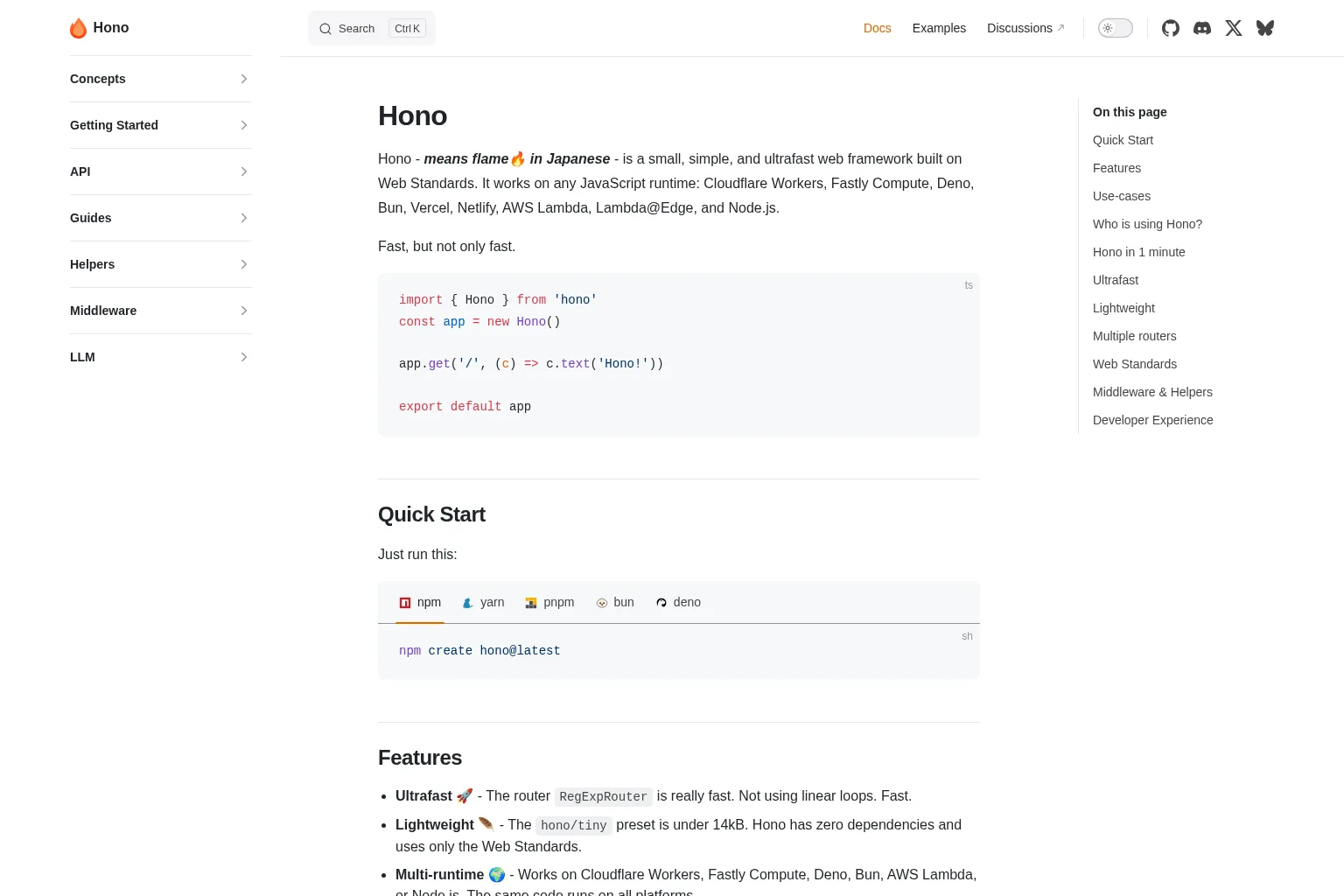
Best use case: Teams deploying lightweight APIs across Web Standards-based environments such as Cloudflare Workers, Deno, Bun, serverless platforms, and Node.js.
Routing and architecture: Hono uses a small, direct routing model and Web Standard Request and Response primitives. It is well suited to focused services, proxies, edge endpoints, and APIs where portability matters more than an opinionated server architecture.
Validation and type contract: Hono provides a thin validator and supports third-party schema tools such as Zod. Its RPC approach can share route types with TypeScript clients, but we should choose a separate OpenAPI strategy if the API will be consumed broadly outside our TypeScript codebase.
Authentication: Hono includes middleware for common HTTP concerns, including bearer auth, basic auth, JWTs, CORS, and secure headers. Production identity, session storage, and authorization policies still need deliberate design around the selected runtime.
Deployment and runtime: Multi-runtime support is Hono's distinguishing advantage. The same core application can run across edge and server environments, but runtime-specific integrations, database connectivity, observability, and background execution still require testing on the real target platform.
Background work: Hono is primarily an HTTP framework. Use platform queues, scheduled triggers, or external workers for durable work, and avoid assuming an edge request lifecycle is suitable for long-running jobs.
Trade-offs: Its minimalism can move architecture decisions into our application code. Hono is less attractive when we want an integrated ORM, authentication system, queue service, and conventional Node-only operating model out of the box.
Cost posture: Model costs per target runtime, including requests, execution time, database access, and platform queue or scheduler services. Edge portability can be valuable, but not every workload benefits from it.
Who should choose it: Choose Hono when runtime portability and a compact Web Standards API are more valuable to us than batteries-included application services.
5. AdonisJS: Best for a batteries-included Node.js product backend
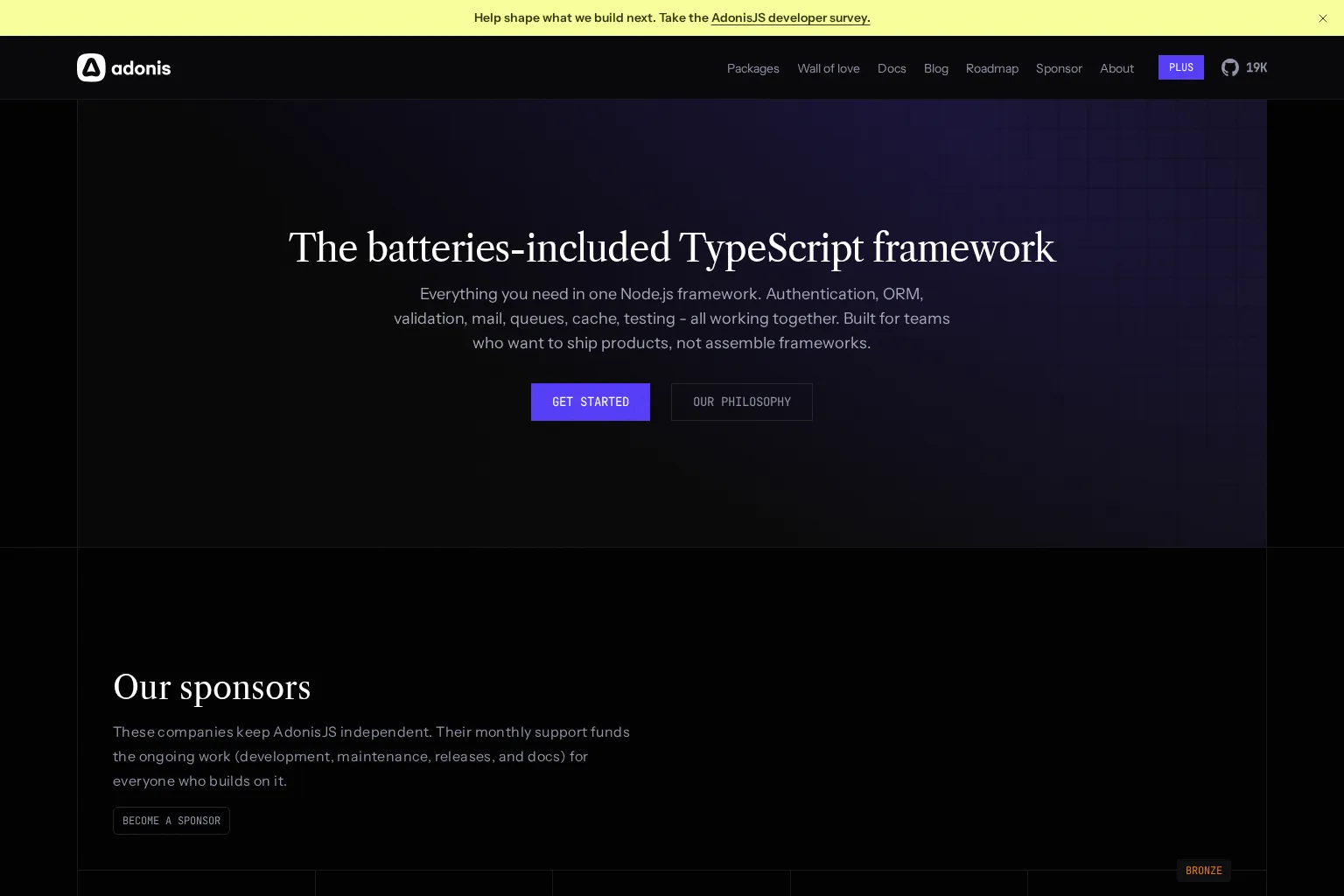
Best use case: Teams that want a cohesive Node.js framework with routing, validation, authentication, ORM support, mail, queues, caching, file handling, and testing conventions.
Routing and architecture: AdonisJS provides a conventional router and controller organization, plus resource routing and middleware. It gives a product backend clear places for routes, handlers, models, and policies without requiring us to design every convention from scratch.
Validation and type contract: AdonisJS uses VineJS validators at the controller boundary. It can validate request data before it reaches business logic, creating a clear trust boundary for request handling.
Authentication: AdonisJS supplies an authentication system with guards and providers, supporting session and access-token approaches. This reduces initial assembly work for typical web and API applications, while still requiring careful domain-level authorization rules.
Deployment and runtime: AdonisJS applications compile TypeScript to JavaScript for production and run on Node.js. Its standalone build process fits conventional server and container deployment workflows.
Background work: The framework includes queue capabilities and a broader application toolkit, which can make it attractive for product systems that need email, cache, tasks, and persistence alongside HTTP endpoints.
Trade-offs: AdonisJS asks us to adopt its conventions and service choices. It is less compelling for edge-first workloads or organizations that already have strongly standardized infrastructure components.
Cost posture: Plan for Node hosting plus the database, cache, queue backend, file storage, and email provider the product uses. The framework can lower integration effort, but the underlying services still have operating costs.
Who should choose it: Choose AdonisJS when we want a cohesive Node.js product backend and prefer built-in conventions to a hand-assembled stack.
6. tRPC: Best for internal, end-to-end TypeScript APIs
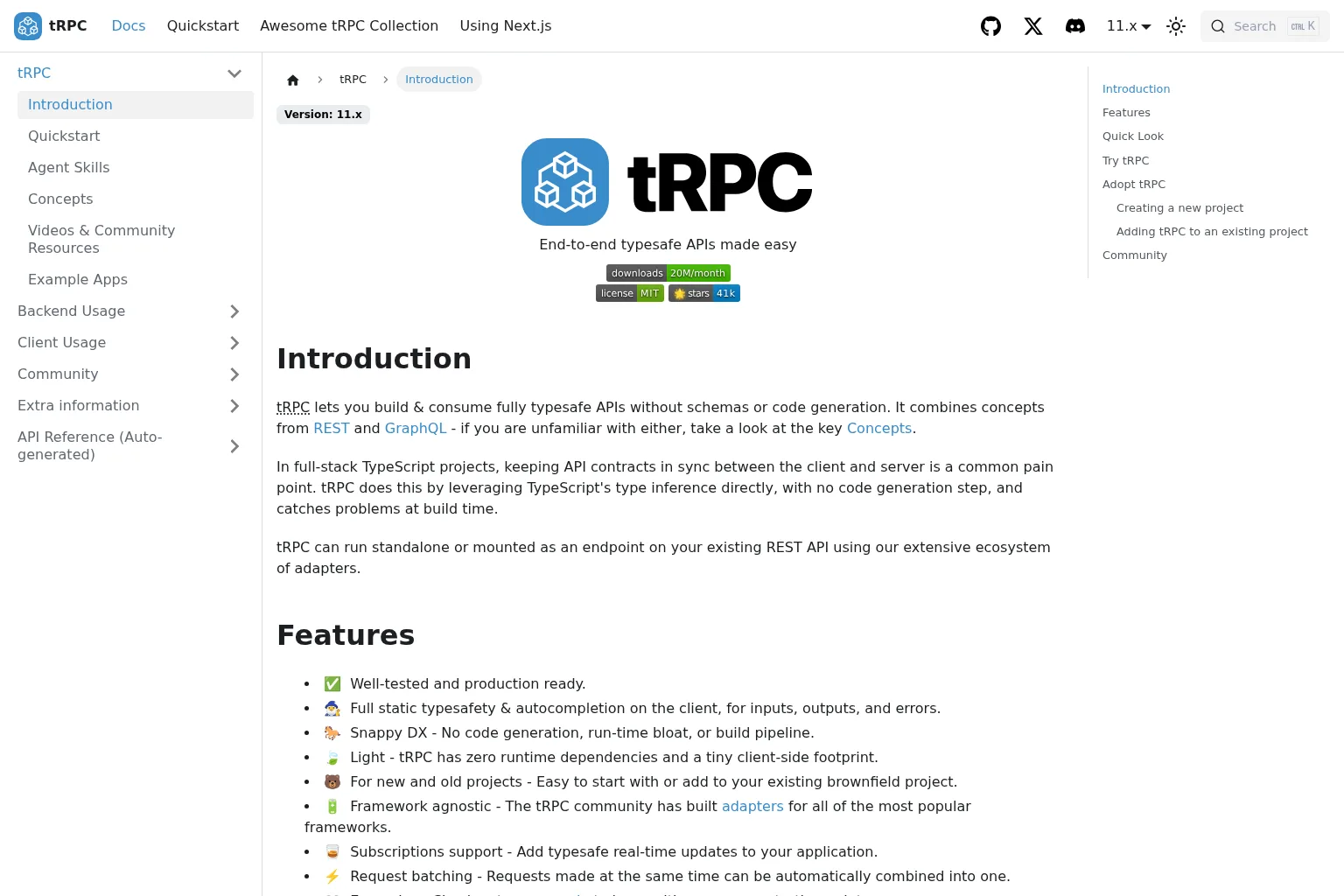
Best use case: Full-stack TypeScript teams that control both client and server and want inferred contracts without maintaining a separate schema or code-generation step.
Routing and architecture: tRPC defines typed procedures rather than centering the design on traditional REST resources. It can run standalone or mount into an existing server through adapters, so it works well as an API layer inside a broader framework.
Validation and type contract: End-to-end type inference is tRPC's primary value. It gives clients autocomplete and static type safety for inputs, outputs, and errors. We should still validate untrusted data at runtime, typically with a schema library, because TypeScript types do not validate network input by themselves.
Authentication: Authentication usually lives in tRPC context and middleware, using the identity mechanism chosen by the application. This is flexible, but it is not an all-in-one identity system.
Deployment and runtime: tRPC is framework-agnostic through adapters, so deployment follows the underlying server or platform. That makes it a strong complement to Fastify, Hono, Next.js, or other TypeScript stacks.
Background work: tRPC is an API contract layer, not a queue or worker runtime. Use a separate job system for tasks that need retries, scheduling, or execution after the request returns.
Trade-offs: It is not the default choice for public APIs consumed by non-TypeScript clients, third-party partners, or teams that require a stable REST or GraphQL contract. In those cases, a formal external API specification is usually clearer.
Cost posture: Budget follows the host framework and supporting services. tRPC can reduce contract-maintenance effort for an internal TypeScript stack, but it does not replace hosting, authentication, data, or worker infrastructure.
Who should choose it: Choose tRPC when we own the client and server, move quickly in TypeScript, and value inferred internal contracts over a separately published HTTP schema.
Which TypeScript API framework should we choose?
Use this short list to narrow the decision:
- Choose db3.ai when we need an API inside a coherent application runtime with data, auth, secure values, queues, storage, scheduling, and AI workflows.
- Choose NestJS when team-scale architecture and familiar server-side patterns matter most.
- Choose Fastify when we want a focused, high-performance Node.js HTTP framework with schema-driven routes.
- Choose Hono when we need a compact API that can travel across edge, serverless, and JavaScript runtimes.
- Choose AdonisJS when we want a convention-led Node.js product backend with many integrated services.
- Choose tRPC when the API is primarily internal to a full-stack TypeScript application.
We should also shortlist adjacent tools when the use case changes. Express and Koa remain lightweight Node options, while Elysia is worth evaluating for Bun-focused teams. None of these replace the need to specify authorization, failure handling, deployment controls, observability, and data ownership.
A practical next step
Before committing, build one vertical slice with the two strongest candidates: a protected write endpoint, runtime validation, a database transaction, one background job, and a production-like deployment. Measure the amount of application code, integration code, test setup, and operational configuration required. That small exercise reveals more than a generic benchmark or feature checklist.
If we want an API framework that keeps those product capabilities in one application runtime, start with db3.ai's API, authentication, security, and queue guides, then implement a representative feature before expanding the architecture.