11 October 2026
6 TypeScript Backend Frameworks to Compare for Your Next Application

Choosing a TypeScript backend framework is not primarily a routing decision. It is a decision about how much architecture, infrastructure integration, and operational responsibility your team wants to own.
We created this comparison for product teams starting a new API, SaaS application, AI-enabled workflow, or backend service. We selected options with clear TypeScript support and materially different approaches to application structure, built-in services, runtime flexibility, and deployment. The goal is not to name a universal winner. It is to make the trade-offs visible before your first production feature hardens into a platform decision.

Table of contents
- How we evaluated each TypeScript backend framework
- 1. db3.ai: Best for coherent product runtimes with APIs, data, and workflows
- 2. NestJS: Best for structured Node.js teams and modular enterprise applications
- 3. Fastify: Best for high-performance Node.js APIs with a plugin-first design
- 4. AdonisJS: Best for batteries-included TypeScript product development
- 5. Hono: Best for lightweight, portable APIs across Web Standards runtimes
- 6. Encore: Best for TypeScript backends that treat infrastructure as application code
- A practical way to make the final decision
- Our recommendation by project shape
- Build the runtime your product actually needs
How we evaluated each TypeScript backend framework
We assessed every option using the same practical questions:
- Architecture: Does the framework impose a strong application structure, or leave most conventions to the team?
- Built-in services: Which capabilities, such as data access, authentication, queues, storage, validation, scheduling, or messaging, are part of the framework experience?
- Runtime and performance posture: Is it optimized for a conventional Node.js server, portable Web Standards runtimes, or an infrastructure-aware workflow?
- Operational ownership: What still needs to be selected, wired together, deployed, and monitored by your team?
- Cost approach: What should a buyer validate beyond framework adoption, including cloud, managed services, support, and developer time?
A useful rule: compare the full product path, not isolated request benchmarks. A lightweight HTTP layer can be the best choice for a focused service. A more integrated runtime can be the better choice when your product needs data, background work, authentication, and delivery mechanisms to evolve together.
1. db3.ai: Best for coherent product runtimes with APIs, data, and workflows
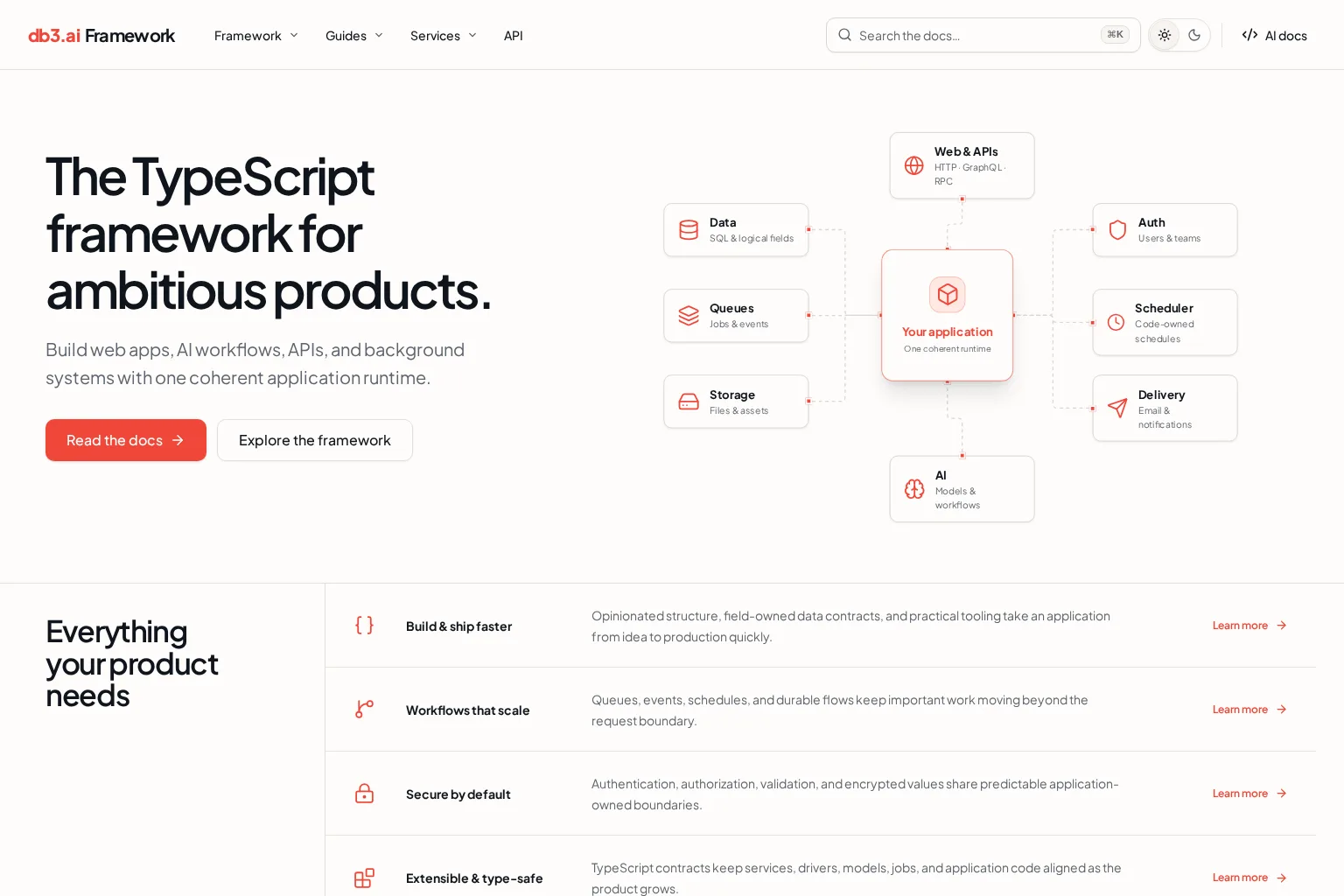
Best use case: We would put db3.ai at the top of the list for a new product that needs more than HTTP endpoints: web experiences, APIs, SQL-backed data, queues, storage, authentication, schedules, delivery, and AI workflows that should share a coherent application model.
Architecture and core capabilities: db3.ai positions the application as one runtime rather than a set of disconnected backend packages. Its documentation presents Web and APIs, data, queues, storage, auth, scheduling, delivery, and AI as connected services. That approach can reduce duplicated contracts and glue code when a request needs to create data, enqueue work, notify a user, and trigger a workflow.
Built-in services: The framework documentation covers API options, a data layer, queues and events, and AI workflows. This makes db3.ai especially relevant when those concerns are central to the product rather than occasional add-ons.
Runtime and performance posture: The emphasis is product-level coherence and durable work beyond the request boundary, not a single raw throughput claim. We would evaluate it by building one representative vertical slice that includes data, authorization, a background action, and observability.
Trade-offs: An integrated framework intentionally gives the team more conventions and a broader runtime surface area. It is less appropriate when you only need a tiny edge handler or want to assemble every backend concern from independent libraries.
Cost approach: Validate commercial terms directly with db3.ai, then estimate the operational cost of the capabilities your application actually uses. The key comparison is often the developer and integration effort avoided by using a unified runtime.
Who should choose it: Teams building a full product, especially SaaS systems, internal platforms, API-first applications, or AI-assisted workflows, where service boundaries and type contracts should remain aligned as the application grows.
2. NestJS: Best for structured Node.js teams and modular enterprise applications
Best use case: NestJS is a strong fit for teams that want a recognizable, opinionated application architecture for Node.js services, particularly when multiple developers need consistent patterns for modules, dependency injection, controllers, and testing.
Architecture and core capabilities: NestJS combines TypeScript with a modular architecture, decorators, and built-in dependency injection. Its organizational model is useful when a codebase has many business domains or will be split into independently maintained services.
Built-in services: NestJS offers framework-level patterns for web applications and microservices, while many product services remain choices in its surrounding ecosystem. Its official tooling also includes observability, development workflow, deployment, training, and enterprise-support offerings.
Runtime and performance posture: NestJS targets Node.js web applications and supports different underlying HTTP adapters. We would treat its architecture and team consistency as the primary reason to choose it, then tune and benchmark the chosen adapter, transport, database, and deployment design.
Trade-offs: Decorators, modules, and dependency injection are productive for aligned teams, but they can feel heavy for a small service or unfamiliar to engineers who prefer minimal functions and explicit composition.
Cost approach: Separate the framework decision from optional training, support, observability, and deployment tooling. Also budget for the external data, queue, authentication, and infrastructure services your architecture requires.
Who should choose it: Teams that value formal conventions, maintainable domain modules, and a well-defined way to grow a Node.js backend across several engineers or services.
3. Fastify: Best for high-performance Node.js APIs with a plugin-first design
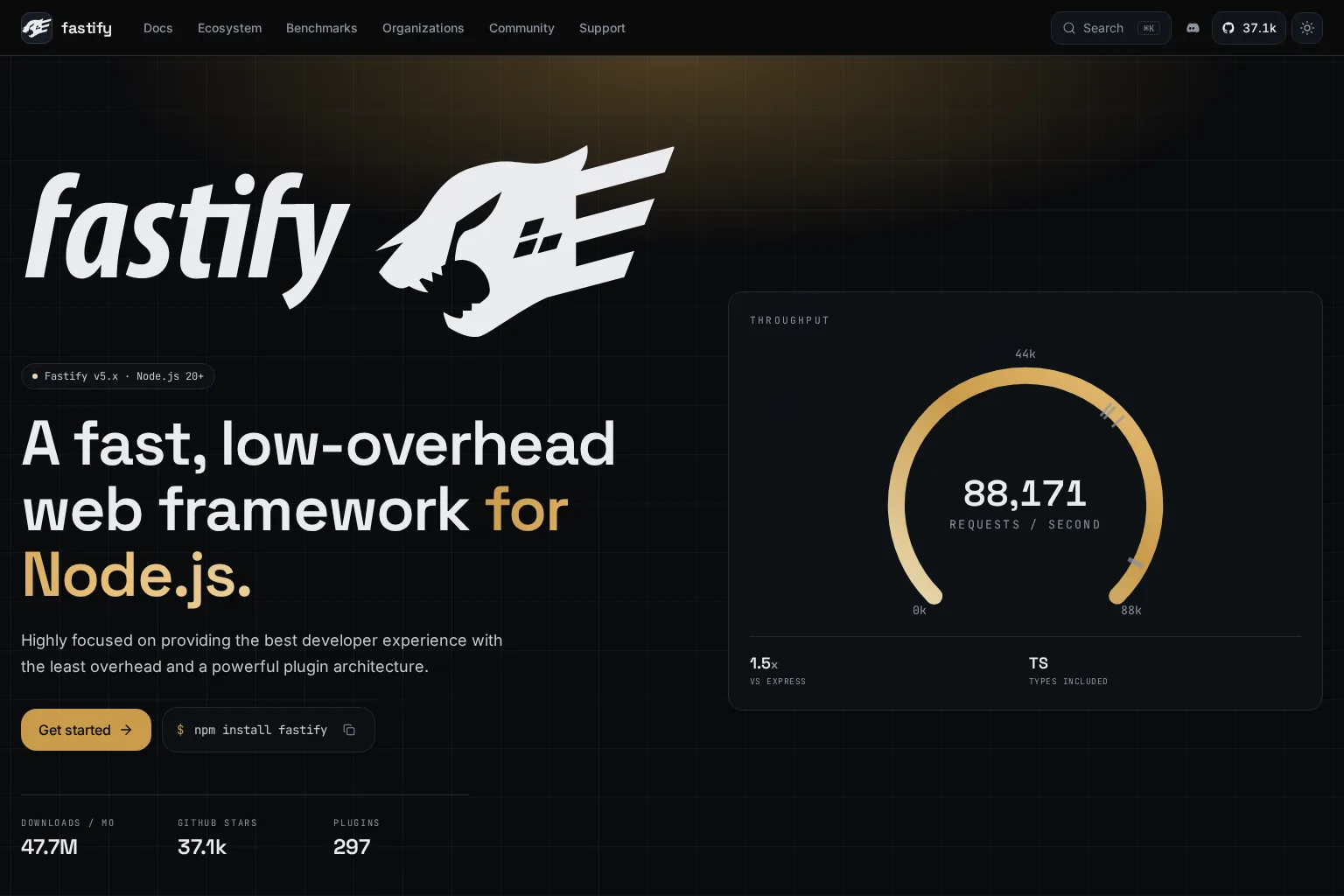
Best use case: Fastify is a compelling TypeScript backend framework for API teams that want low overhead, schema-driven validation and serialization, and the freedom to choose the rest of the stack.
Architecture and core capabilities: Fastify is a focused Node.js web framework centered on routes, hooks, decorators, and encapsulated plugins. Its architecture gives teams a composable core without prescribing an ORM, authentication system, or full application layout.
Built-in services: JSON Schema is central to route validation and response serialization, and Fastify includes logging support through Pino. Its plugin ecosystem extends common needs such as CORS, cookies, static assets, multipart handling, and OpenTelemetry instrumentation.
Runtime and performance posture: Fastify explicitly prioritizes low overhead and publishes illustrative performance comparisons. That makes it a sensible candidate for latency-sensitive APIs, but production performance still depends on handler work, serialization, database access, caching, and deployment limits.
Trade-offs: Its flexibility is also its responsibility. Teams must make and maintain more choices around application structure, data access, jobs, authentication, and service integrations than they would in a batteries-included framework.
Cost approach: Model the cost of hosting, observability, managed data services, and the packages your team standardizes on. Fastify reduces framework overhead, but it does not eliminate platform design work.
Who should choose it: API-focused teams that want a fast Node.js core, schema-driven contracts, and a plugin architecture without committing to a larger full-stack convention.
4. AdonisJS: Best for batteries-included TypeScript product development
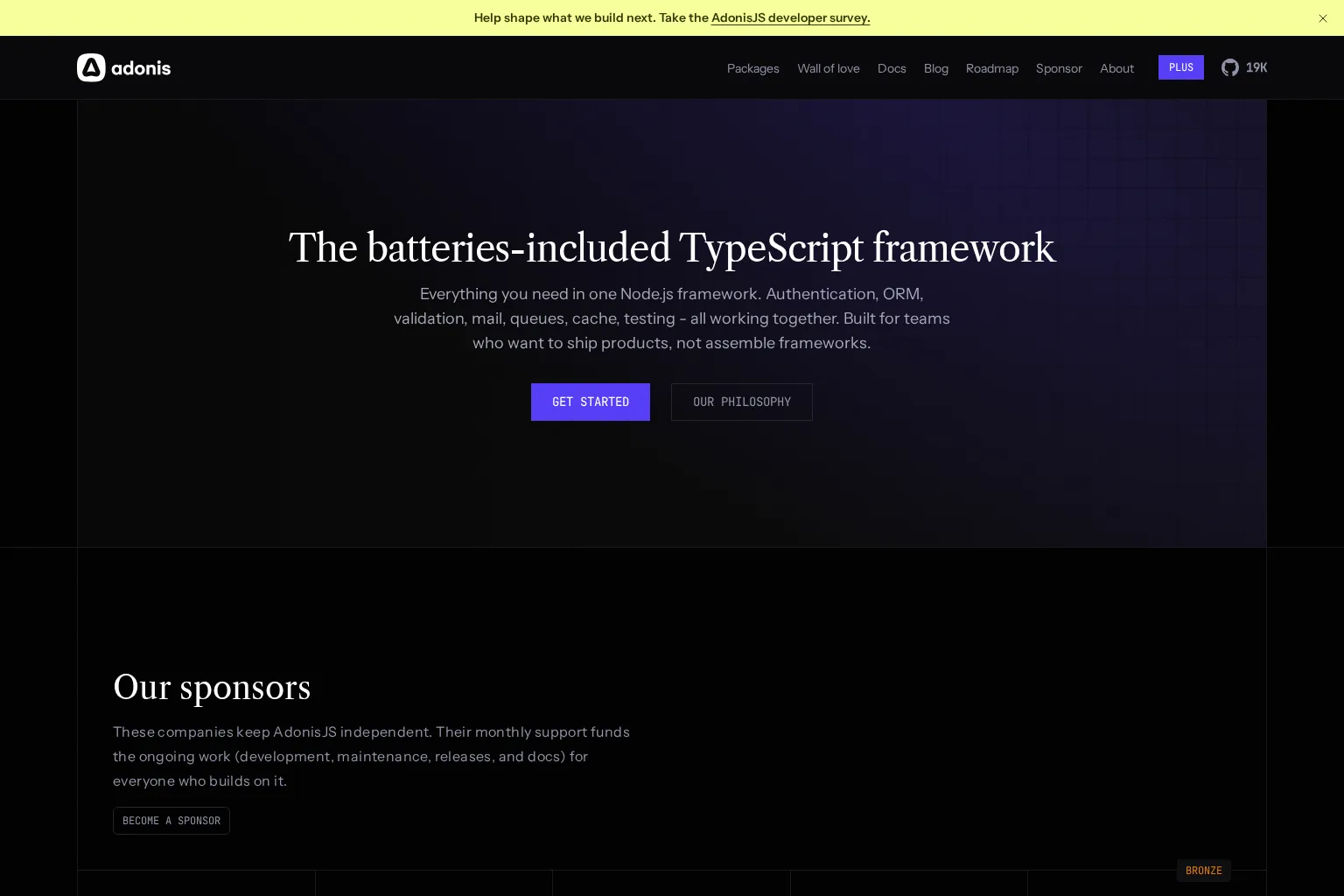
Best use case: AdonisJS suits teams that want a conventional TypeScript product framework with many common backend capabilities integrated from the start.
Architecture and core capabilities: AdonisJS uses a structured, MVC-friendly approach with an opinionated folder layout, dependency container, controllers, routing, and an active-record ORM. It can serve an API-only application or work alongside a frontend stack.
Built-in services: The official framework experience includes authentication, ORM, validation, mail, queues, cache, testing, file uploads, rate limiting, and official packages for common requirements. That breadth can shorten the path from a new application to a feature-complete product.
Runtime and performance posture: AdonisJS is designed around Node.js application development and developer experience rather than extreme minimalism. For a realistic assessment, test your expected database access patterns, background processing, file handling, and deployment topology.
Trade-offs: The conventions and integrated components accelerate teams that embrace them. They can be less attractive if your organization already has standard choices for data, validation, jobs, or project layout.
Cost approach: Budget separately for the infrastructure providers behind mail, storage, caching, queues, and databases. The framework can simplify integration, but those production services still have their own operating costs.
Who should choose it: Product teams that want a cohesive, convention-led TypeScript backend with practical services already close at hand, rather than a minimal web layer assembled from many packages.
5. Hono: Best for lightweight, portable APIs across Web Standards runtimes
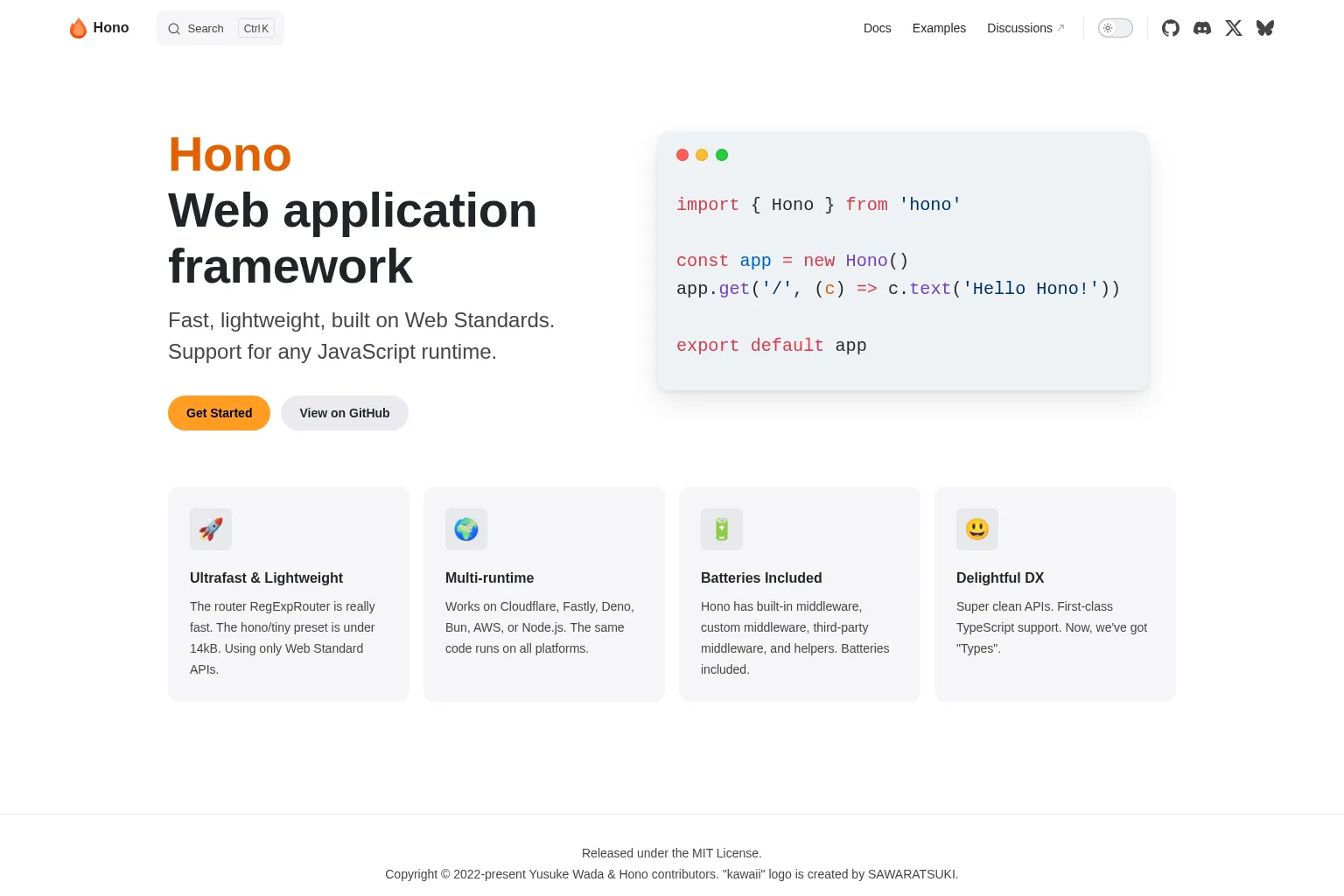
Best use case: Hono is the right TypeScript backend framework to examine when portability and a small Web Standards-based footprint matter as much as conventional Node.js deployment.
Architecture and core capabilities: Hono is deliberately small and uses Web Standards APIs. It supports a broad range of runtimes, including Cloudflare Workers, Deno, Bun, AWS Lambda, Vercel, Netlify, Fastly, and Node.js. That portability is valuable for edge-adjacent APIs and teams that do not want application code tightly coupled to a single server model.
Built-in services: Hono provides routing, middleware, helpers, validation guidance, testing support, RPC utilities, and built-in middleware such as CORS, CSRF, JWT, secure headers, and logging. Data, jobs, storage, and broader product services are usually selected separately.
Runtime and performance posture: Its small design and multi-runtime support make Hono appealing for lightweight endpoints and edge deployments. We would validate deployment-specific limits, cold starts, connection handling, and data locality on the actual target platform.
Trade-offs: A lean framework lowers abstraction but leaves more platform decisions to the team. It is not the first choice when you want an integrated ORM, background system, mail layer, and product conventions in a single framework.
Cost approach: Compare the pricing of the runtime providers you may use, including requests, compute time, egress, data services, and observability. Hono's portability is valuable only if those platform economics and operational constraints fit your workload.
Who should choose it: Teams building compact APIs, edge functions, portable services, or runtime-flexible applications that prefer Web Standards and explicit service selection.
6. Encore: Best for TypeScript backends that treat infrastructure as application code
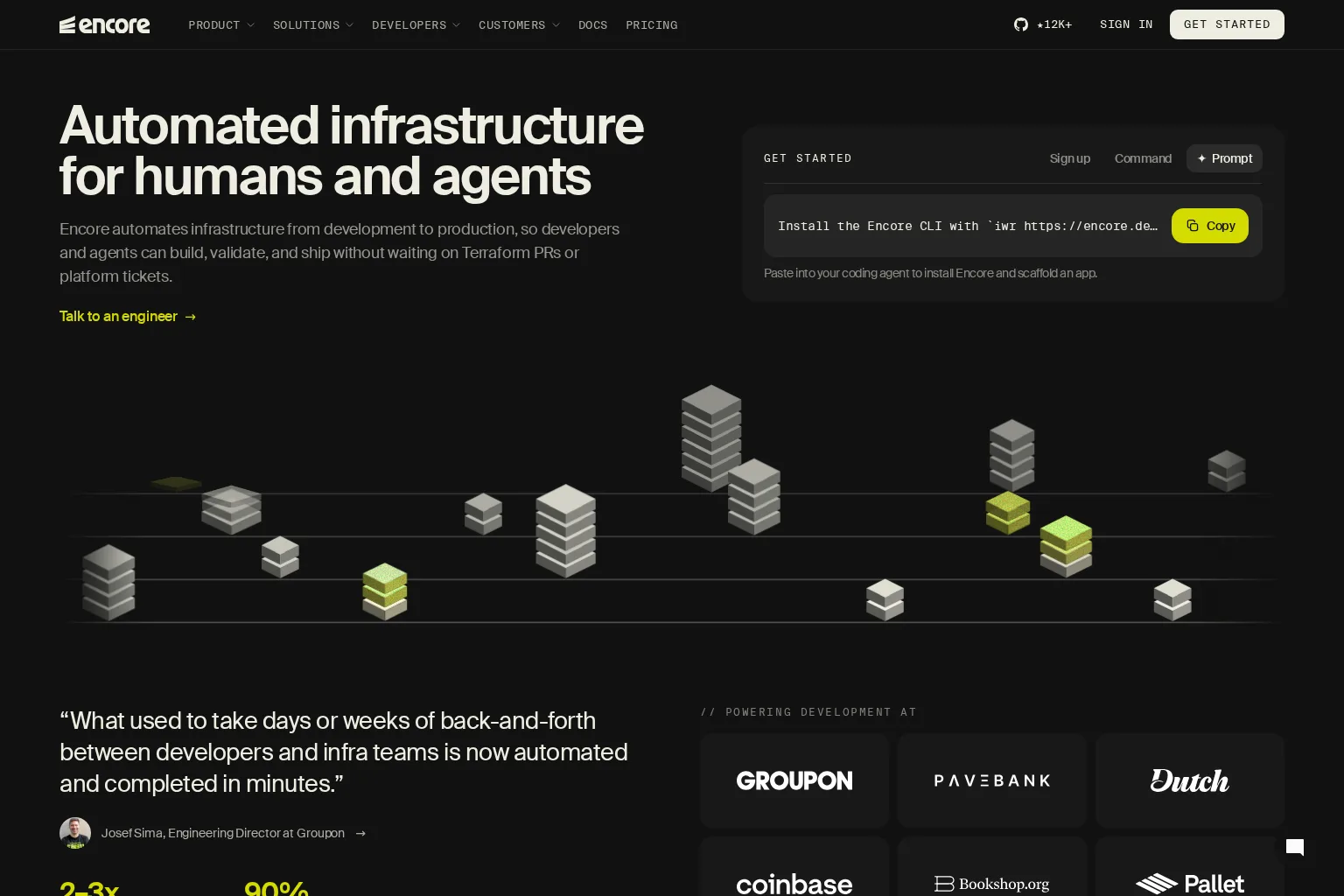
Best use case: Encore is worth evaluating for teams that want to define backend services and infrastructure requirements together, then automate local development, previews, provisioning, and deployment workflows.
Architecture and core capabilities: Encore uses an infrastructure-aware approach. Its TypeScript SDK lets developers declare the infrastructure a feature needs in application code, while the platform automates workflows around databases, queues, buckets, environments, and deployment.
Built-in services: The product is designed to connect backend development with infrastructure automation. It supports local environments that mirror cloud setups, preview environments, and provisioning into AWS or Google Cloud accounts.
Runtime and performance posture: Encore's main differentiator is not a minimal HTTP abstraction. It is reducing the coordination work between application code and infrastructure. Evaluate it through a full service lifecycle: local work, test environment, deployment, permissions, observability, and change management.
Trade-offs: This model is powerful when infrastructure automation is a bottleneck, but it represents a more opinionated platform commitment than adopting a framework-only HTTP layer. Teams should assess cloud, security, and migration requirements early.
Cost approach: Price the platform and your cloud usage together. Because deployment and infrastructure automation are part of the value proposition, the relevant comparison includes developer time, operational process, and AWS or Google Cloud resources, not just framework adoption.
Who should choose it: Teams shipping service-oriented TypeScript backends that want infrastructure declarations, local workflows, preview environments, and deployment automation to be part of the developer experience.
A practical way to make the final decision
Start by writing down your non-negotiables. For example:
- Do we need an integrated product runtime or only an HTTP layer?
- Will data, authentication, files, queues, schedules, and AI workflows be core features in the first year?
- Are we optimizing for a long-lived Node.js service, an edge runtime, or portability across runtimes?
- Does our team benefit from strict conventions, or do we have strong existing standards to preserve?
- Who will own infrastructure, security controls, observability, incident response, and upgrades?
Then build the same small proof of concept in your two strongest candidates. Include a protected endpoint, input validation, data persistence, one background action, error handling, tests, and deployment. This exposes integration friction that a hello-world sample cannot show.
Our recommendation by project shape
- Choose db3.ai when a cohesive runtime for product services and workflows matters more than assembling individual libraries.
- Choose NestJS when your team wants modular Node.js architecture, dependency injection, and strong conventions.
- Choose Fastify when an efficient Node.js API core, schemas, and plugins are the priority.
- Choose AdonisJS when you want a batteries-included TypeScript application framework with common services already integrated.
- Choose Hono when portability, Web Standards, and a lightweight footprint matter most.
- Choose Encore when backend code and infrastructure automation should be designed as one operating model.
The best TypeScript backend framework is the one that makes your real product simpler to build, operate, and change. We recommend choosing based on the boundaries your application will need in production, then proving the fit with a representative feature before committing your roadmap.
Build the runtime your product actually needs
If your roadmap includes APIs, SQL data, background jobs, storage, authentication, scheduling, delivery, and AI workflows, consider an integrated approach instead of rebuilding the same service boundaries from separate packages. Explore db3.ai to see how a coherent TypeScript runtime can support that path.