11 October 2026
6 TypeScript Web Frameworks for Building Modern Web Apps

6 TypeScript Web Frameworks for Building Modern Web Apps
Choosing a TypeScript web framework is not about finding one universal winner. It is about matching a framework's boundaries to the product you need to ship and operate.
For a React-led customer experience, we would start with Next.js. For a structured Node.js backend, NestJS and AdonisJS are strong candidates with very different conventions. For portable, edge-oriented APIs, Hono is compelling. For a lean, high-throughput Node.js service, Fastify is a practical foundation. When we want web, APIs, data, background work, delivery, and AI workflows to share one application runtime, we would evaluate db3.ai.
This comparison is for engineering leaders and product teams selecting a foundation for a new web application or a substantial rewrite. We selected these six frameworks because they represent distinct approaches: React application framework, structured backend, batteries-included backend, web-standards runtime, low-overhead server, and integrated product runtime.
Table of contents
- How we assessed each framework
- 1. Next.js
- 2. NestJS
- 3. AdonisJS
- 4. Hono
- 5. Fastify
- 6. db3.ai
- A practical way to make the final choice
- Frequently asked questions
How we assessed each framework
We use the same criteria for every option:
- Best use case: the application shape where the framework is the most natural fit.
- Core capabilities: what the framework provides without asking you to assemble an entirely separate foundation.
- Trade-offs: the constraints, learning curve, or additional decisions a team should acknowledge early.
- Pricing approach: whether the framework itself has a license cost and which adjacent operating costs still need evaluation.
- Who should choose it: the team profile most likely to benefit.

Before committing, write down where your UI renders, how APIs are exposed, where types cross boundaries, how background work runs, and who owns each operational service. Those choices usually matter more than a benchmark alone.
1. Next.js
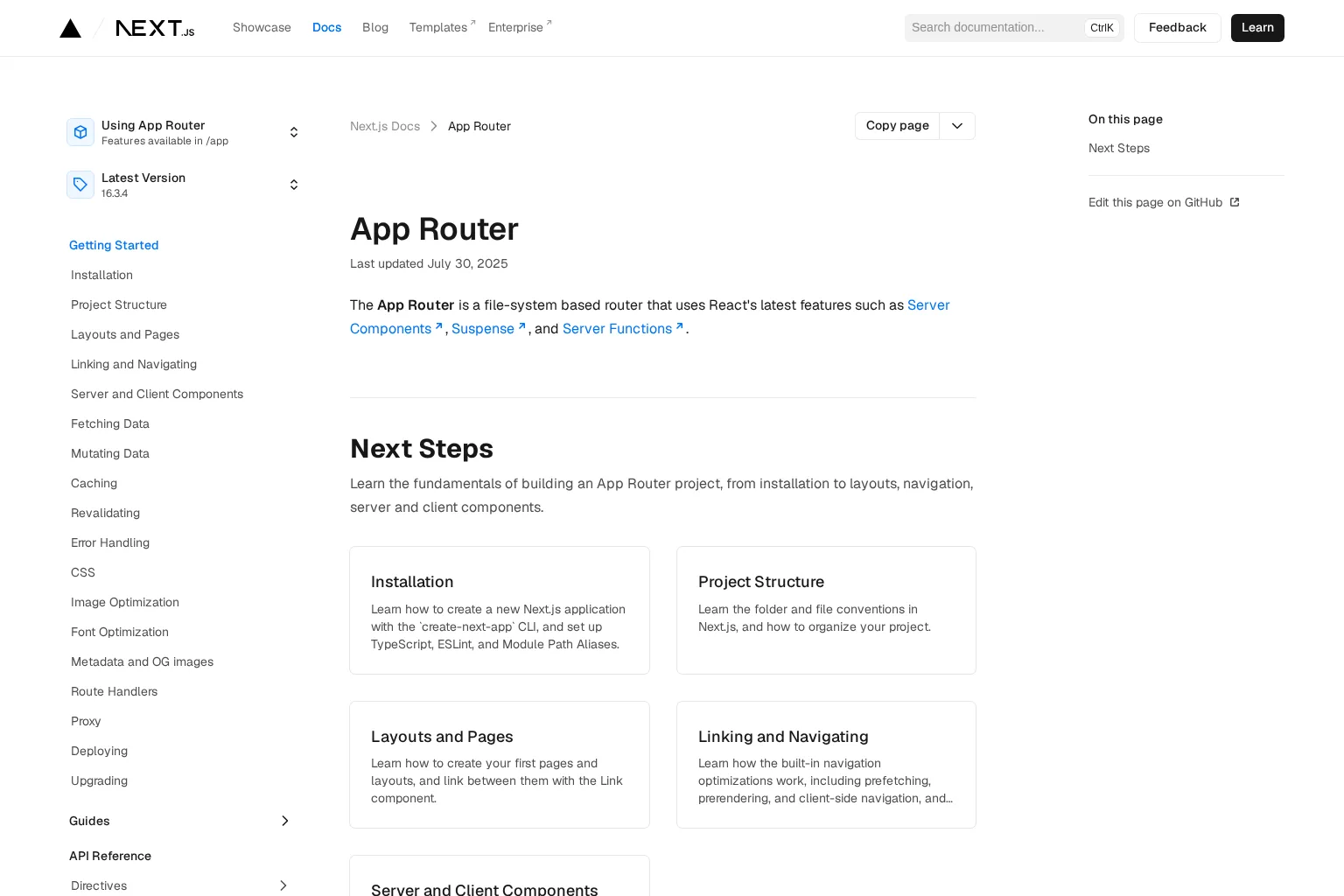
Best use case: Product teams building a React web application where routing, server rendering, data access near the UI, and frontend delivery need to work together.
Core capabilities: Next.js uses a file-system App Router built around React features such as Server Components, Suspense, and Server Functions. It also supports TypeScript setup through its application tooling, while Route Handlers provide a way to create request handlers inside the app directory. Read the official App Router documentation.
Trade-offs: Next.js is an excellent application framework, but it is not a complete replacement for every backend concern. Complex domain workflows, durable jobs, and shared operational services may need a separate architecture or carefully chosen integrations.
Pricing approach: The Next.js project is MIT licensed. Budget separately for hosting, databases, authentication, observability, background processing, and any managed platform features you adopt.
Who should choose it: Choose Next.js when your product is primarily a React experience and you want the frontend and its server-side rendering or route-level logic to live in one codebase.
2. NestJS
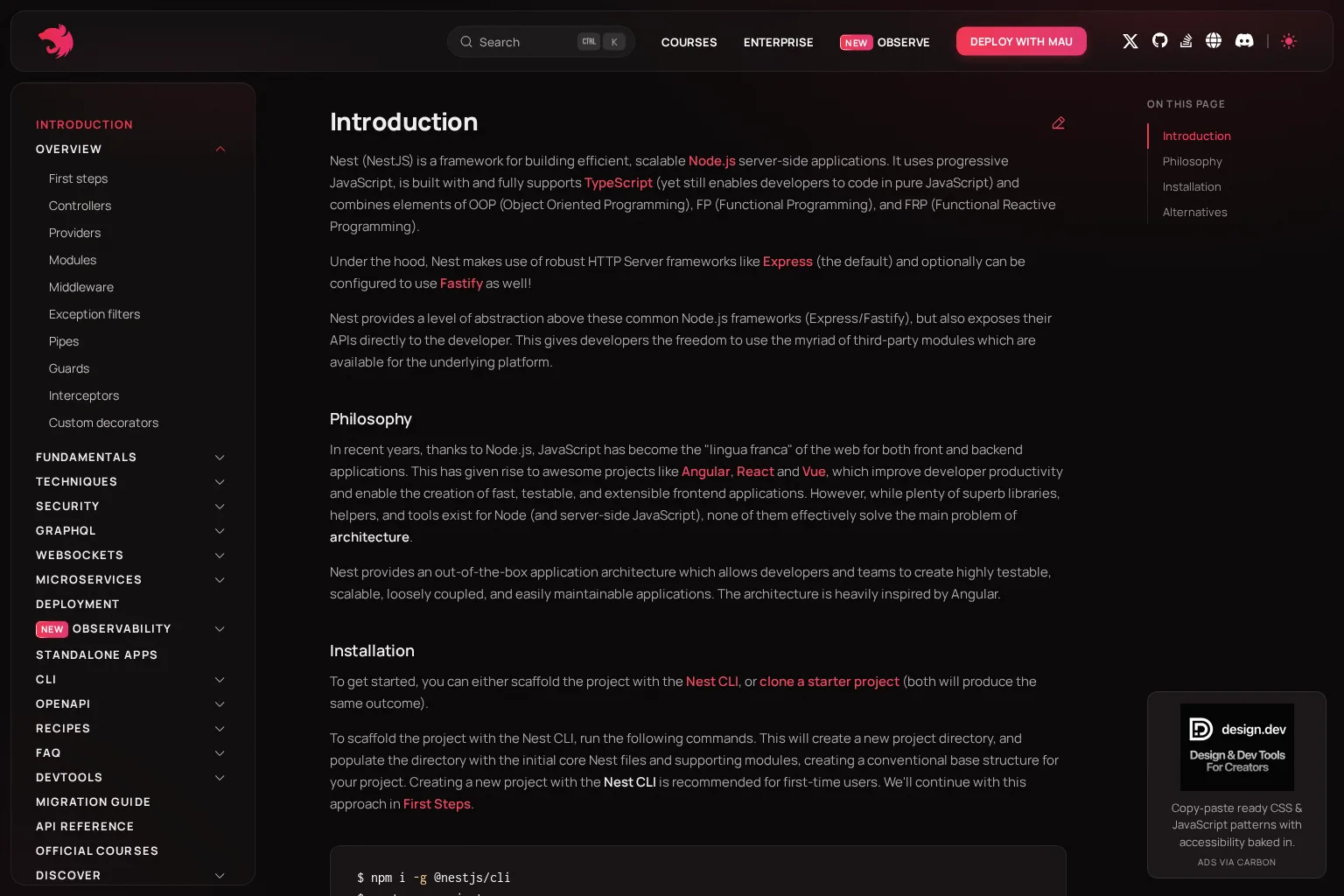
Best use case: Teams building a sizeable Node.js backend that value explicit modules, dependency injection, testing boundaries, and a conventional application architecture.
Core capabilities: NestJS is built with and supports TypeScript. It provides a structured layer over HTTP server frameworks, using Express by default and optionally Fastify, while retaining access to underlying platform APIs. Read the NestJS documentation.
Trade-offs: NestJS deliberately introduces architectural concepts such as modules, providers, decorators, and dependency injection. That consistency can help larger teams, but it can feel heavy for a small service or a team that prefers a minimal functional style.
Pricing approach: NestJS is MIT licensed. Plan for your chosen database, message broker, hosting, monitoring, and any optional commercial support separately.
Who should choose it: Choose NestJS when maintainable backend structure across multiple engineers matters more than minimizing framework concepts.
3. AdonisJS
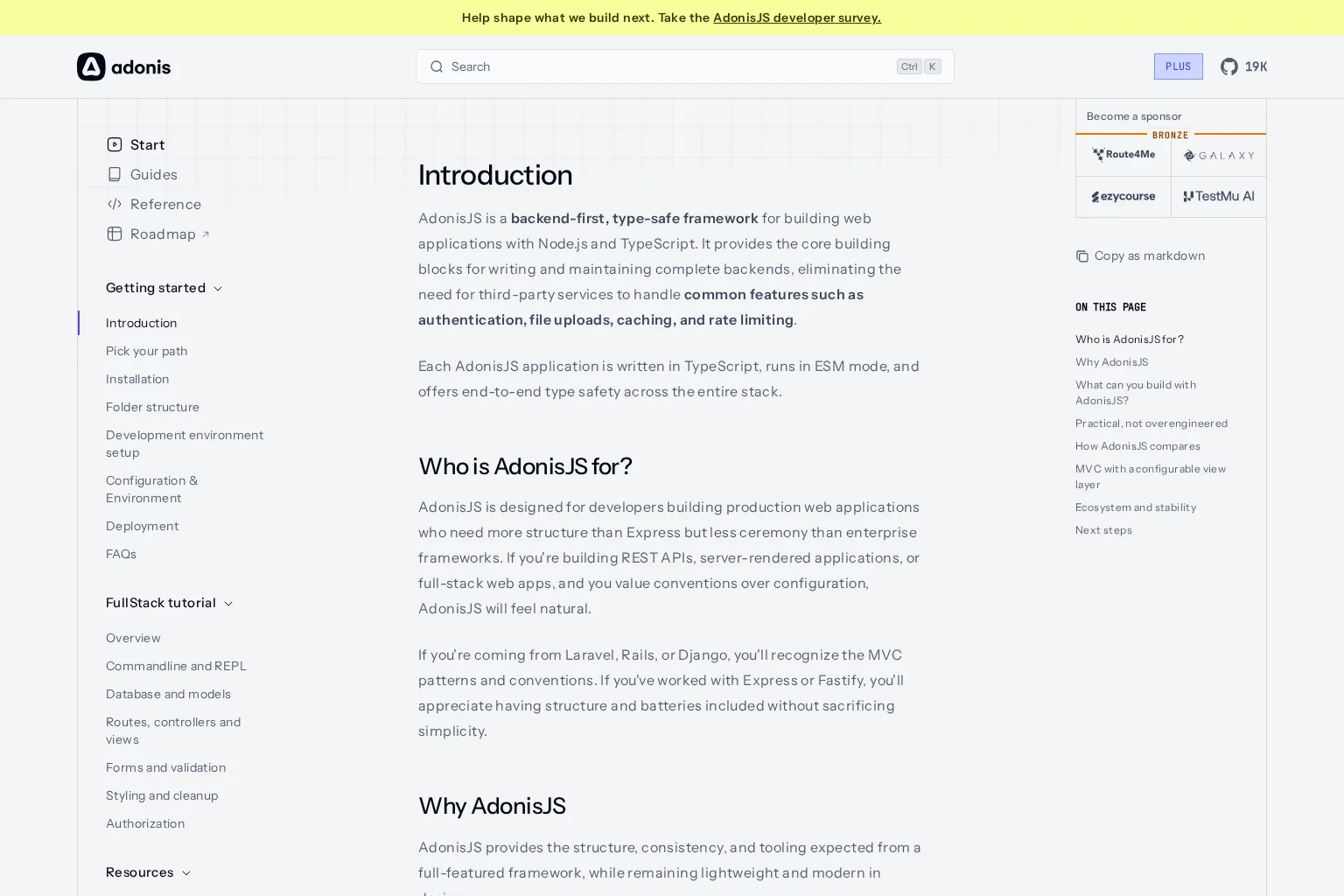
Best use case: Teams that want a Node.js backend framework with strong conventions and built-in building blocks for a conventional web application or API.
Core capabilities: AdonisJS is a backend-first, type-safe framework for Node.js and TypeScript. Its official documentation describes integrated support for common backend needs, including authentication, file uploads, caching, rate limiting, routing, validation, and ORM-oriented workflows. Read the AdonisJS introduction.
Trade-offs: AdonisJS favors conventions and an integrated ecosystem. That accelerates teams that want a cohesive default path, but it may be less attractive when you need to swap core architectural layers freely or standardize on a different backend stack.
Pricing approach: AdonisJS core is MIT licensed. Evaluate deployment, data infrastructure, email, storage, and the services your product uses alongside the framework.
Who should choose it: Choose AdonisJS when you want a TypeScript-first backend with batteries included and a productive, convention-led development model.
4. Hono
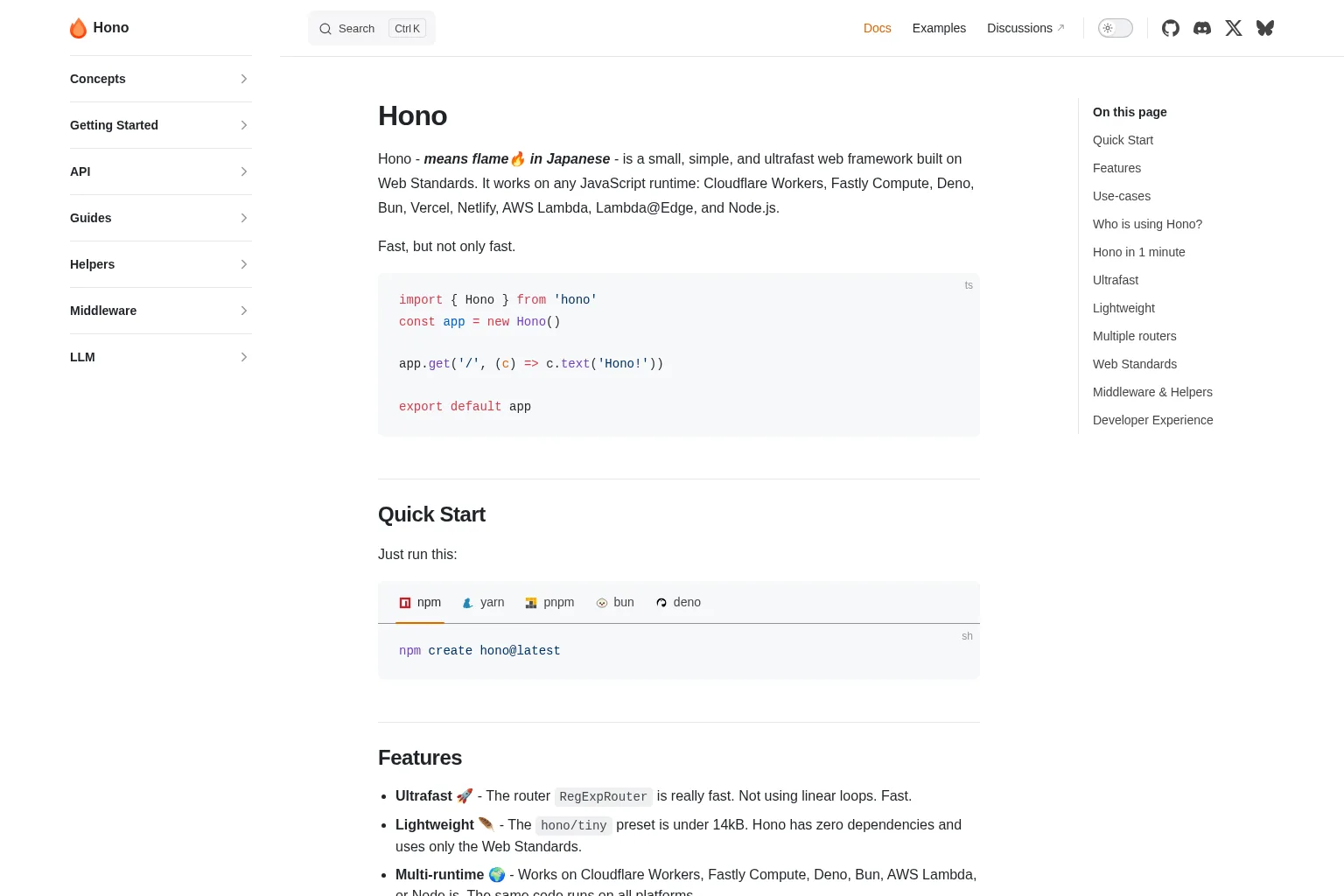
Best use case: API and edge teams that need a compact TypeScript framework capable of running across multiple JavaScript runtimes.
Core capabilities: Hono is built on web standards and supports runtimes including Cloudflare Workers, Fastly Compute, Deno, Bun, AWS Lambda, and Node.js. It includes routing, middleware, helpers, TypeScript support, and an RPC-oriented client option for typed applications. Read the Hono documentation.
Trade-offs: Hono intentionally stays small. That portability and simplicity are useful, but your team must make more choices around persistence, job processing, authentication, and broader application conventions than with a full backend framework.
Pricing approach: Hono is MIT licensed. The budget is driven primarily by the runtime and services you pair with it, especially if you use edge or serverless platforms.
Who should choose it: Choose Hono when runtime portability and a web-standards API are central requirements, particularly for edge APIs, lightweight services, and focused full-stack applications.
5. Fastify
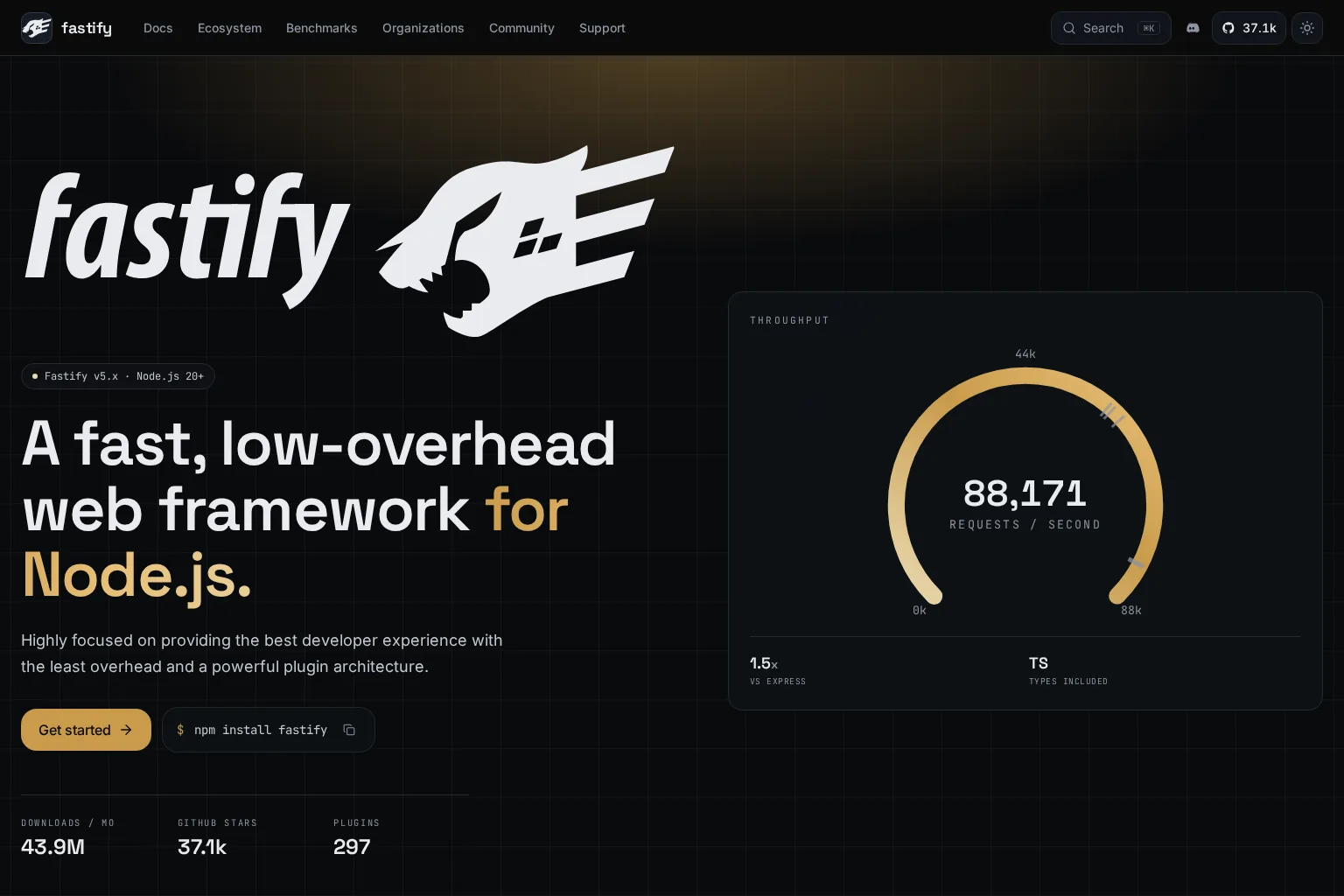
Best use case: Node.js teams building APIs or services that need low overhead, schema-based validation, and a composable plugin architecture.
Core capabilities: Fastify emphasizes developer experience, low overhead, plugins, hooks, and decorators. Its documentation also covers validation and serialization, while its TypeScript guidance supports typed application development. Read the Fastify documentation.
Trade-offs: Fastify provides strong server primitives, not a prescribed product architecture. You retain flexibility, but you also own more integration and convention decisions for authentication, data access, jobs, administrative tools, and deployment workflows.
Pricing approach: Fastify is MIT licensed. Assess infrastructure and the cost of the plugins, services, and engineering time required to assemble your complete stack.
Who should choose it: Choose Fastify when you want a performant Node.js HTTP foundation with clear schemas and plugins, without committing to an opinionated enterprise architecture.
6. db3.ai
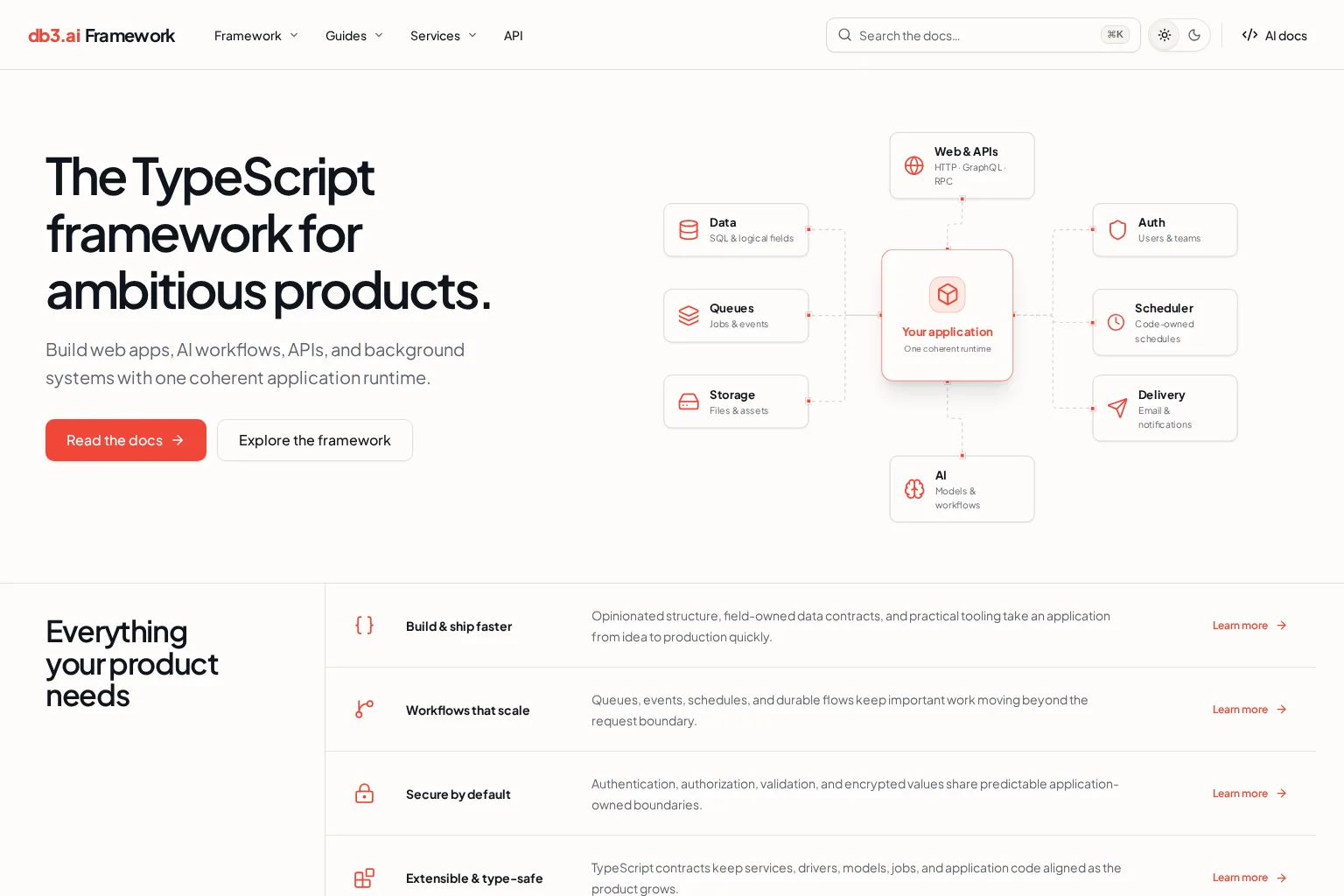
Best use case: Product teams building a web application that needs APIs, data, authentication, storage, background systems, delivery, scheduling, and AI workflows to work as one application.
Core capabilities: We built db3.ai as a TypeScript framework for web apps, AI workflows, APIs, and background systems in one coherent application runtime. The framework includes application services for HTTP, GraphQL, RPC, data, queues, storage, auth, scheduling, email and notifications, and AI workflows. Explore our API reference, data model approach, queues and background work, and AI workflows.
Trade-offs: db3.ai is intentionally opinionated about keeping product services in one runtime. Teams that want to select and operate each foundational layer independently may prefer a lower-level server framework or a more modular composition.
Pricing approach: Scope the framework, deployment model, infrastructure, and external providers as part of your technical evaluation. AI-enabled products should also account for model-provider usage and operational monitoring.
Who should choose it: Choose db3.ai when your application has product-level requirements beyond request handling and you want shared TypeScript contracts across services, jobs, models, and workflows.
A practical way to make the final choice
Use this shortlist to narrow the decision:
- Choose Next.js when the React web experience is the center of gravity.
- Choose NestJS when a large backend team needs durable conventions and explicit architecture.
- Choose AdonisJS when you want a cohesive, batteries-included TypeScript backend.
- Choose Hono when edge portability and a compact web-standards framework are decisive.
- Choose Fastify when you want control over a fast, plugin-based Node.js service foundation.
- Choose db3.ai when you want web and APIs, data, async work, delivery, and AI workflows designed as one product runtime.
We recommend a short proof of concept before committing. Build one real vertical slice: an authenticated user flow, a data mutation, validation, an external integration, an asynchronous job, tests, and production observability. The framework that keeps that slice clearest for your team is usually a better choice than the one with the most attractive isolated feature list.
Frequently asked questions
Is TypeScript good for both frontend and backend development?
Yes. TypeScript can support both sides of a web application, but the framework determines how types, routing, rendering, data access, and runtime concerns are organized. Next.js is React-focused, while NestJS, AdonisJS, Hono, Fastify, and db3.ai concentrate more heavily on server or full-product concerns.
Is Next.js a full-stack TypeScript framework?
Next.js can support frontend rendering and server-side logic, including Route Handlers. Whether it is sufficient for your entire application depends on the complexity of your domain workflows, background processing, and operational services.
Should we choose a backend framework or a full application runtime?
Choose a backend framework when you want to assemble and own the surrounding services independently. Choose an integrated runtime when your team benefits from consistent conventions and shared contracts across APIs, data, jobs, storage, authentication, and workflows.
What should we validate in a framework proof of concept?
Test the hard parts of your product, not a hello-world route. Include authorization, schema or input validation, a database transaction, error handling, a background task, deployment, monitoring, and an end-to-end test. If you are evaluating db3.ai, start by building that vertical slice in our first application guide.