10 October 2026
5 Application Authentication Services Compared for Multi-User Products

TL;DR
For an application authentication service, choose Auth0 when hosted identity and federation are central, Clerk when organization-aware application UI is the priority, Supabase Auth when identity should sit beside Postgres policies, Keycloak when you can operate your own identity server, or db3.ai Auth when your TypeScript application should own its session transport and resource rules alongside framework services. None makes a logged-in user automatically entitled to every record. Test session revocation and tenant isolation before committing.
An engineering team selecting authentication for a multi-user product has to decide more than how to display a sign-in form. We need an identity that survives across requests, a way to end access, a policy for each organization's data, and a trusted context for workers and AI tools. The right purchase or build decision depends on who will own those boundaries after launch.
This comparison is for teams building web apps, APIs, and products with user-owned or tenant-owned records. We selected five verifiable options with different operating models: two hosted identity platforms, a database-integrated service, a self-hosted identity server, and application-framework-integrated authentication. We compare each on best fit, identity and session capabilities, authorization integration, operational responsibility, and pricing approach. These are not interchangeable packages: shortlist against your architecture rather than treating the list as a feature ranking.
Table of contents
- What an application authentication service actually needs to do
- 1. Auth0: Hosted identity for B2B and federated login
- 2. Clerk: Managed sign-in and organization-aware product UX
- 3. Supabase Auth: Identity next to Postgres authorization
- 4. Keycloak: Self-hosted identity and federation
- 5. db3.ai Auth: Framework-integrated identity in a TypeScript app
- Put session identity to work without trusting a record ID
- Evaluation checklist for the final two options
- Our decision rule
- Frequently asked questions
- Sources
- Recommended Reads
What an application authentication service actually needs to do
Authentication verifies an identity; authorization determines whether that identity can perform a particular action on a particular resource. Between them sits the session, which binds subsequent requests to the verified account. OWASP's session guidance treats authentication, session management, and access control as connected but separate concerns.
When we evaluate a service, we ask who stores identities and provider links, how credentials or federated logins are handled, how sessions are issued and revoked, what happens during password recovery, and how a verified identity reaches an API. Then we ask a second question: who checks membership, role, ownership, and tenant scope on every read and write? OWASP identifies missing object-level checks as a distinct API vulnerability, even when the caller is properly signed in. Its API1:2023 guidance recommends authorization checks for every endpoint that acts on a client-selected object.

1. Auth0: Hosted identity for B2B and federated login
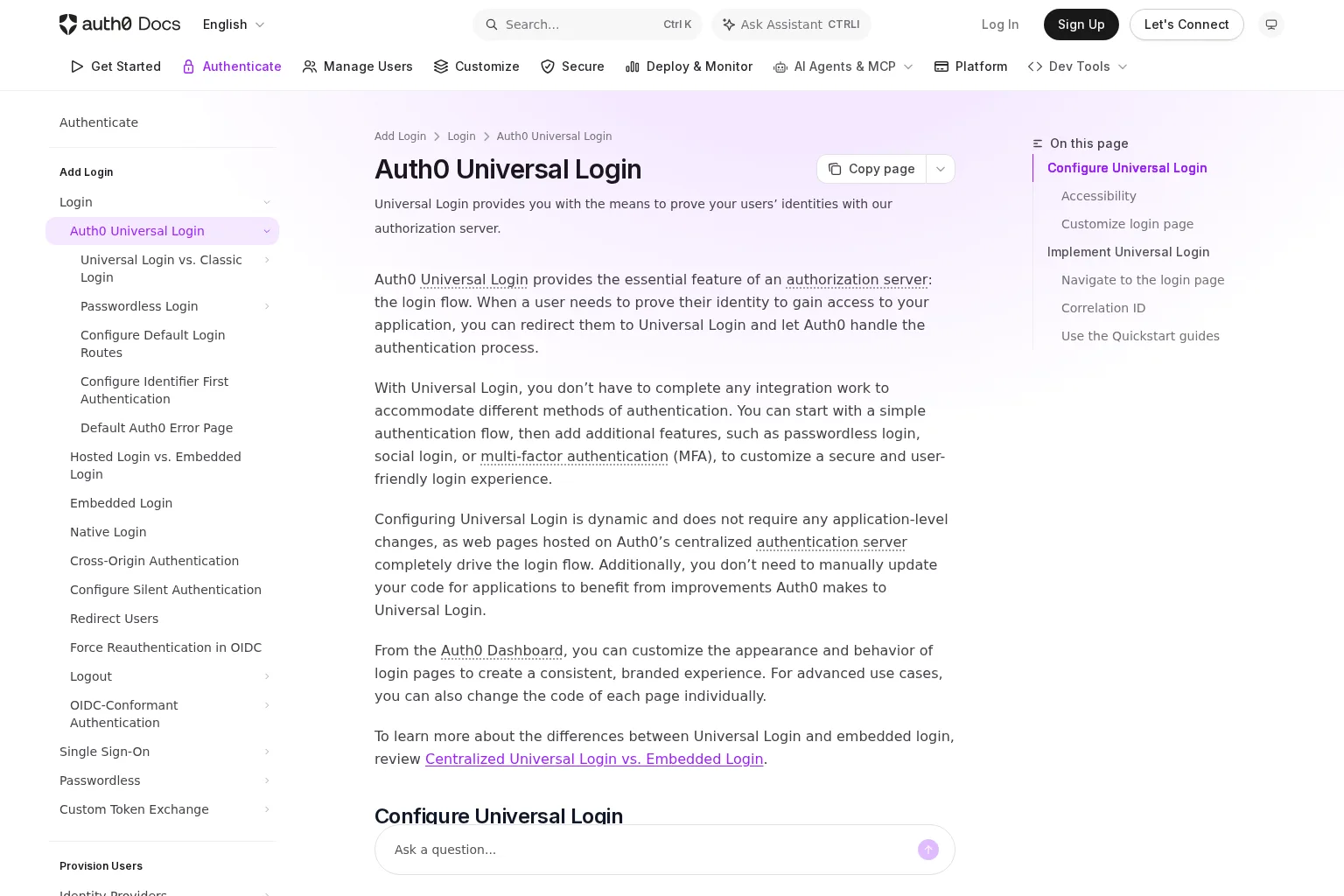
Best fit: A team that wants a hosted login and identity platform across applications, especially where customer organizations and federated connections matter. Auth0 Universal Login hosts the login flow and supports adding passwordless, social, and multifactor methods. Its Organizations documentation describes customer membership, organization-specific login, roles, and machine-to-machine access on behalf of an organization.
Sessions and permissions: Decide how your application's browser or API session relates to Auth0's tokens and how revocation reaches your own backend. An organization identifier or role in a verified token can inform a policy, but the application still must check the target resource and action. The main integration effort is not drawing the login screen; it is mapping provider identities and organization membership to your product's data model and testing the boundaries when someone changes organizations.
Pricing and responsibility: Auth0 publishes a free tier and paid B2C and B2B plans based on monthly active users, with some connections, tokens, and advanced capabilities subject to plan or add-on limits. Model your likely MAU tier and required features using Auth0's pricing page, rather than assuming the entry plan covers enterprise requirements. Auth0 operates the identity service; your team still owns application authorization, integration, and tenant-scoped tests. Choose it when those hosted capabilities outweigh the added external service dependency.
2. Clerk: Managed sign-in and organization-aware product UX
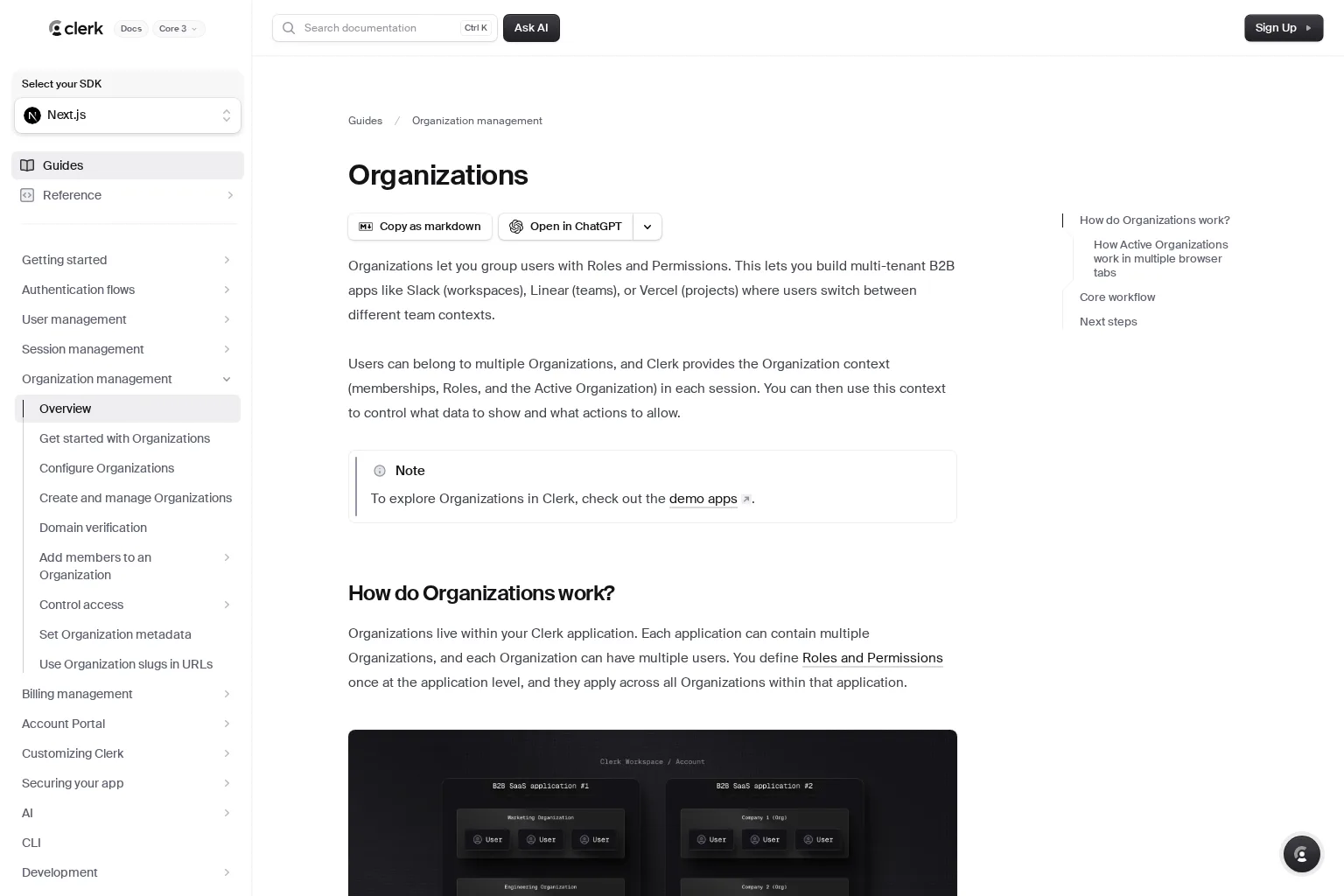
Best fit: A SaaS team that wants managed authentication closely coupled to user and organization experiences. Clerk's Organizations guide describes memberships, an active organization, roles, permissions, and switching between organizations. These make it useful when a person may belong to several customer workspaces.
Sessions and permissions: Clerk exposes organization context in sessions, but this is not a substitute for applying server-side permissions to each requested record. A particularly useful evaluation case is two browser tabs on different organizations: Clerk's own guide warns that background fetches should not rely on a global session cookie to infer the originating tab's active organization. Validate the organization context accompanying the request, then check membership and resource ownership on the server. Clerk explains the multi-tab behavior.
Pricing and responsibility: Clerk's pricing distinguishes a Hobby tier, paid plans, monthly retained users, monthly retained organizations, and additional charges or limits for some B2B features. Compare your expected active organization count and required SSO or session controls, not just registered-user totals. Choose Clerk when rapid product-facing sign-in and organization workflows matter; expect to design the application data-access layer yourself.
3. Supabase Auth: Identity next to Postgres authorization
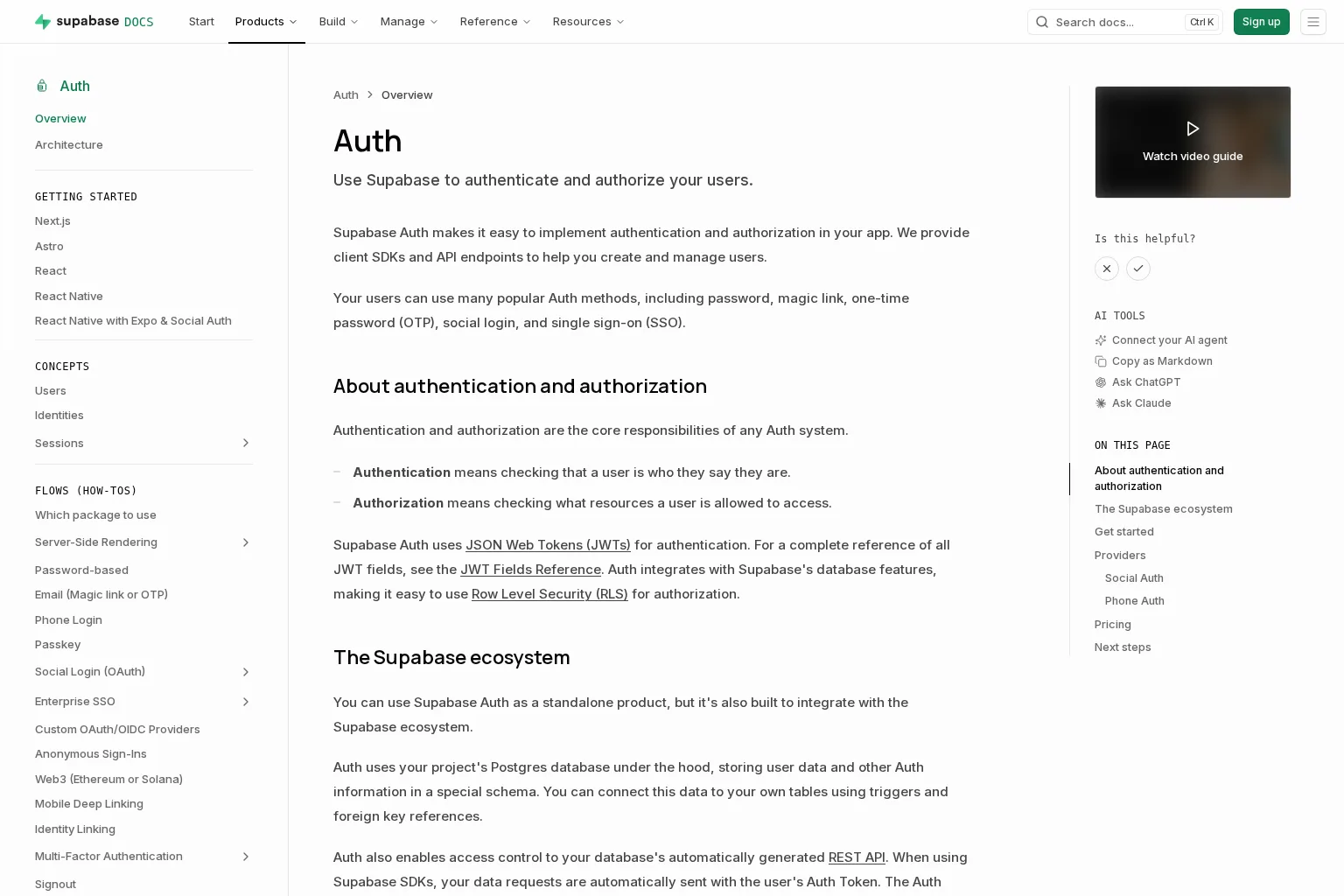
Best fit: A product using Supabase Postgres that wants user identity linked to database access policy. Supabase Auth supports password, magic link, OTP, social sign-in, and SSO paths. It issues JWTs and integrates with Postgres Row Level Security (RLS), so data access through Supabase APIs can be scoped by policies attached to the database.
Sessions and permissions: Supabase documents access and refresh tokens, configurable session controls, and important timing behavior: timeouts and single-session restrictions take effect at refresh, so an existing access token may remain valid until expiry. Review its session documentation before promising instant logout across every API. RLS is powerful only if policies cover your tables and the actual access path. Test privileged server clients, background processes, and migrations separately; a valid JWT alone does not establish record ownership.
Pricing and responsibility: Supabase pricing combines a platform plan, usage allowances, and project compute, with some authentication charges or controls depending on plan and usage. Supabase's Auth overview identifies different billing categories for regular, third-party, and SSO active users. Choose it when your team is prepared to make and test database policies as part of the product's authorization design, not merely to replace a login form.
4. Keycloak: Self-hosted identity and federation
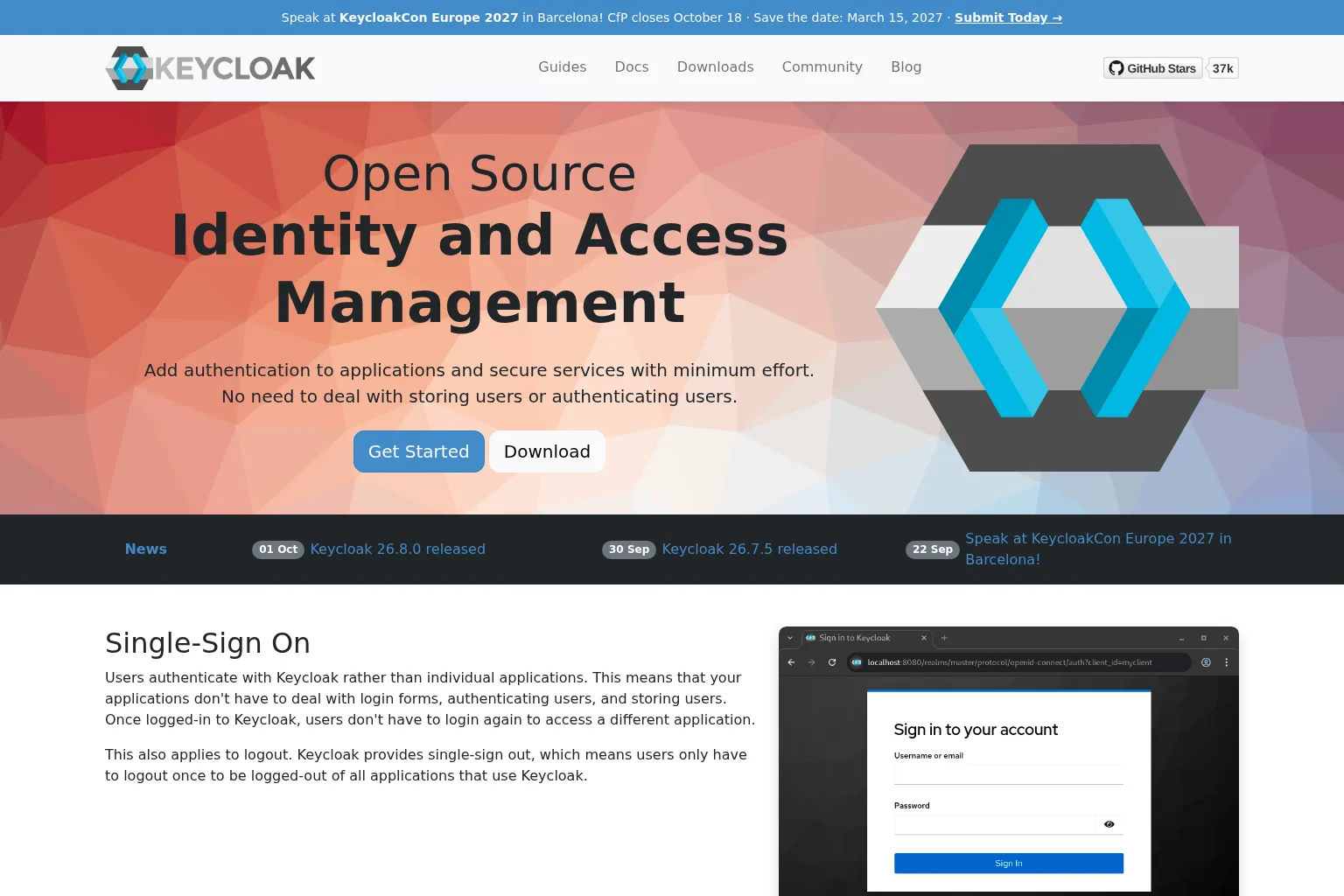
Best fit: A team able to deploy and maintain an identity server, particularly one connecting multiple applications or existing directories. The Keycloak project documents single sign-on, identity brokering with OpenID Connect or SAML providers, LDAP and Active Directory federation, session administration, and authorization services.
Sessions and permissions: Centralized login can simplify identity across several applications, but each application still needs a reliable translation from the Keycloak principal and claims to its own permissions. Work out logout propagation, token validation, key rotation, and organization mapping before migration. A policy in an identity server does not automatically filter records in a separate application database.
Pricing and responsibility: Keycloak is open-source software rather than a hosted subscription from the project. That does not mean operating it is costless: infrastructure, availability, patching, backup, incident response, and specialist time belong to your team or hosting provider. Choose it when infrastructure control, federation, and the ability to customize identity operations justify that ownership. If you lack an on-call path for the identity tier, compare a managed option first.
5. db3.ai Auth: Framework-integrated identity in a TypeScript app
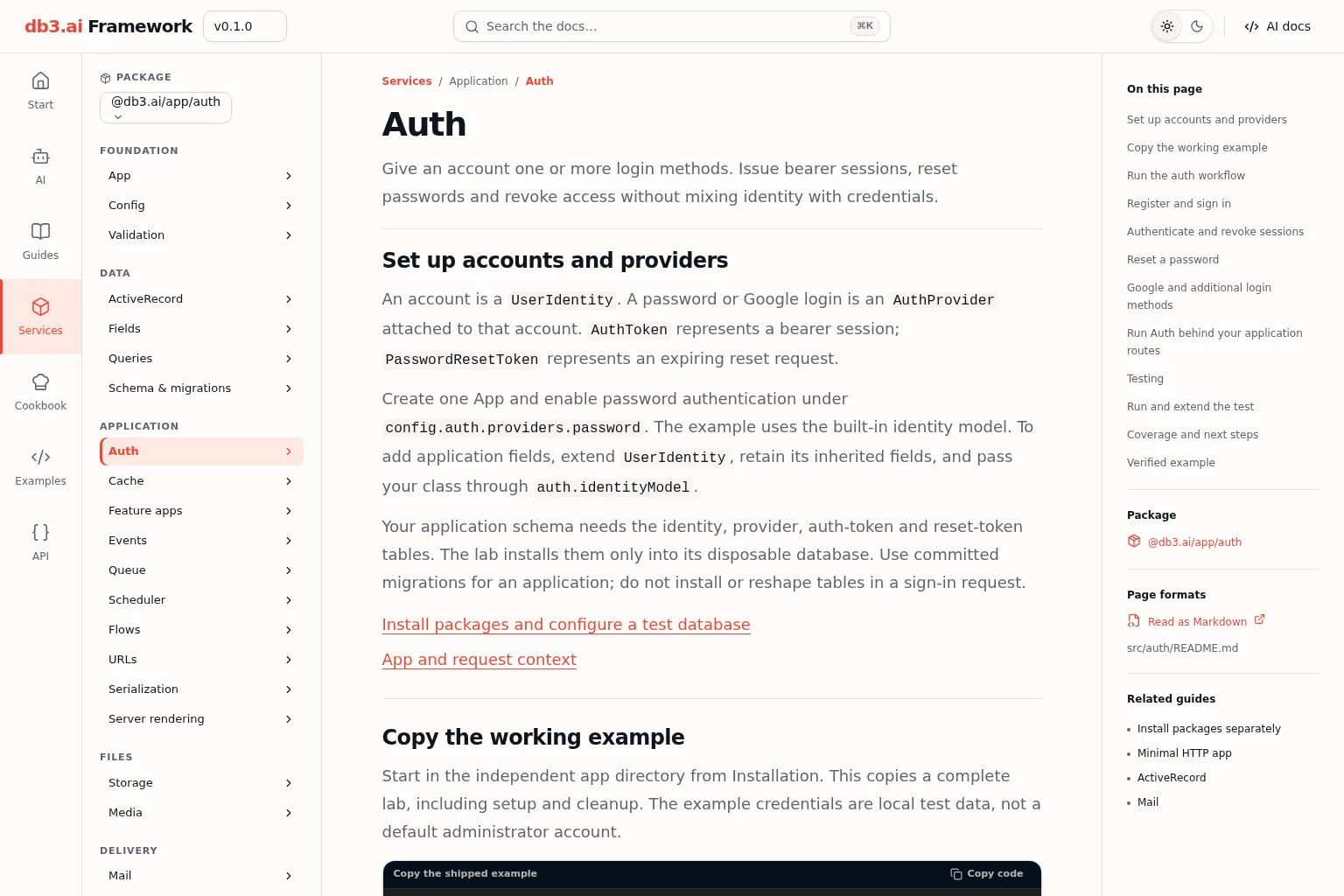
Best fit: A TypeScript team that wants identity, durable bearer sessions, records, jobs, and request-local state in one application runtime, while owning its public HTTP routes. The db3.ai Auth guide documents password registration, providers, session tokens, password resets, session listing, and revocation. It is a framework service, not a hosted identity provider or a drop-in set of public login routes.
Sessions and permissions: The generated starter's login walkthrough puts an opaque bearer value in a host-only, HttpOnly cookie and revokes the durable token at logout. The HTTP application chooses its transport, origin policy, and routes. The Auth API reference documents authenticateToken(), revokeCurrentToken(), and user-session operations. Application code still has to enforce membership and owner-scoped queries; the framework does not decide which customer's note a user may read.
Pricing and responsibility: The saved db3.ai offering has no published price in its catalogue, so we cannot treat it as free or quote a subscription. The package documentation describes a preview with maintainer-supplied package tarballs where packages are not yet published; confirm access and commercial terms before making a production commitment. Choose this model when you want direct control of application routes and data and are willing to implement missing product requirements, such as organization membership or recovery screens, rather than assuming they ship with the starter. The starter guide lists its current limits.
Put session identity to work without trusting a record ID
A useful proof of the architecture is a private note request. In the generated db3.ai starter, requireUser() authenticates the incoming session cookie before the note query. The route then looks up both the record ID and authenticated owner ID. The browser cannot submit a different owner to gain access. This is a short excerpt from the documented owned-note route, not a standalone, independently executed example:
// Inside the starter's Fastify GET /api/notes/:id handler.
// The starter imports requireUser, Note, and HttpError in createServer.ts.
const user = await requireUser(application, request);
const note = await Note.where({ id: request.params.id, owner: user.id }).first();
if (!note) throw new HttpError(404, 'Note not found.');
return { note: note.toJSON() };
To run the full route, use the generated starter with its documented Node.js 24+, MariaDB setup and migrations; application, request, cookie handling, and HTTP validation are supplied by that app, not by this excerpt. The starter's tests cover cross-user denial, but test the policy against your schema and every new operation, including updates and deletes. If your product has tenants rather than individual owners, add a verified membership check and a tenant predicate; do not swap owner for an unchecked request parameter. The starter setup and OWASP's object-level authorization guidance show why the second check matters.
For background jobs or agent tools, persist the initiating user and tenant IDs as trusted application context, then recheck the necessary permissions when the worker reads or changes data. Never pass a browser session or let model-generated tool arguments choose an unrestricted tenant. Decide how work behaves if access is revoked after dispatch; a queued job does not inherit an automatically current browser session. This is application policy, regardless of which authentication service issues the identity.
Evaluation checklist for the final two options
Run the same small proof of concept for each finalist rather than comparing marketing checkboxes:
- Identity and recovery: Can you support the exact methods your customers need, account linking, verification, recovery, and enterprise federation? Who builds the missing UI and email flow?
- Session lifecycle: What are the cookie or token lifetime, refresh behavior, device listing, revocation delay, key rotation, and post-password-change behavior? Reproduce logout in another tab and API client. OWASP's session checklist is a useful baseline.
- Authorization: Can user A read user B's record by changing an ID? Can a member of organization A access B's report? Check reads, writes, exports, websockets, jobs, and AI tools, not just page visibility.
- Operations and exit: Who manages secrets, incident logs, configuration environments, outages, migrations, account export, and user-ID mapping if the provider changes?
- Total cost: Use each provider's own billing unit and required feature tier. Price hosted identity alongside database, email, infrastructure, operational staffing, and any add-ons. For db3.ai, ask for commercial terms rather than filling in an unknown price.
Our decision rule
We would start with Auth0 if federation and a hosted B2B identity layer drive the requirements, or Clerk if product-facing account and organization workflows drive them. We would test Supabase Auth when Postgres policies are already part of the authorization strategy. Keycloak is worth the operating burden when deployment control and identity federation are core capabilities. db3.ai Auth is the framework-integrated route when a TypeScript team wants to keep session handling and record-level policy close to its application code.
Before deciding, run the same two-user, two-tenant test through a browser route, an API endpoint, and one background action. The winning service is the one your team can integrate, operate, and audit against those tests, not simply the one with the shortest login demo. If you are taking the db3.ai route, start with the login-to-database walkthrough, then adapt the owned-note API example to your policy.
Frequently asked questions
Is authentication the same as authorization?
No. Authentication verifies who is making a request. Authorization decides whether that caller may act on a specific record or tenant. Even a valid session must be followed by a resource-level check. OWASP explains the object-level failure mode.
Should a background worker reuse the user's browser session?
Usually not. A worker needs an explicit, durable task identity and a product-defined policy for checking the user and tenant when it runs. Browser sessions can expire or be revoked between dispatch and execution; a job should fail safely or follow a deliberately authorized service-account policy rather than silently inherit access.
Sources
- OWASP Session Management Cheat Sheet
- OWASP API1:2023 Broken Object Level Authorization
- Auth0 Universal Login, Organizations, and Pricing
- Clerk Organizations and Pricing
- Supabase Auth, User sessions, and Pricing
- Keycloak project
- db3.ai Auth guide, Auth API reference, starter login walkthrough, owned-note API, starter setup, and package documentation
Recommended Reads
- How to Create TypeScript APIs With Clear Boundaries, Authentication, and Tests: Translate the identity decision into tested route and record-level policy.
- 4 TypeScript AI Frameworks for Production Agents and Workflows: Compare the surrounding agent and background-work architecture.