5 October 2026
Message Queue TypeScript: 5 Options for Reliable Jobs and Events

TL;DR
For disposable work inside one process, consider Effect Queue. For durable application jobs, compare BullMQ and db3.ai Queue against the infrastructure you already operate. Choose RabbitMQ when broker routing and multiple subscribers matter, or Amazon SQS when you need a managed AWS message buffer. None of these choices makes an external side effect exactly once: test duplicate handling, worker failure, and recovery before committing.
A search for message queue typescript can lead to two very different things: an array-like queue coordinating functions in one process, or messaging infrastructure that keeps work available after the producer exits. Picking the former for a promised customer report can lose work; picking a full broker for a few local tasks can create an unnecessary operational system.
I would start with the delivery path your product actually needs. Does one worker own each job, or should several independent services receive the same event? How long may a task wait, and what should happen when a worker crashes after calling an external API? This guide is for product engineers making that architecture decision, not a second implementation manual for any one queue.
Table of contents
- How I selected and compared these five options
- 1. Effect Queue: process-local coordination
- 2. BullMQ: dedicated background jobs with a backend you operate
- 3. RabbitMQ: broker routing for independently owned consumers
- 4. Amazon Simple Queue Service: managed message storage for AWS consumers
- 5. db3.ai Queue: jobs inside an application runtime
- Make the choice by workload, not by the word queue
- Run this operational acceptance check before committing
- Frequently asked questions
- Sources
- Recommended Reads
How I selected and compared these five options
I selected five documented products with different execution boundaries: a process-local queue, a dedicated job library, a routing broker, a managed cloud queue, and an application-integrated queue. Each can be used from a TypeScript application, but they do not offer identical persistence or delivery behavior. The official pages linked in each assessment establish capabilities; I have not ranked them by unmeasured throughput.
The same questions apply to every candidate: where messages live; whether a producer can exit safely; whether work goes to one consumer or several; how retries, delayed work, and terminal failures operate; who runs and scales workers; and what infrastructure or usage creates cost. TypeScript adds another question: who validates the payload at runtime after it crosses a process or version boundary? A compile-time type is not a validation step for stored JSON.

The five lanes illustrate architectural boundaries, not performance rankings. A bounded local queue can apply backpressure, while a durable broker or job store can preserve work across processes. Neither property by itself guarantees that a downstream payment, email, or AI call happens only once.
| If your primary requirement is... | Evaluate first | Check before adoption |
|---|---|---|
| In-process coordination with bounded capacity | Effect Queue | Whether losing pending work is acceptable |
| Durable jobs with a dedicated Node.js worker API | BullMQ | Backend choice, retention, worker deployment |
| Topic routing to separately owned consumers | RabbitMQ | Exchanges, bindings, acknowledgements, broker operation |
| Managed message storage in AWS | Amazon SQS | Consumer ownership, redelivery, SNS for fan-out |
| Jobs within an existing db3.ai application | db3.ai Queue | Shared registration, driver, worker supervision |
1. Effect Queue: process-local coordination
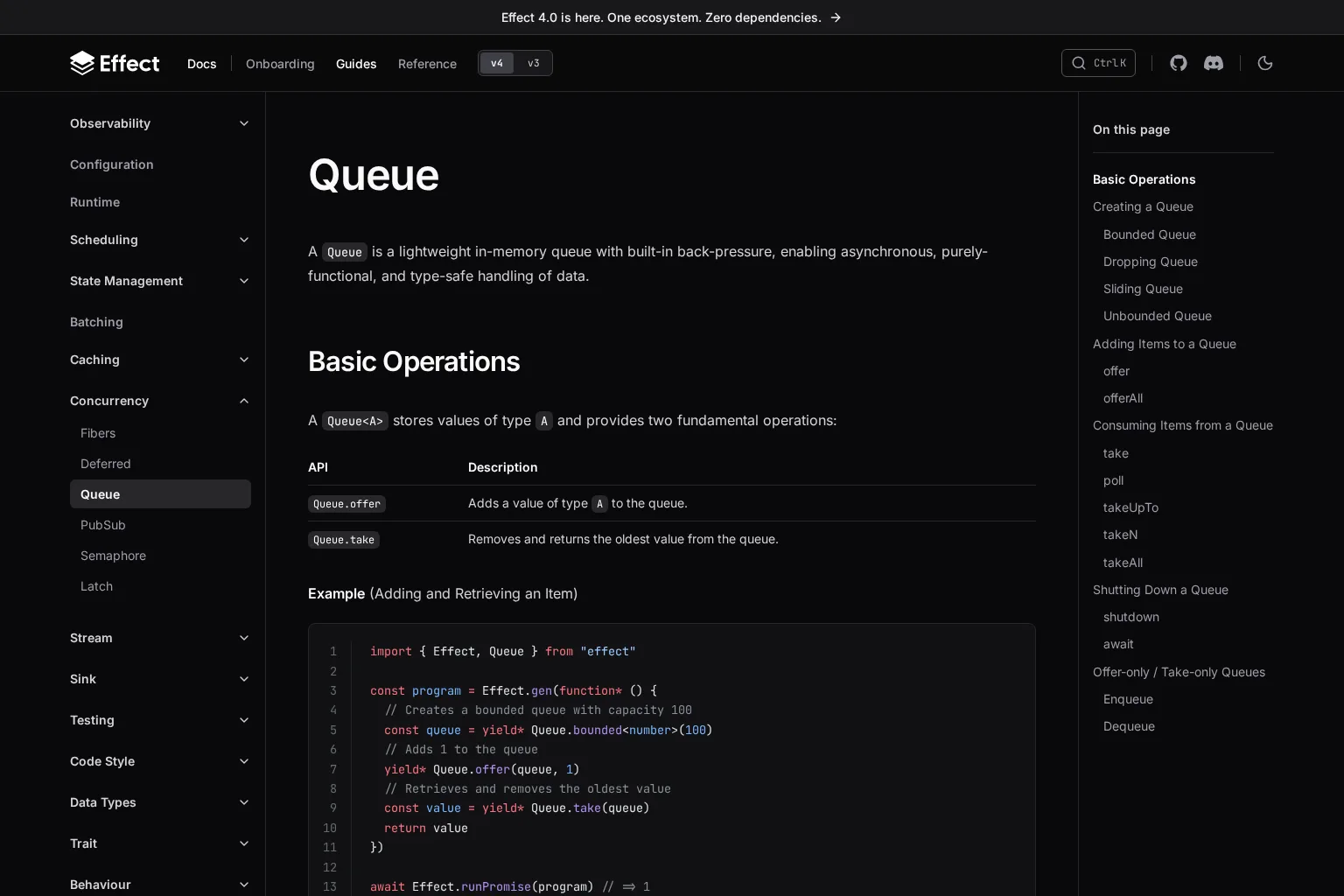
Best fit: A TypeScript service coordinating short-lived, disposable work among fibers within the same running process. Effect's Queue documentation calls it an in-memory, typed queue. Bounded queues suspend offers when full; dropping and sliding variants make different overload trade-offs. That is useful when a producer must slow down rather than pile up unlimited pending work.
Delivery and limits: Memory is the boundary. Do not infer cross-process persistence, worker takeover after a restart, or an operator replay trail from an in-memory queue. When a process exits, design as though pending work can disappear. For a notification that can be reconstructed from another durable source, that may be fine. For a committed purchase or report request, store a durable work record elsewhere first. A Queue<number> constrains code in your process; it does not validate a JSON payload arriving from another service.
Operations and cost approach: There is no separate broker to deploy for this queue, but your application still consumes compute and must decide how overload is handled. Check the applicable package and hosting terms rather than treating absence of a per-message price in the queue guide as a price guarantee. Choose it when capacity control matters and loss of queued in-memory items is an explicit, acceptable product decision.
2. BullMQ: dedicated background jobs with a backend you operate
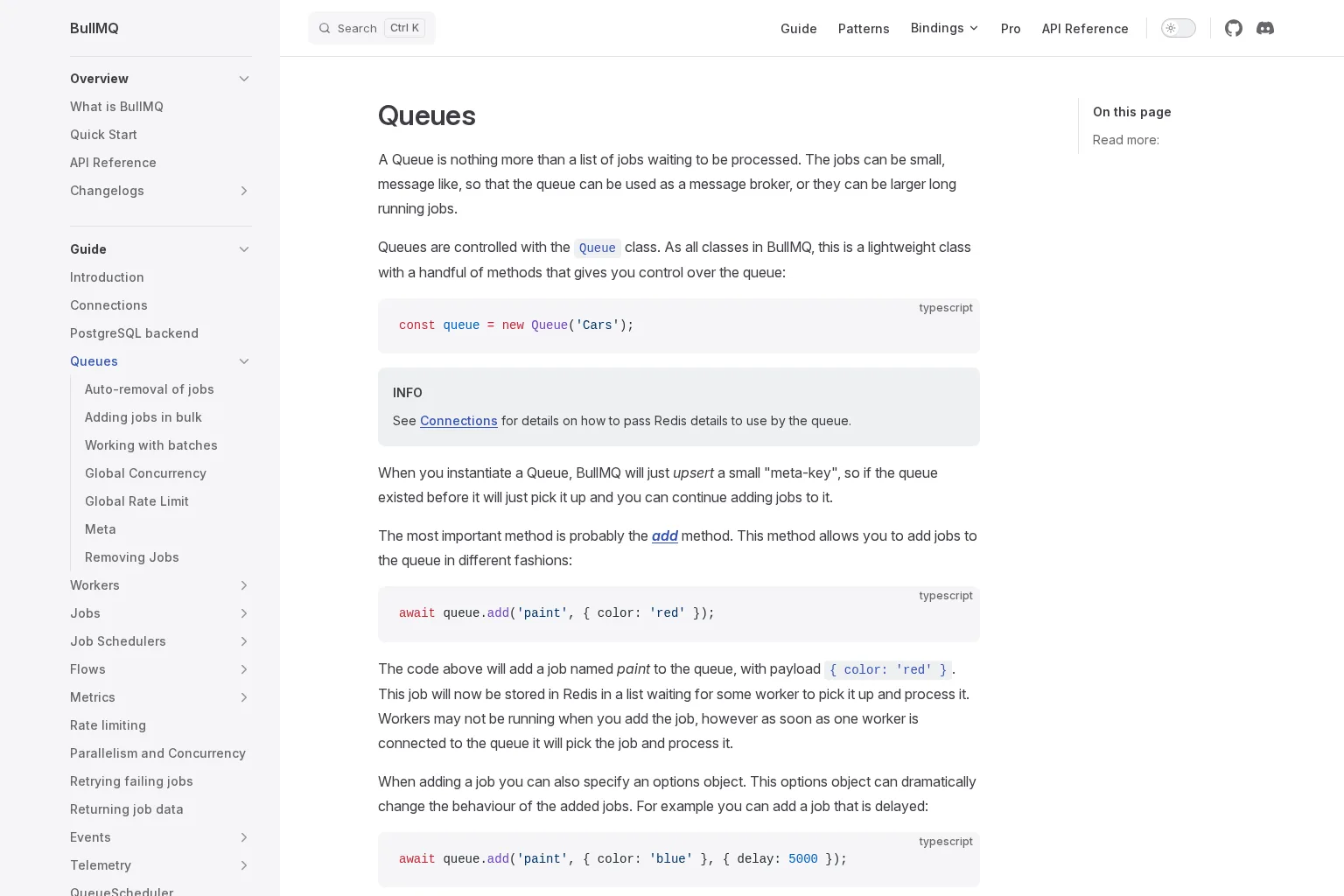
Best fit: A Node.js team that wants a job-oriented Queue and separate Worker processes without adopting a whole application runtime. The BullMQ Queues guide shows jobs persisted for workers and delayed enqueueing. Redis is its default backend, but its documented PostgreSQL backend is an alternative; BullMQ calls Redis the more battle-tested option. Evaluate the backend and version you will actually deploy, not an outdated Redis-only description.
Delivery and recovery: BullMQ supports attempts and fixed or exponential retry backoff. Failed jobs can be retained or automatically removed depending on configuration, so decide your retention and operator-retry policy before the first incident. Its retry guide expresses delays in milliseconds. A job that stalls or retries can repeat work after an earlier handler performed an external effect; make the business operation repeatable instead of confusing queue completion with provider completion.
Routing, scaling, and cost approach: Job names and separate queues help isolate worker workloads, but a job queue is not automatically a topic exchange delivering a copy to each independently owned subscriber. You run the workers and provide capacity, storage configuration, backup, and monitoring. Count the chosen datastore and worker infrastructure, and verify any optional commercial tooling separately. Choose BullMQ for durable task processing when direct control over the queue subsystem outweighs the integration work with your own application models and schedules.
3. RabbitMQ: broker routing for independently owned consumers
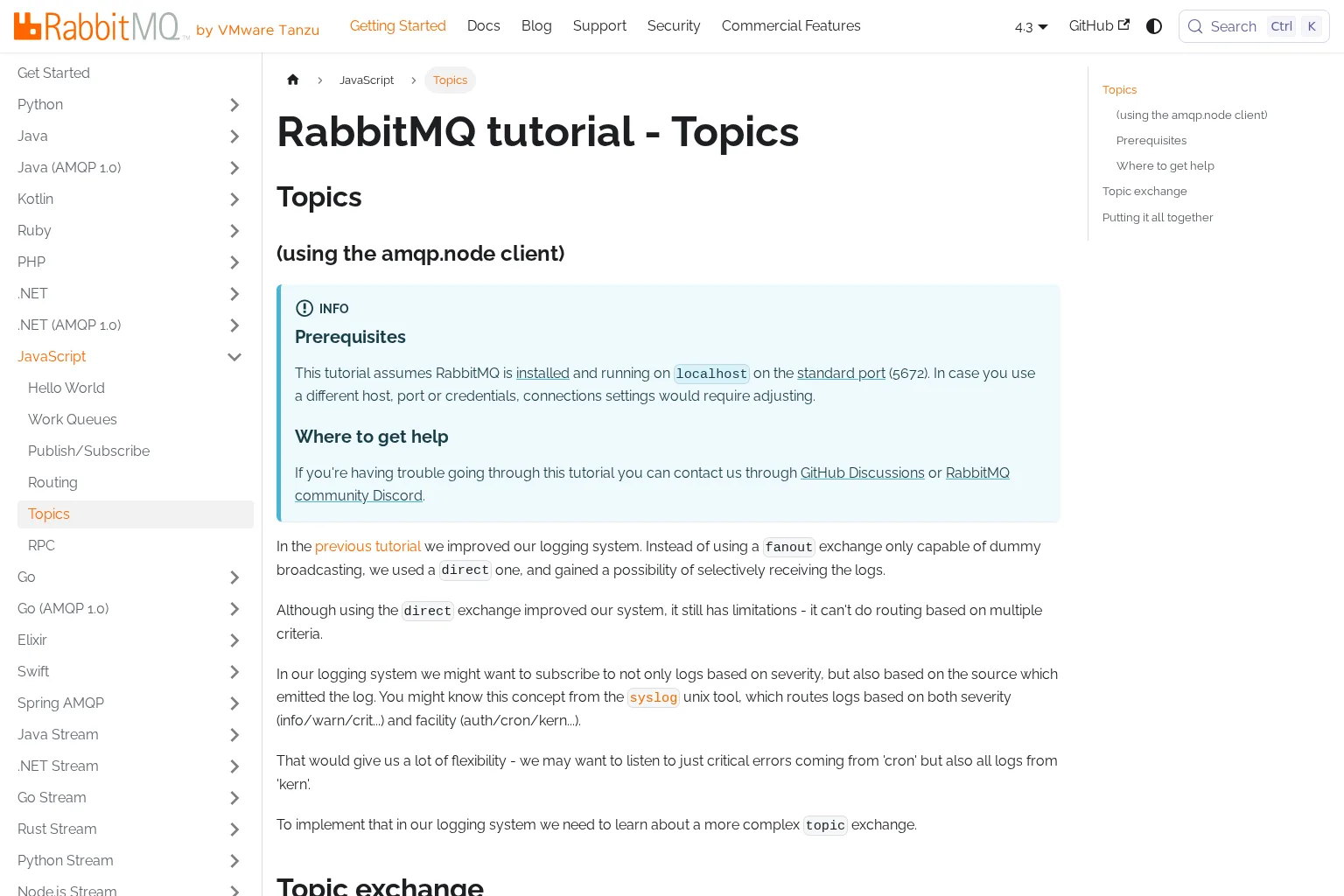
Best fit: An application publishing events that several services must receive under different routing rules. RabbitMQ's JavaScript topic tutorial shows a topic exchange delivering a message to every queue whose binding matches a routing key. Separate queues can give billing, search indexing, and audit processing independent backlogs. A single work queue, by contrast, distributes tasks among competing consumers rather than making copies for every subscriber.
Delivery and recovery: Configure the actual durability and acknowledgement path rather than calling every RabbitMQ publish durable. Publisher confirms establish what the broker accepted; consumer acknowledgements establish what a consumer settled. These are separate boundaries, as RabbitMQ's acknowledgements guide explains. Decide what happens to rejected, repeatedly requeued, or unroutable messages. The linked topic tutorial uses temporary example queues and automatic acknowledgements for teaching; do not copy those settings as a production reliability recipe.
TypeScript, operations, and cost approach: A TypeScript producer can use a compatible Node.js client, but the broker cannot validate your domain's TypeScript interface. Version message schemas, decode untrusted payloads, and run integration tests for routing changes. Your team, or a separately contracted hosting provider, operates the broker and consumer processes; account for both rather than assuming publishing includes managed execution. Choose RabbitMQ when routing and subscriber independence justify that additional topology and operational ownership. If all work goes to one job handler, start with a simpler option.
4. Amazon Simple Queue Service: managed message storage for AWS consumers
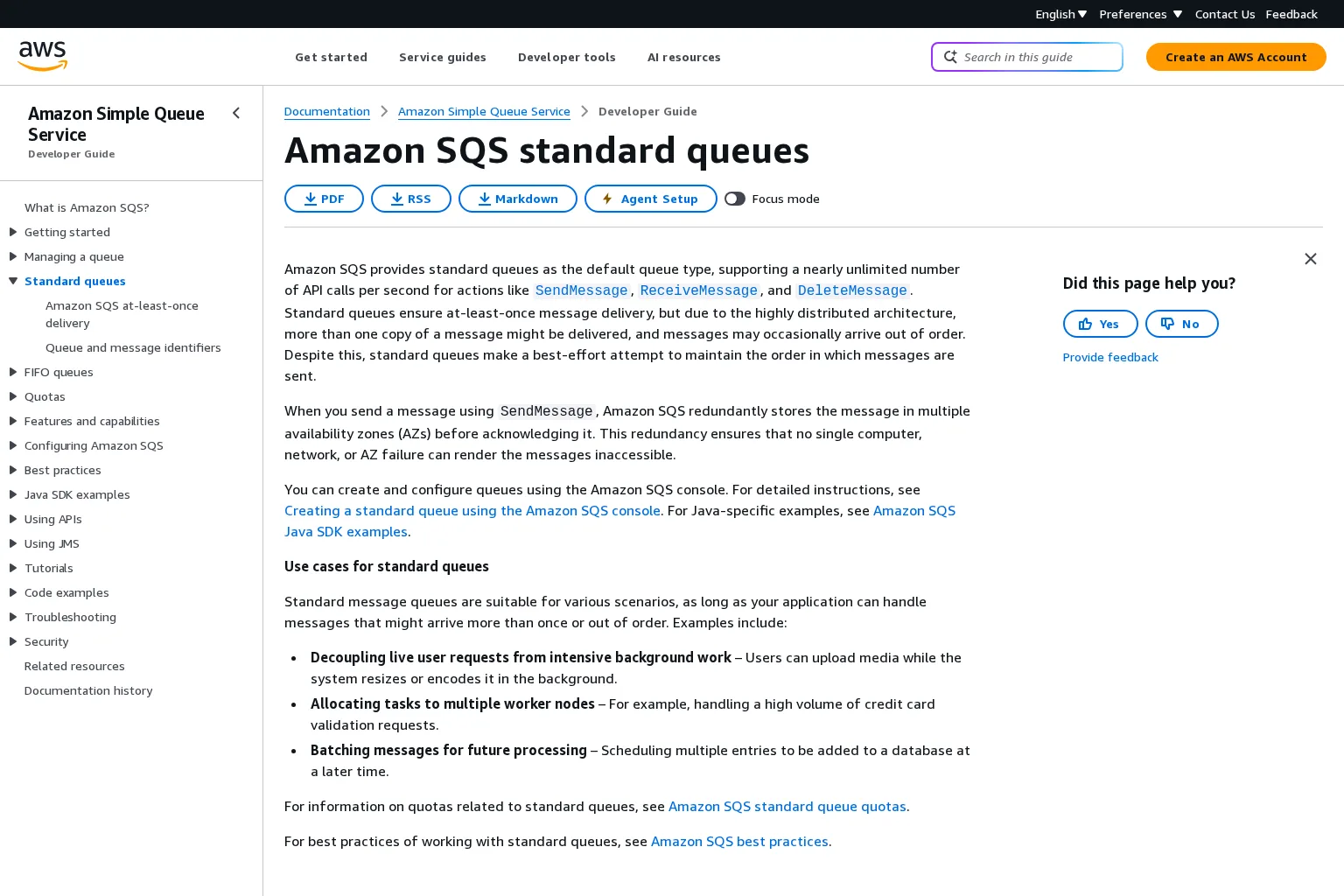
Best fit: An AWS-hosted product needing a managed message buffer while retaining control over how its TypeScript consumers run. AWS's SQS standard-queue guide documents at-least-once delivery, potential duplicates, and occasional out-of-order delivery. If strict ordering matters, evaluate FIFO queues and their specific constraints instead of assuming standard-queue order is guaranteed.
Delivery and recovery: A consumer must receive, perform work, and delete its message after processing. Visibility timeout and redelivery need to fit your handler duration; configure a dead-letter queue and a deliberate redrive procedure for messages that repeatedly fail. AWS's dead-letter-queue guidance explains the inspection and recovery boundary. The AWS JavaScript SDK v3 examples provide a client path for Node.js or TypeScript applications, but your workers, validation, and user-facing completion record are still application concerns.
Fan-out, scaling, and price approach: SQS is a queue, not a standalone topic router. AWS documents SNS topics delivering to subscribed SQS queues when several services each need a copy. AWS operates the message service; you still arrange consumer execution and its scaling, whether you run services or configure another compute integration. SQS pricing is request-based and varies by request and queue type; budget polling, retries, consumer compute, and SNS separately where applicable. Choose SQS when managed AWS message storage fits your deployment and those extra responsibilities are clear.
5. db3.ai Queue: jobs inside an application runtime
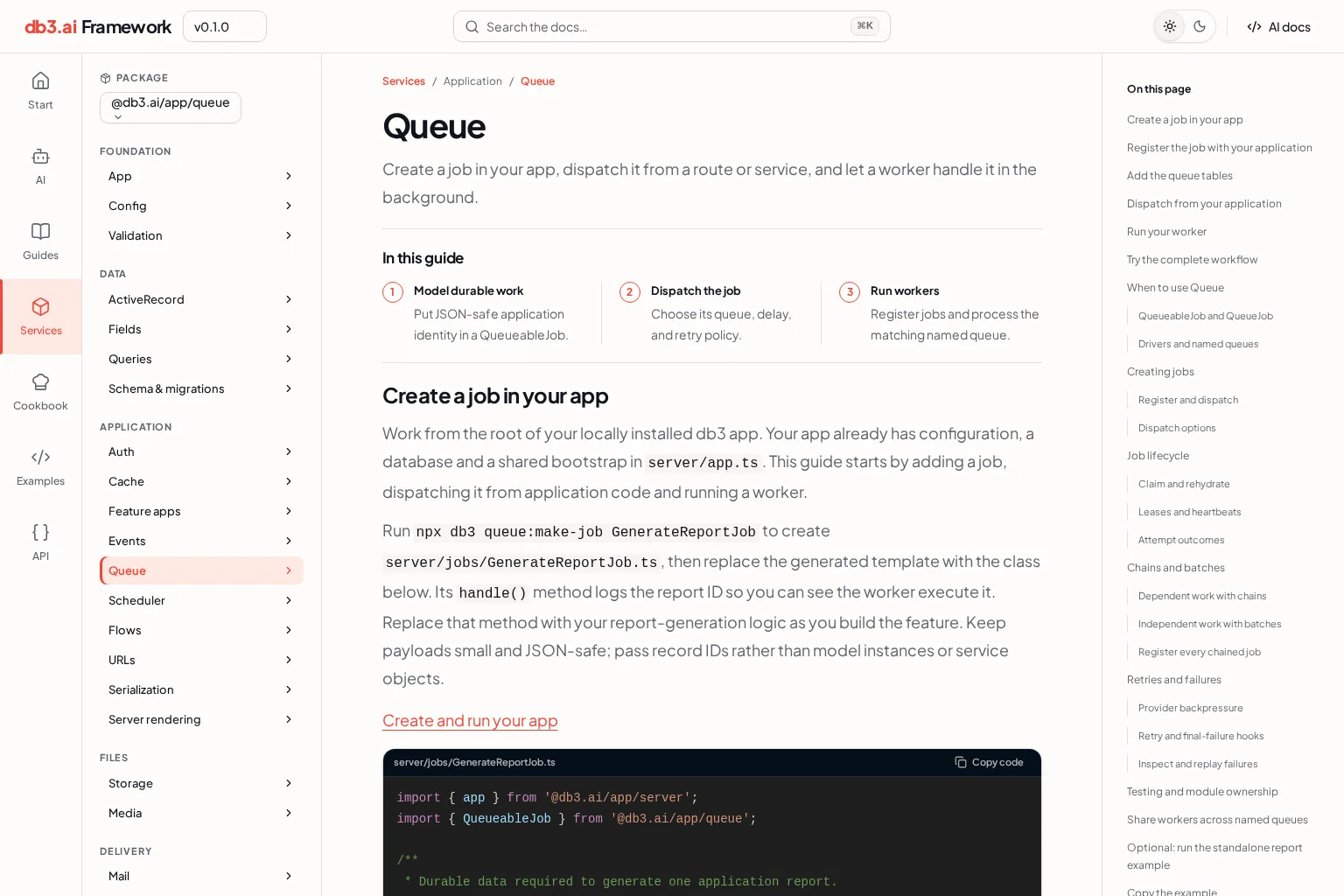
Best fit: A product already built with @db3.ai/app that wants job definitions, dispatch, and workers to use its existing application bootstrap. The db3.ai Queue guide describes an application-database driver by default and an optional Redis driver. Its JSON-safe jobs, named queues, delayed dispatch, retry policies, chains, batches, and persisted failed-job replay address background work. It is not presented here as a hosted RabbitMQ-style topic broker or a managed worker fleet.
A small selection test is whether a report can be represented by a stable identifier rather than a database connection or request object. In an installed db3.ai application, the following job validates what will be restored by the worker. Its handler only logs the report ID; your application must implement the real, repeatable report write.
import { app } from '@db3.ai/app/server';
import { QueueableJob } from '@db3.ai/app/queue';

interface GenerateReportJobData extends Record<string, unknown> {
  reportId: string;
}

export class GenerateReportJob extends QueueableJob<GenerateReportJobData> {
  constructor(data: GenerateReportJobData) {
    if (typeof data.reportId !== 'string' || !data.reportId.trim()) {
      throw new Error('A report ID is required.');
    }
    super(data);
  }

  async handle(): Promise<void> {
    app().log.info({ reportId: this.data.reportId }, 'Generating report');
  }
}
Inside a booted route or application service, dispatch the job to the separately staffed reports queue:
import { app } from '@db3.ai/app/server';
import { GenerateReportJob } from './jobs/GenerateReportJob';

const jobId = await app().queue.dispatch(
  new GenerateReportJob({ reportId: 'weekly' }),
  {
    queue: 'reports',
    maxTries: 4,
    backoff: {
      strategy: 'exponential',
      initialSeconds: 15,
      maxSeconds: 300,
      jitter: true,
    },
  },
);
This is a focused excerpt, not a standalone app: first configure the matching installed package and database, migrate the queue tables for the database driver, register GenerateReportJob in the bootstrap shared by producer and worker, and run a worker on reports. The returned jobId establishes enqueueing, not report completion. The Queue guide contains setup and worker commands, while the Queue API reference verifies the dispatch options. These snippets follow the documented API; they have not been executed in your application.
Delivery, operations, and cost approach: An ordinary failure can retry with the selected policy; a terminal failure can be inspected and replayed as a linked replacement, as the queued-work example demonstrates. A lost worker lease can still leave an ambiguous external effect, and chains are not an atomic handoff. You operate the driver and workers, monitor their health, and keep old payloads readable during deployment. No price for @db3.ai/app is established here; confirm distribution and infrastructure terms for your deployment. Choose db3.ai Queue when keeping durable jobs in the same application model matters more than outsourcing broker and worker operations.
Make the choice by workload, not by the word queue
For a report or AI generation started by an HTTP request, I would shortlist BullMQ and db3.ai Queue if the key requirement is one durable job per request. Decide whether the job should live in a separately owned queue subsystem or within the application's existing runtime. An AI provider timeout makes either option's retry path uncertain: correlate attempts with a stable business key, then reconcile the provider result before repeating an expensive or irreversible call.
For an order.created event needed by billing, analytics, and search as independent subscribers, start with RabbitMQ topic routing or SNS plus separate SQS queues. Do not put those three services on one competing-consumer queue and expect each to see every message. For a bounded, disposable stream inside one process, Effect Queue may be the smallest correct tool. A nightly report adds a separate question: who creates and records each due occurrence? A delayed job is not automatically a calendar scheduler. Our background task scheduling guide develops that boundary.
There is no credible cross-product throughput winner without your payload sizes, worker runtimes, ordering requirements, and downstream limits. Measure enqueue-to-start time, end-to-end completion, duplicate effects, peak backlog, and recovery time with one representative workload. More worker replicas can increase load on a provider that is already throttling; set a fleet-wide limit when the provider requires one.
Run this operational acceptance check before committing
- Storage and handoff: Save a business record, enqueue related work, and force a failure between them. Can you identify or repair a record with no job? A durable queue does not make two separate writes one transaction.
- Worker ownership: Stop a worker after a harmless external effect but before acknowledgement. Which attempt runs next, and can the repeated attempt preserve one business result?
- Poison messages: Submit an invalid payload. Does runtime validation fail visibly, are retries bounded, and who can repair or redrive a terminal failure?
- Capacity: Flood one workload, then test whether an urgent queue still progresses. Measure queue wait, worker concurrency, downstream throttling, and retention under the same load.
- Deployment and visibility: Deploy a changed payload schema while old jobs wait. Can the new worker read them, can on-call distinguish waiting from failed work, and can they replay one job without duplicating a successful business effect?
Frequently asked questions
Is a message queue the same thing as an event topic?
No. A competing-consumer queue normally gives each message to one consumer for processing; an event topic can route copies to separate subscriber queues. RabbitMQ documents topic bindings, and AWS documents SNS-to-SQS fan-out. Choose the delivery topology before choosing a client library. RabbitMQ topic routing and AWS fan-out guidance show the difference.
Does FIFO or a successful acknowledgement guarantee exactly-once business effects?
No. Ordering and broker settlement are different from an external side effect and its application record. A worker can complete an external action before it confirms success, or a confirmation can be lost. Give the business operation a stable identity and reconcile uncertain outcomes before redriving it. RabbitMQ explicitly distinguishes publisher confirms from consumer acknowledgements; db3.ai documents a lost lease as an ambiguous outcome. See the RabbitMQ acknowledgement guide and db3.ai Queue lifecycle.
Next step: Pick one real but harmless job and run the failure drill on two finalists. If your application already uses db3.ai, start with the complete Queue walkthrough, then use its queued-work example to examine retries and replay before putting a customer-facing result behind the worker.
Sources
- Effect: Queue documentation
- BullMQ: Queues guide
- BullMQ: PostgreSQL backend
- BullMQ: Retrying failing jobs
- RabbitMQ: JavaScript topic tutorial
- RabbitMQ: Consumer acknowledgements and publisher confirms
- AWS: Amazon SQS standard queues
- AWS: SQS dead-letter queues
- AWS: SDK for JavaScript v3 SQS examples
- AWS: SNS fan-out to SQS queues
- AWS: SQS pricing
- db3.ai: Queue guide
- db3.ai: Queue API reference
- db3.ai: Build and operate queued work
- db3.ai: Background Task Scheduling: A Reliability Guide for Backend Jobs