25 November 2026
Choosing a Web Framework for Node.js: 3 Practical Trials

TL;DR
To choose a web framework for Node.js, build the same protected report feature in your finalists. Compare TypeScript contracts, application boundaries, integration effort, and failure recovery. I explain what to test in Fastify, NestJS, and db3.ai, then provide a decision worksheet. These are proposed trials, not measured benchmark results.
The useful comparison starts where a demo usually stops: after accepting a request, when work still has to finish. Can another customer retrieve the report? What happens if saving succeeds but enqueueing fails? Can a restarted worker finish without publishing an unintended second result?
Our existing Node.js framework comparison helps you build a shortlist. Here, we take the next step through one representative feature, rather than repeating a catalogue of capabilities.
Table of contents
- Set the rules before writing code
- Define one protected report feature
- 1. Fastify: Test schema-to-worker integration
- 2. NestJS: Test whether structure helps the team
- 3. db3.ai: Test the application-to-worker handoff
- Run the same failure suite against every finalist
- Use a decision worksheet, not an invented score
- Know when the trial is too narrow
- Choose the framework your team can operate
- Sources
- Recommended Reads
Set the rules before writing code
This guide is for TypeScript teams selecting an application foundation. I chose three candidates to examine schema-led HTTP composition, framework-led structure, and application-service integration. The goal is evidence about a product decision, not a universal winner.
The layers can overlap. NestJS supports Fastify beneath its application architecture. db3.ai separates its App service hub from the HTTP server in its lifecycle guide. Compare the stack you would deploy, not only its name.
Use four shared criteria:
- TypeScript ergonomics: Can runtime rules and handler types stay aligned as requirements change?
- Application structure: Can a teammate locate policy, persistence, orchestration, and delivery logic?
- Service integration: Which packages, adapters, credentials, and infrastructure must you add?
- Operational ownership: Who handles migrations, retries, shutdown, monitoring, and repair?
Give each candidate the same acceptance criteria and a comparable time budget. Record versions and deployment settings. Count documentation, infrastructure setup, and help from specialists, not only time writing handlers.
Have a second engineer review each implementation. Its author already knows where everything lives; the next maintainer does not. Ask the reviewer to make a small contract change without coaching and record where they become blocked.
Define one protected report feature
I would give every finalist this acceptance contract:
- A signed-in user submits a date range for a tenant they belong to.
- Invalid input and unauthorized access fail without creating work.
- The application saves a report request with a stable business ID.
- A worker creates an artifact after the HTTP response.
- Only an authorized reader can retrieve its status and result.
- Repeating one logical operation preserves the intended business outcome.
Specify whether the worker uses data captured at submission or current data read during execution. Otherwise, two implementations may return different results while both look correct.
Define when the API may acknowledge acceptance. Keep the report ID separate from the queue job ID: the report is the product object, while attempts describe execution. Decide which durable record lets support staff explain unfinished work.
Keep the trial small, but use realistic relationships. One protected write, a background operation, and an authorized read expose useful integration questions. Do not build an entire billing system merely to compare frameworks.
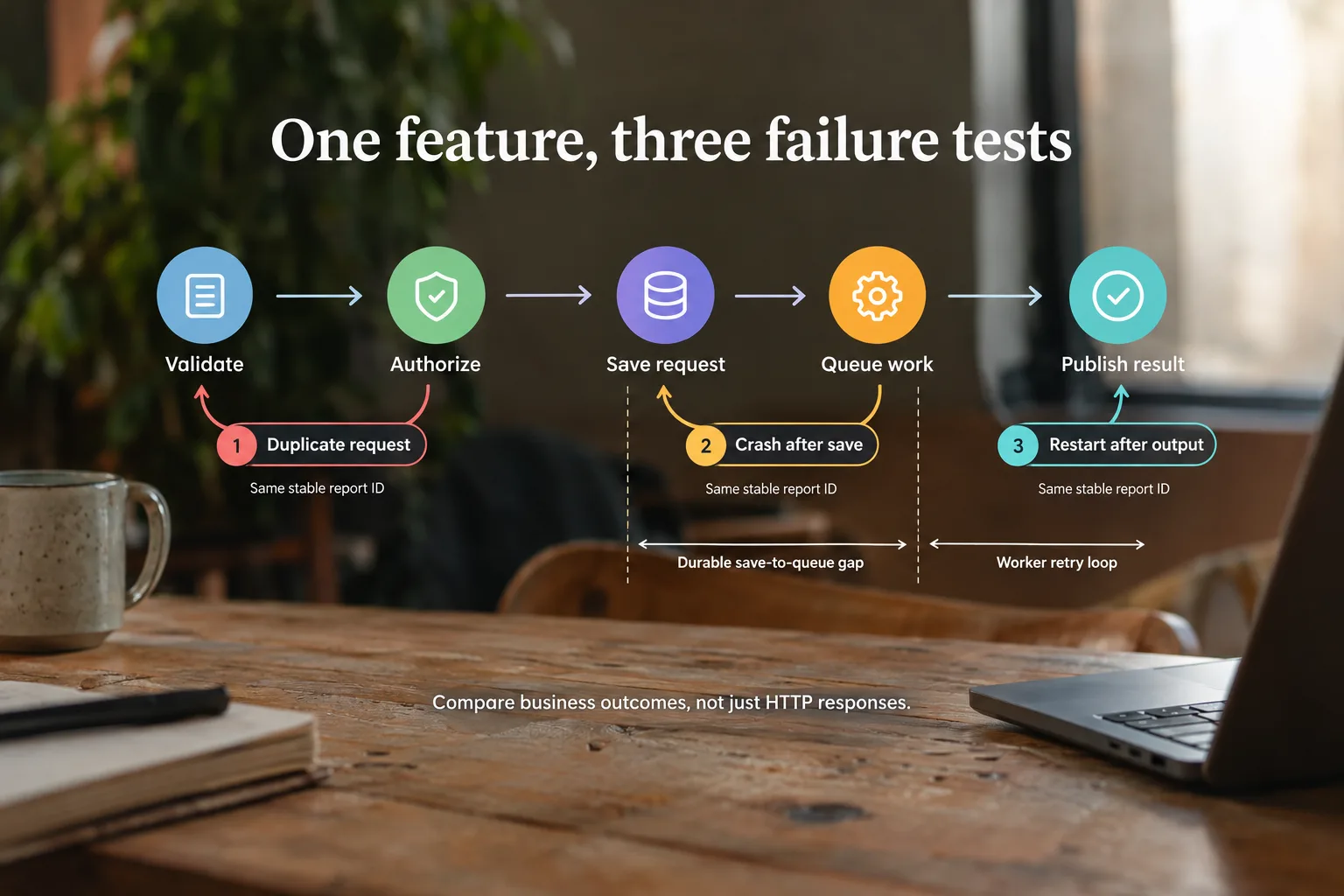
The diagram identifies three failure injections for every candidate. It describes the trial, not automatic framework guarantees.
1. Fastify: Test schema-to-worker integration
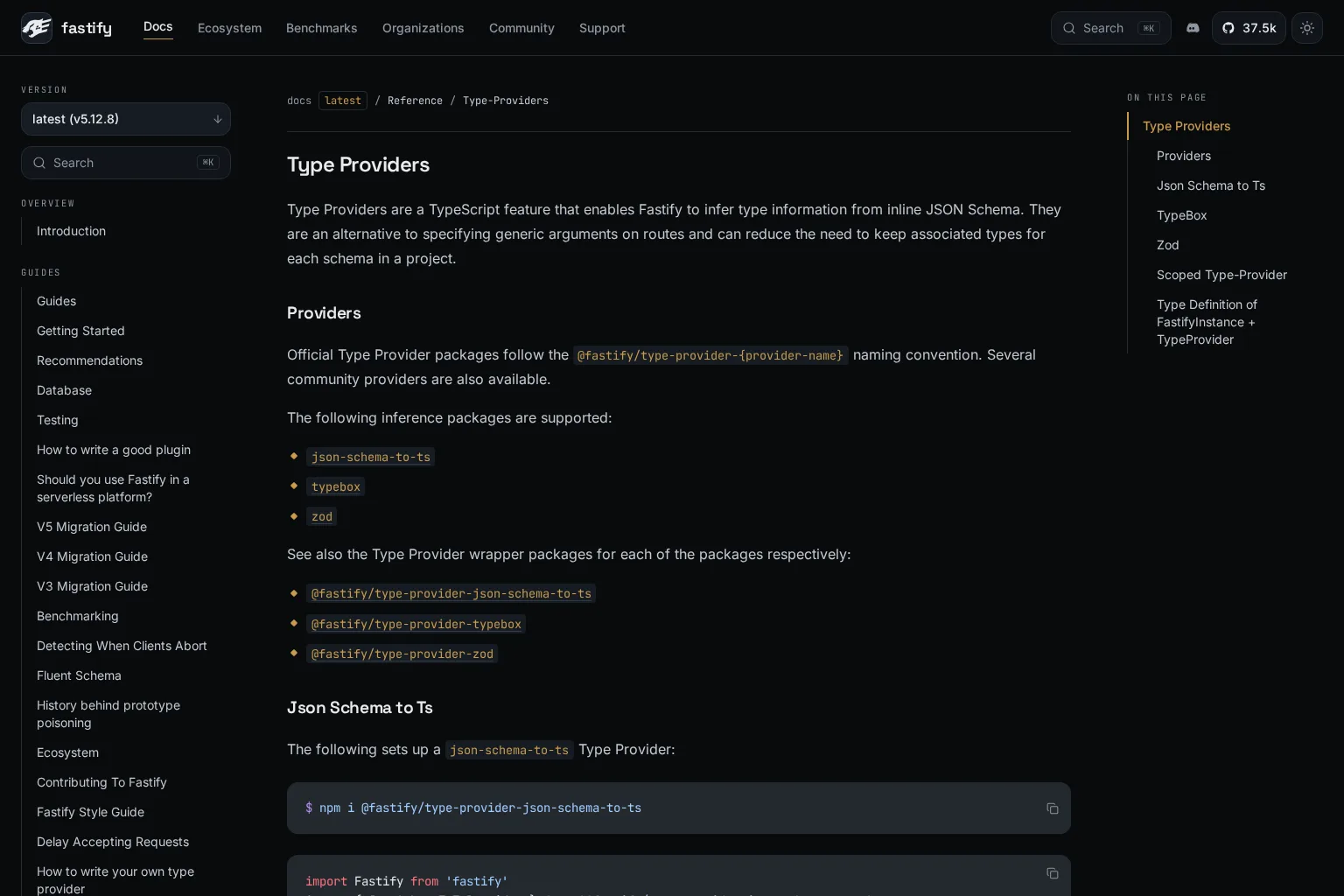
Best trial fit: You want a focused HTTP foundation and are comfortable choosing surrounding services.
Fastify's type providers can infer handler types from schemas. Its documentation also notes that provider types do not propagate globally across encapsulated scopes.
Start with report input and output. Move the route into your intended plugin structure. Does inference still work without broad casts? Add a required field and count the definitions that need editing. Check what the caller receives, not only what the editor accepts.
Build the slice: Add tenant authorization, save the report, and connect your chosen durable worker system. Record the identity, database, and queue integrations you introduce. This inventory is part of the result, not a penalty for choosing composition.
The Fastify testing guide supports HTTP injection without a listening port. Use that for request contracts, then test persistence and workers separately. A route test with a fake queue cannot establish recovery after a process restart.
Decision evidence: Prefer this path when existing platform services connect cleanly and your team understands their boundaries. Reconsider if most effort goes into conventions nobody wants to maintain. Include plugin upgrades, infrastructure, and worker supervision in the estimate, even if the HTTP implementation is short.
2. NestJS: Test whether structure helps the team
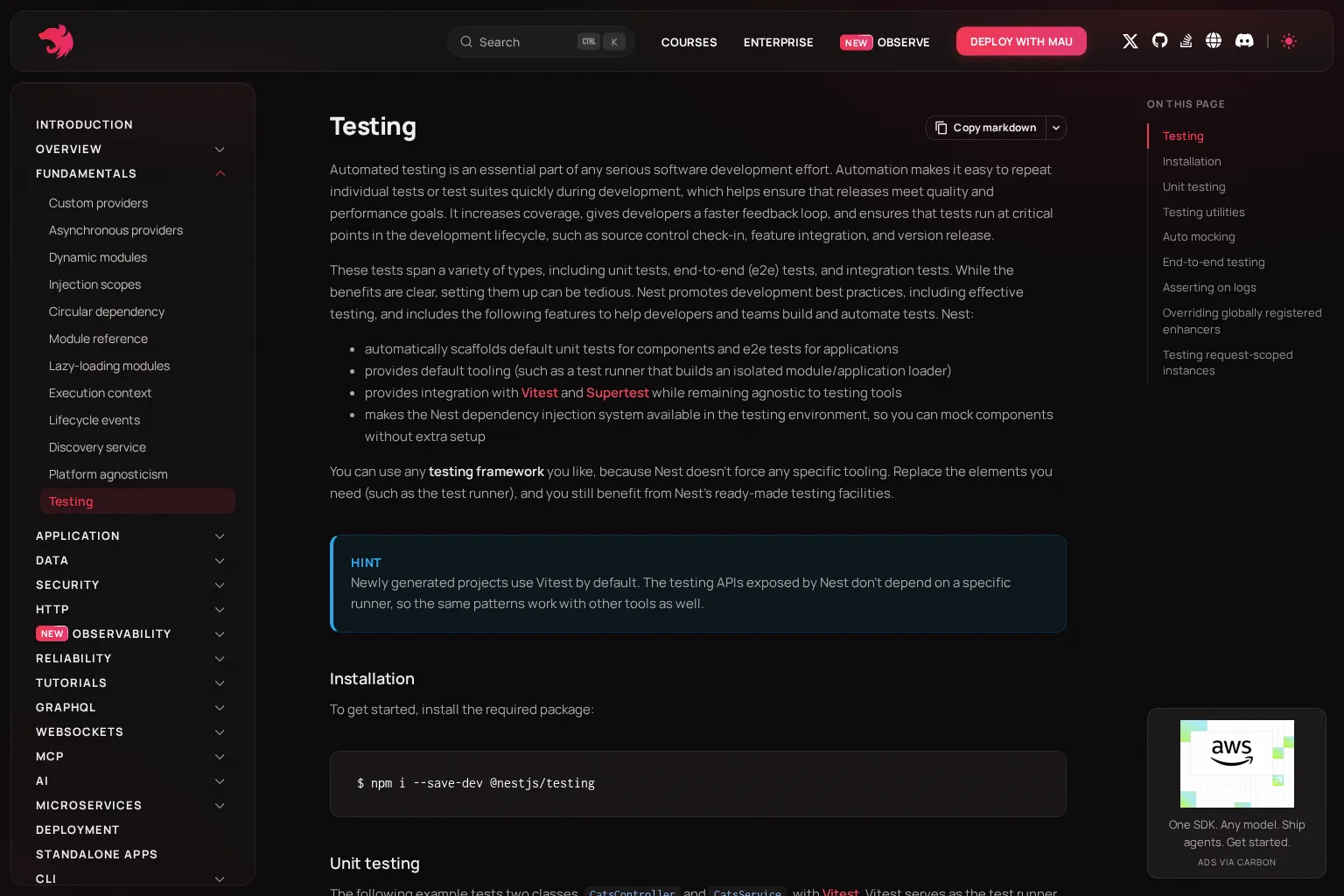
Best trial fit: Several engineers need shared application structure, and you want to evaluate it through a complete feature.
NestJS provides application architecture above its HTTP platform. Organize report acceptance, processing, and result access so their responsibilities remain visible. Ask another engineer to trace the path from incoming request to durable result.
The useful exercise is a contract change. Add a report format or restrict the date range. Inspect how the change travels through validation, service inputs, and worker payloads. Do the boundaries prevent accidental coupling, or merely spread one decision across more files?
Build the slice: Connect your chosen database and identity implementation, then add a real queue consumer. For the documented Redis-backed BullMQ path, include Redis and worker supervision in the inventory. The Nest queue guide explains producer and consumer configuration; installing the integration does not operate its backend.
Keep authorization and persistence in the acceptance suite. Isolated service tests help, but cannot substitute for demonstrating tenant isolation and durable handoff. Have the second engineer recover a failed report using the proposed procedure.
Decision evidence: Choose this approach if its structure clarifies ownership and changes for your team. Count module wiring, onboarding, and integration maintenance alongside that benefit. Neither fewer files nor more layers automatically means a better foundation. Record what the architecture makes easier and what it makes harder.
3. db3.ai: Test the application-to-worker handoff
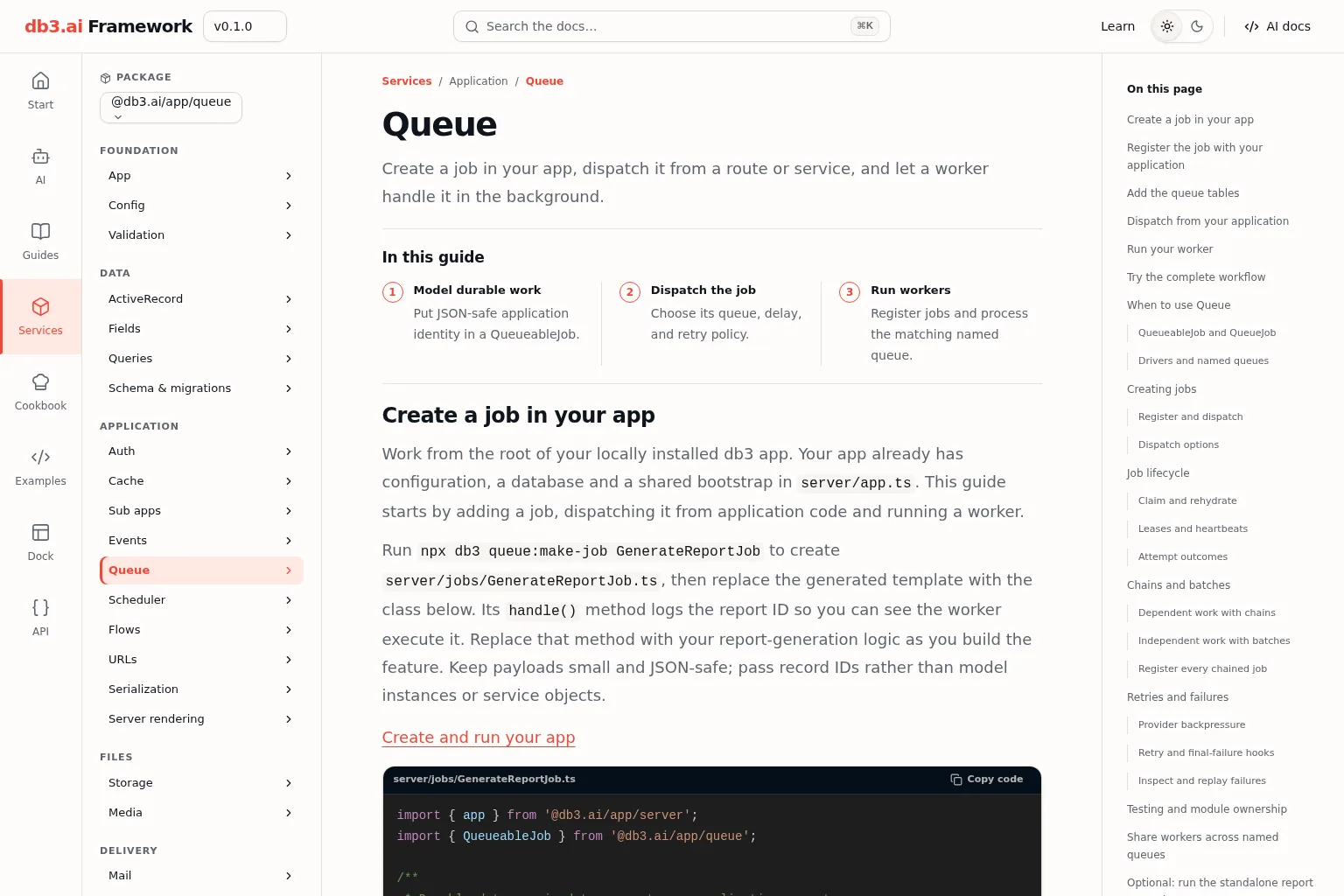
Best trial fit: Data, identity, storage, and background work should share an application service boundary.
The useful question is whether a request and separate worker can use the intended services and configuration consistently. Your product still needs authorization rules, a report model, and a publication policy.
Check access first: The installation guide currently describes an unpublished preview installed from matching maintainer-supplied App and Pure tarballs. Walkthroughs use Node.js 24 or newer. Database-backed Queue needs the documented MariaDB/MySQL setup. Confirm these prerequisites before allocating implementation time.
Give the worker an observable effect
After completing the queue setup, save this adapted example as server/jobs/ReportProbeJob.ts. It writes a fixture artifact, not a customer report. Imports and methods follow the Queue API and Storage guide.
import { QueueableJob } from '@db3.ai/app/queue';
import { app } from '@db3.ai/app/server';

interface ReportProbeData extends Record<string, unknown> {
  reportId: string;
}

export class ReportProbeJob extends QueueableJob<ReportProbeData> {
  constructor(data: ReportProbeData) {
    if (
      typeof data.reportId !== 'string' ||
      !/^[a-z0-9-]{1,64}$/.test(data.reportId)
    ) {
      throw new Error('Expected a short report identifier.');
    }
    super(data);
  }

  async handle(): Promise<void> {
    await app().storage.write(
      `reports/${this.data.reportId}.json`,
      JSON.stringify({ reportId: this.data.reportId, status: 'ready' }),
    );
  }
}

export function registerReportProbe(): void {
  app().queue.registerJob(ReportProbeJob);
}

export async function enqueueReportProbe(reportId: string) {
  return app().queue.dispatch(
    new ReportProbeJob({ reportId }),
    { queue: 'reports', maxTries: 3 },
  );
}
Call registerReportProbe() after constructing the App in the shared factory used by HTTP and workers. Call enqueueReportProbe() only after validating input, authorizing access, and establishing the required report state.
This assumes matching installed preview artifacts, migrated queue tables, and the console adapter from the queue guide. Start its worker on the matching named queue:
npx tsx server/console.ts queue:work --queue=reports --once
Configure persistent storage accessible to the worker and authorized result-delivery process. The Storage guide warns that a container filesystem is not automatically durable. Customer queries, HTTP authentication, status persistence, and private downloads are deliberately omitted. I have not executed this adapted code.
Enqueue the same report identity twice and inspect the resulting bytes. Reusing a path is not atomic publication or proof of exactly-once execution. Concurrent writers and versioned reports need an application-owned publication rule.
Decision evidence: Measure the work remaining after configuration. Include preview readiness, database operations, and worker deployment. The App lifecycle guide requires one active App per process and explains that closing it does not drain workers. Isolate tests and stop workers before closing their application resources.
Run the same failure suite against every finalist
Use disposable databases and dedicated storage. Never inject failures into production or trigger real payments, customer messages, or other irreversible effects.
Duplicate requests and repeated processing
Submit the same request twice, including concurrently. Define its identity, such as a tenant-scoped idempotency key linked to the original parameters. Assert the intended report count and final artifact, not just handler invocations.
Then arrange repeated processing of the same business report through the selected queue's documented mechanisms. Request deduplication and worker idempotency are separate requirements. Also reuse a request key with different parameters and check the declared conflict policy.
A crash between saving and dispatch
Stop after saving the request but before queue acceptance. Restart and inspect whether the work is discoverable and recoverable.
This is the dual-write problem described in AWS's transactional outbox guidance. One option is to save an outbox entry with the business change in the same transaction, then relay committed entries separately. Consumers still need duplicate handling.
Do not assume adjacent API calls share a transaction because their services belong to one framework. Require evidence or an explicit reconciliation path. Check what a customer sees while recovery is pending.
A restart after partial completion
Terminate the worker after writing output but before recording completion. Restart it, wait through the backend's documented reservation or recovery interval, and observe the result.
Can another attempt finish safely? Is incomplete output hidden? Can operators distinguish a failed attempt from a failed report? A retry policy cannot tell you whether an external provider performed an action after an ambiguous timeout.
For db3.ai, the queue guide describes lease ownership and warns that external effects may already exist when an attempt loses its lease. Include this ambiguity in publication design rather than assuming worker status proves the business outcome.
Repair without erasing evidence
Make one report fail permanently, repair the cause, and have someone other than its author recover it. Preserve its business identity and required history. Record how the operator found the problem, checked earlier effects, and confirmed completion.
If recovery requires the author to edit database rows from memory, capture that as remaining work. A passing demonstration is not yet a repeatable runbook.
Use a decision worksheet, not an invented score
Copy this worksheet per candidate. Attach a test, trace, configuration file, or runbook to each answer.
| Criterion | Evidence | Acceptance question |
|---|---|---|
| TypeScript contracts | Schema changes, casts, duplicate definitions | Does a change expose the right errors? |
| Structure | Policy, data, orchestration boundaries | Can another engineer change the feature? |
| Integration effort | Time, packages, adapters, configuration | What is reusable versus project-specific glue? |
| Durable handoff | Transaction and recovery mechanism | Can accepted work become stranded? |
| Retry safety | Business identity and publication rule | Does repetition preserve the intended outcome? |
| Operations | Processes, alerts, shutdown, repair steps | Can the team deploy and recover it? |
Separate mandatory gates from preferences. Cross-tenant access, lost accepted work, or an unsupported deployment requirement should not disappear inside an average score.
For passing candidates, weigh trade-offs against the roadmap. Existing identity and messaging systems may favor composition; a greenfield team may prefer another service boundary. Estimate infrastructure, provider charges, maintenance, and support. A shorter dependency list does not establish lower operating cost.
Keep an unresolved-questions column. Distinguish what your team reproduced independently from work completed with substantial specialist help. Agree who will resolve each important unknown before committing.
Know when the trial is too narrow
This feature tests HTTP, policy, data, and background work. It does not establish suitability for every product. Add another slice if your roadmap depends on server rendering, WebSockets, large uploads, complex transactions, or AI streaming and cancellation.
For AI products, include provider timeouts, usage attribution, and cancellation after client disconnect. Start with controlled fixtures so provider variability does not obscure framework differences.
If capacity is a decision gate, measure the same feature on comparable infrastructure. Record runtime, payload, data volume, concurrency, and errors. Separate request acceptance latency from queue wait and report completion. A fast response does not prove fast background completion.
Choose the framework your team can operate
I would shortlist by architectural fit, then commit after the feature and failure tests expose the remaining ownership.
If db3.ai is a finalist, begin with the preview installation and queue walkthrough. Replace the fixture with one authorized product operation. Bring your worksheet, recovery evidence, and unresolved constraints to the review, not just a successful demo.
Sources
- Fastify: Type providers
- Fastify: Testing
- NestJS: Introduction
- NestJS: Queues
- db3.ai: Installation
- db3.ai: App lifecycle
- db3.ai: Queue
- db3.ai: Queue API
- db3.ai: Storage
- AWS: Transactional outbox