21 October 2026
Node.js Web Frameworks Compared: Express, Fastify, NestJS, AdonisJS, and db3.ai

TL;DR
For a focused HTTP service, start with Express if you want a deliberately small middleware layer, or Fastify if schema-based validation and encapsulated plugins suit your team. Choose NestJS for module-driven backend structure, AdonisJS for a convention-led web application, or db3.ai when APIs, data, identity, jobs, and AI work should share an application runtime. Build the same protected feature in your two finalists before choosing.
A route that returns JSON is easy to compare. A product that must validate requests, protect customer data, generate a report after the response, and survive a worker restart is harder. That is where Node.js web frameworks make different architectural promises.
This guide is for TypeScript teams choosing a Node.js foundation for a new full-stack product, SaaS application, or AI-enabled service. I focus on what each option gives the team at the HTTP boundary and what the team must still build, integrate, and operate. If you need a comparison across non-Node runtimes or frontend-first frameworks, see our broader TypeScript web framework comparison instead.
Table of contents
- What is a Node.js web framework?
- How I selected and assessed these five options
- 1. Express: Keep the Node.js HTTP layer deliberately small
- 2. Fastify: Compose a Node.js API around schemas and plugins
- 3. NestJS: Give a growing backend a shared module structure
- 4. AdonisJS: Follow conventions for a complete web application
- 5. db3.ai: Connect the web boundary to product services and AI work
- Compare the application boundary at a glance
- Prove the web boundary with one real test
- Evaluate performance where the product actually spends time
- A short selection checklist for TypeScript teams
- Frequently asked questions
- Next step
- Sources
- Recommended Reads
What is a Node.js web framework?
Node.js is the runtime: it can serve HTTP without an additional framework. A web framework provides higher-level ways to route requests and compose handlers. Some options stop near the request-response boundary. Others add conventions for modules, authentication, database models, rendering, and asynchronous work. An integrated runtime can connect those services under one application lifecycle, but it is not automatically a managed hosting platform.
That difference matters more than the word framework. A minimal HTTP layer may be exactly right for an existing service that already has shared identity and messaging. A new product without those systems faces a much larger integration decision. I would first draw the path from incoming request to validated data, authorized operation, queued work, and user-visible result, then ask which parts the chosen framework genuinely owns.
How I selected and assessed these five options
I selected five verifiable Node.js-oriented approaches with distinct application boundaries, not the five fastest servers or an exhaustive popularity ranking. Express and Fastify represent composable HTTP foundations; NestJS supplies a structured application architecture; AdonisJS provides conventional product features; db3.ai connects HTTP to a wider TypeScript application runtime.
For each, I assess the same practical criteria: best fit, routing and TypeScript development, validation and testing, product services and background work, and trade-offs, deployment, and cost ownership. Where a framework offers an integration rather than an operated service, I say so. There are no comparable hosting quotes for these different deployment models, so the cost discussion concerns what you must operate, not a fabricated price comparison.

The visual contrasts three ownership patterns: independently assembled HTTP services, a structured application with selected integrations, and services joined by one runtime. It does not rank throughput or count features.
1. Express: Keep the Node.js HTTP layer deliberately small
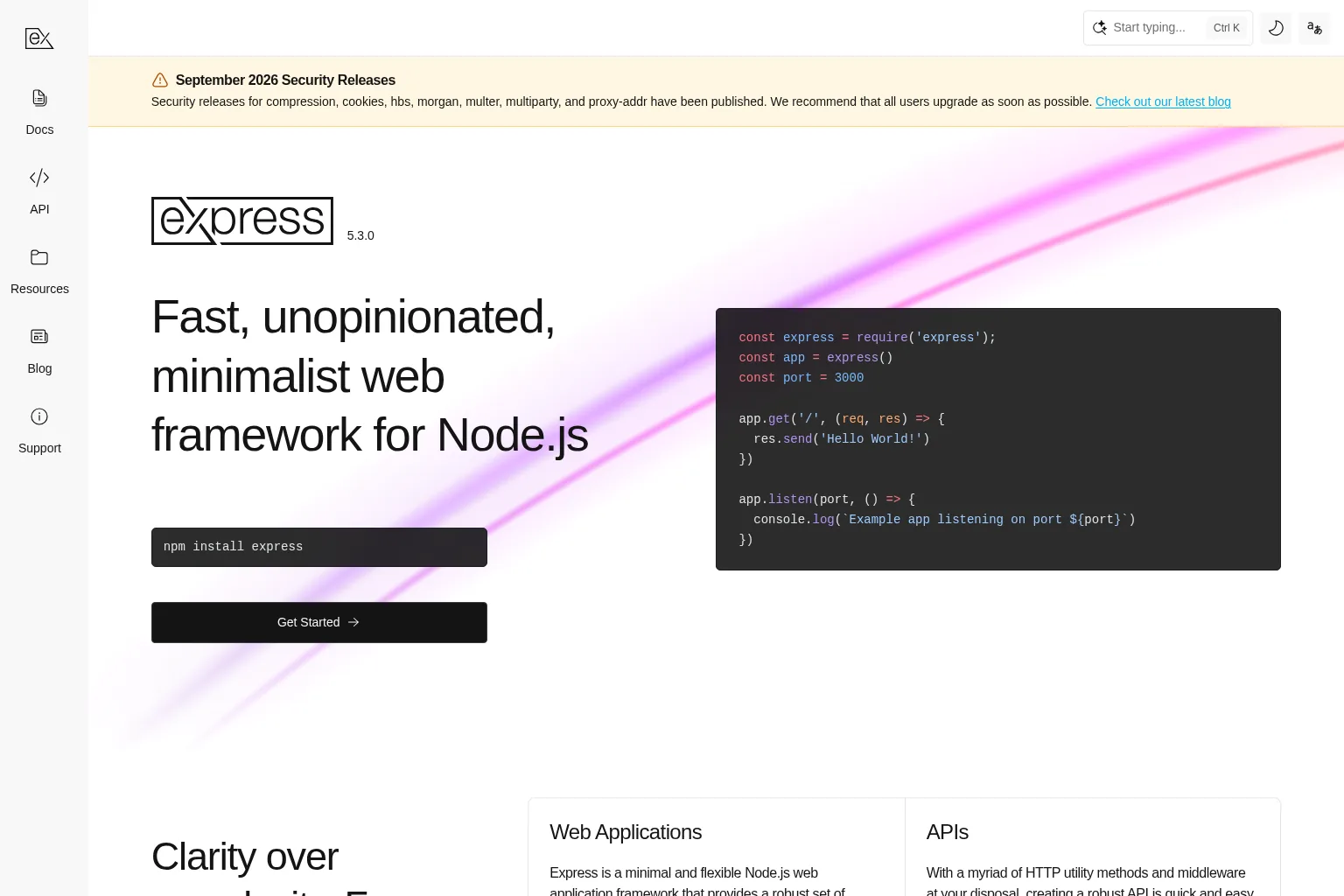
Best fit: An existing Node.js service, a small API, or a platform team that has already standardized its data, authentication, jobs, and deployment components.
Routing, TypeScript, and testing: Express documents a routing and middleware model in which handlers can modify requests, end responses, or pass control onward. The straightforward route shape makes it easy to see where HTTP behavior lives. TypeScript teams can type their application code, but they still need to choose runtime input validation, error conventions, and the testing strategy for their own route and service layers. A static type on a request body is not a runtime check.
Product work: Treat persistence, session policy, file access, scheduled tasks, and durable job execution as separate choices. That is not a defect if those systems already exist and the service only needs a slim web adapter. For a greenfield SaaS product, it is integration work that belongs in the project estimate.
Trade-off and operating cost: You can keep existing components and replace only the request layer. You also own how those pieces fit together, their upgrades, server hosting, and worker operations. I would choose Express when the organization values that control more than an integrated product path.
2. Fastify: Compose a Node.js API around schemas and plugins
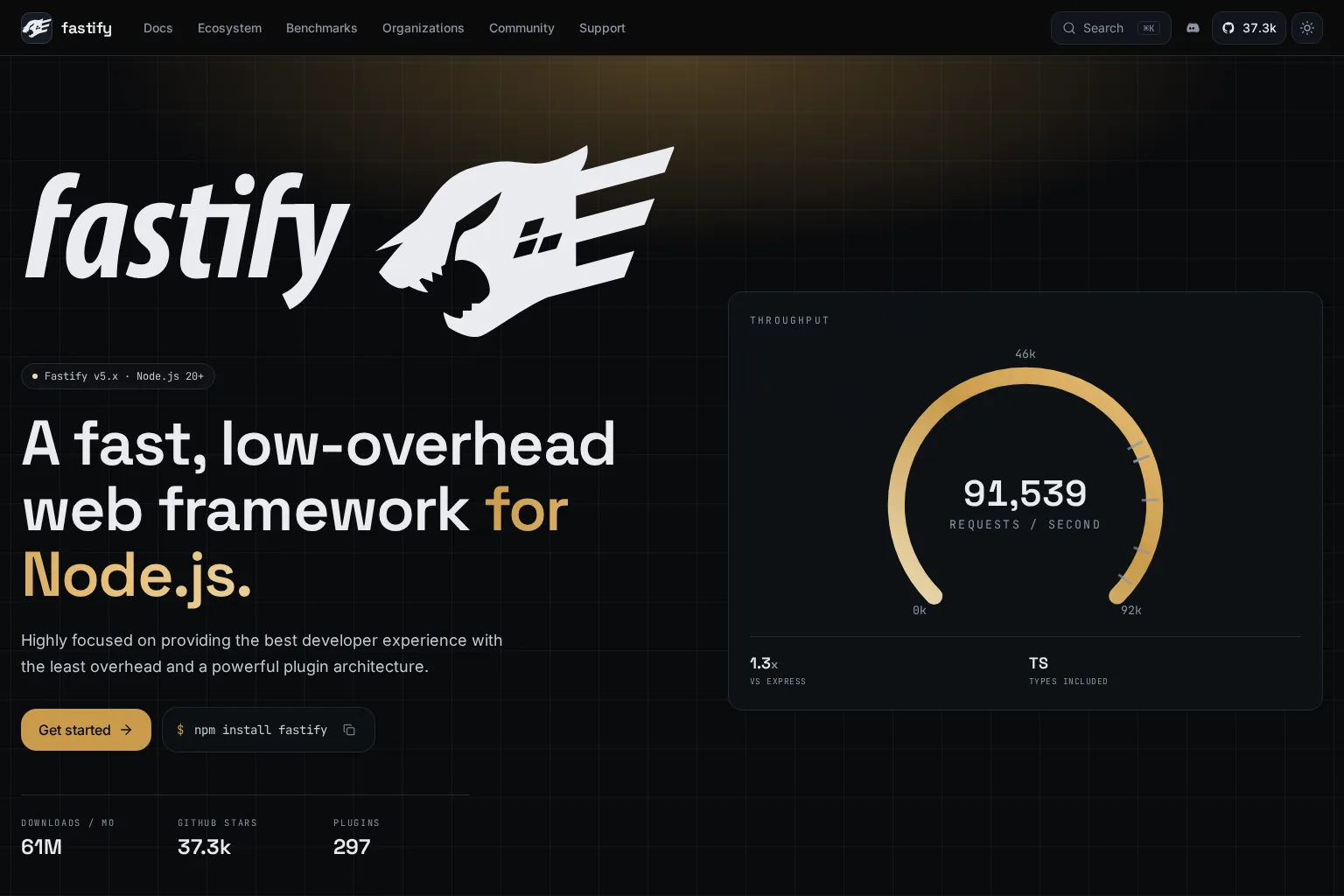
Best fit: A Node.js team that wants a focused API server with clear request contracts and a composable extension model, without adopting a full application framework.
Routing, TypeScript, and testing: Fastify combines routes with plugins, hooks, and decorators. Its plugin documentation explains that registration normally creates an encapsulated scope, so dependencies and route groups can be organized without every decoration becoming global. The validation guide documents JSON Schema for request validation and response serialization. Define a consistent way to connect those runtime schemas to TypeScript types, then test the actual invalid-input response rather than trusting editor completion alone.
Product work: A plugin ecosystem offers many integration routes, but choosing a plugin does not choose the application's identity model, database design, or background-worker topology for you. For a report that outlives an HTTP request, plan a queue and separate worker rather than starting untracked asynchronous work in a handler.
Trade-off and operating cost: Fastify's explicit scopes and schemas reward teams willing to establish conventions. Plan for the selected database, auth system, job backend, hosting, and maintenance of the plugins you adopt. Its low-overhead design is worth evaluating, but it does not establish that your database-backed product will outperform another framework.
3. NestJS: Give a growing backend a shared module structure
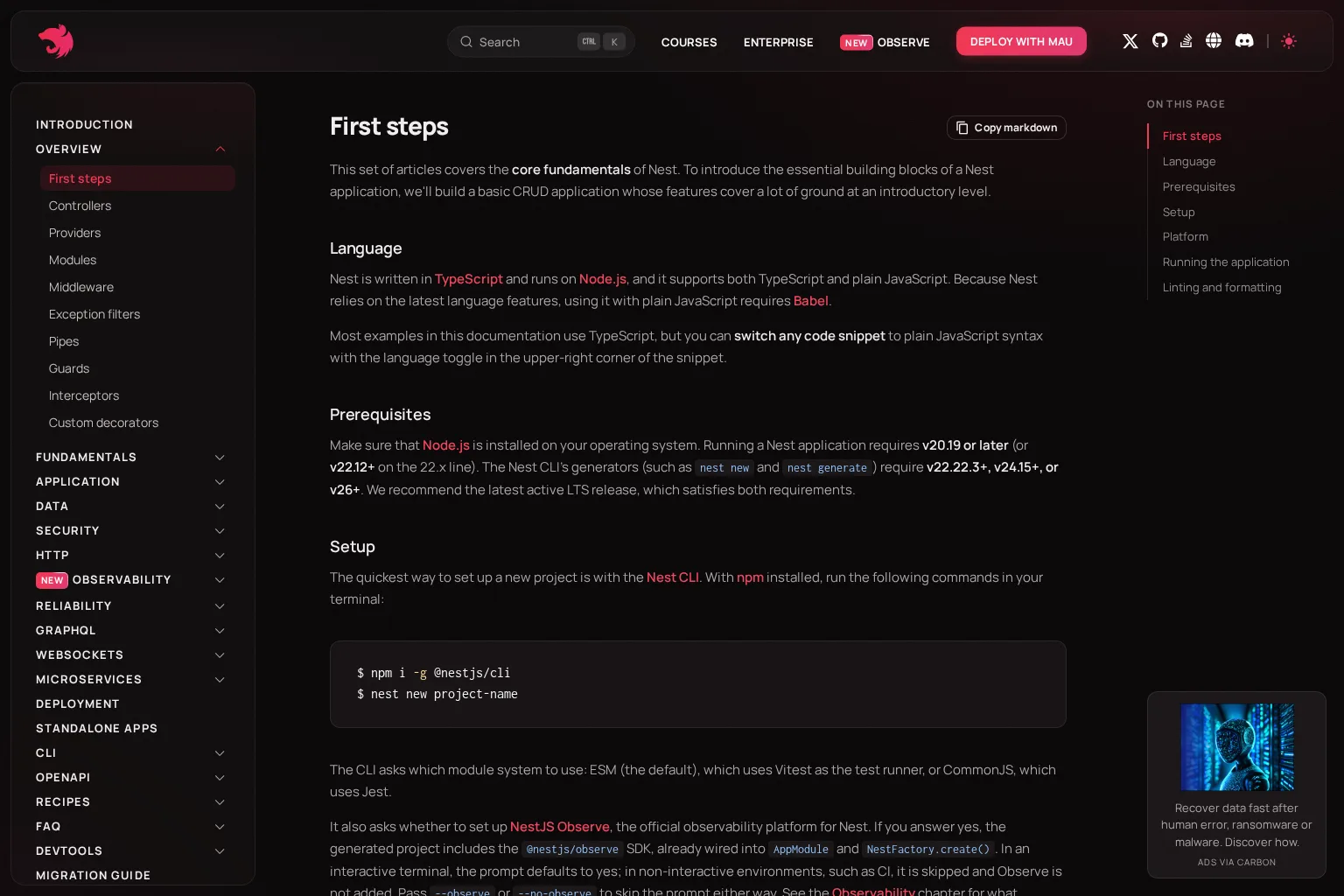
Best fit: A team with multiple domain owners that wants controllers, providers, dependency injection, and consistent module boundaries across a long-lived Node.js application.
Routing, TypeScript, and testing: Nest's first-steps guide shows its TypeScript application structure and explains that Express is the default HTTP platform while Fastify is another supported adapter. Controllers and modules provide obvious homes for routes and dependencies. For runtime input safety, its validation documentation describes both class-oriented ValidationPipe and schema-oriented StandardSchemaValidationPipe. Pick one contract strategy for a feature and verify its HTTP errors in tests. Swapping HTTP adapters is not a promise that every platform-specific integration will also transfer unchanged.
Product work: Nest provides architectural patterns and integrations rather than prescribing one universal database or identity provider. Its BullMQ queue integration requires the relevant packages and a running Redis instance. The team still supervises workers, sets retry policy, and defines authorization for the business operation that enqueues a job.
Trade-off and operating cost: Modules and injection introduce concepts a tiny service might not need. For a growing product, they may repay that learning cost by making ownership clearer. Budget for your chosen persistence, Redis if using this queue path, deployment, and observability rather than assuming module registration operates those services.
4. AdonisJS: Follow conventions for a complete web application
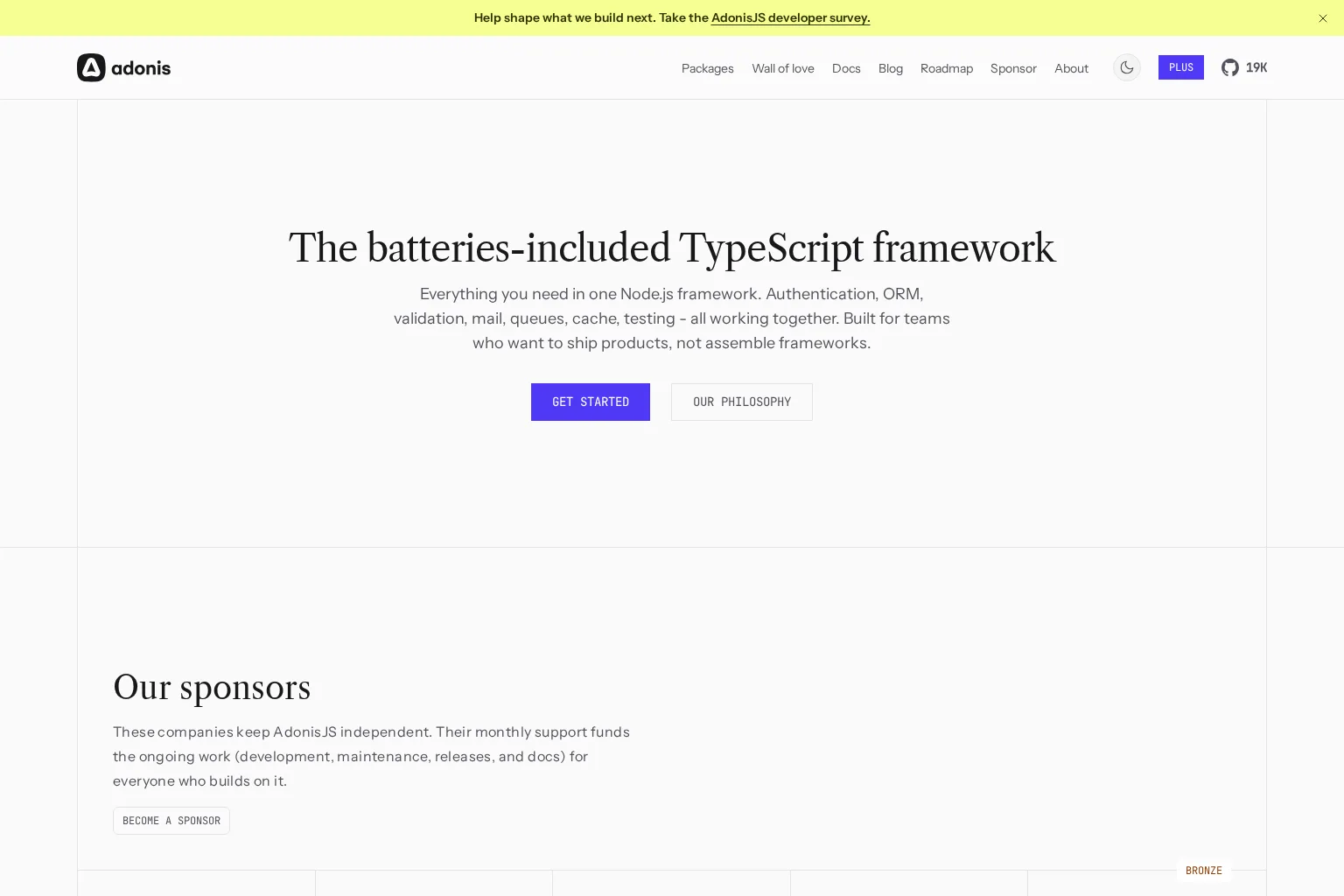
Best fit: A greenfield product team that wants a backend-first TypeScript framework with an established path through routing, validation, data access, and authentication.
Routing, TypeScript, and testing: AdonisJS describes itself as a type-safe Node.js framework with MVC conventions, an optional view layer, and built-in building blocks for ordinary backend work. Its routing guide places route definitions in start/routes.ts and supports groups and middleware. Teams can keep an API-only backend or pair the server with a frontend. Test request validation, authorization, and database behavior through the intended application conventions, not just isolated controller methods.
Product work: Official capabilities cover common requirements such as authentication, ORM-backed application development, uploads, and caching. Queues deserve a closer look: the AdonisJS queue guide documents typed jobs, Redis or database storage, workers, retries, and recurring scheduling, but currently labels @adonisjs/queue experimental and advises pinning its version. If background work is critical on day one, evaluate that maturity explicitly.
Trade-off and operating cost: A cohesive convention set reduces assembly decisions when it matches your product. It may be less attractive if your team must preserve an existing ORM, authentication system, or folder layout. Hosting, database capacity, delivery providers, and supervised workers still belong in the operating plan.
5. db3.ai: Connect the web boundary to product services and AI work
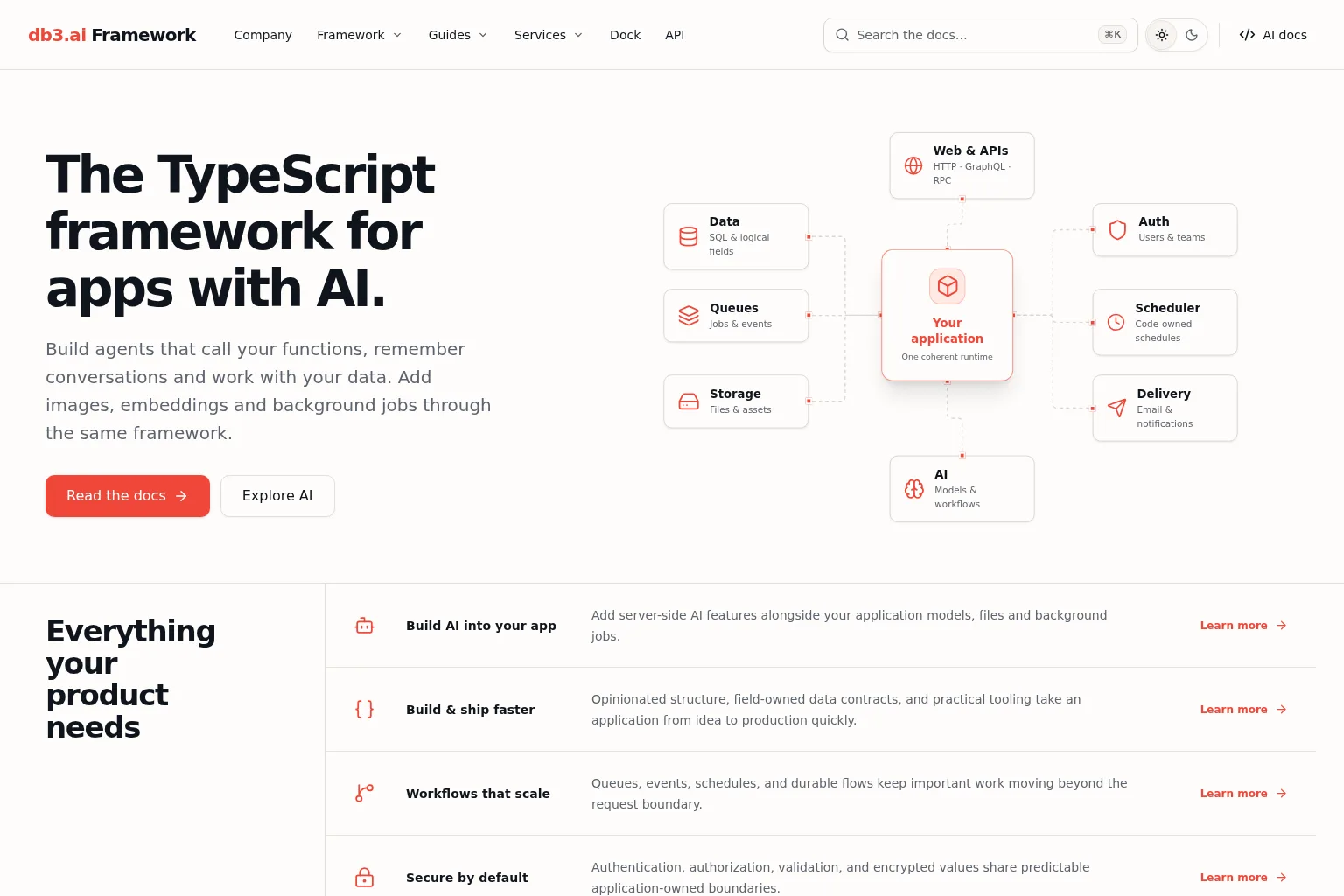
Best fit: A TypeScript team building a Node.js application where HTTP, data, user accounts, files, background work, scheduling, delivery, and AI workflows need consistent application-owned boundaries.
Routing, TypeScript, and testing: We built @db3.ai/app as an application service hub, not a replacement for writing your product's routes and authorization rules. The minimal HTTP app guide pairs one App with a Fastify server, a validated path parameter, request context, health handling, and shutdown. Its consumer test uses HTTP injection without opening a port. The App lifecycle guide cautions that the active application is process-global: create one per process, close it after the server or worker stops, and avoid concurrent active Apps in a test process.
Product work: Package entry points cover Auth, data, Queue, Scheduler, storage, delivery, and AI, while the consuming app owns domain models, permissions, and provider credentials. The queue walkthrough distinguishes a returned queued job ID from completed business work; a separately running worker needs job registration and a matching queue. The documented database-backed Auth, ActiveRecord, Media, Queue, and Scheduler examples require MariaDB/MySQL. An integrated API does not provision the database or operate a worker for you.
Trade-off and operating cost: This is a broader, more opinionated runtime than a router-only framework, so a small existing Express service might not benefit from migrating. The installation guide currently describes a preview installed using matching maintainer-supplied App and Pure tarballs, not an already published npm package. Its walkthrough uses Node.js 24 or newer. Check access to those artifacts, production readiness, deployment requirements, and external model and infrastructure costs before committing. We do not publish a verified price here.
Compare the application boundary at a glance
| Option | What you adopt first | What you still need to decide | Start here when |
|---|---|---|---|
| Express | Middleware and routing | Runtime validation, identity, data, jobs, conventions | Your stack is already chosen |
| Fastify | Routes, schemas, encapsulated plugins | Identity, persistence, worker architecture | API contracts and composability lead |
| NestJS | Modules, controllers, providers | Specific data, identity, and queue integrations | Several engineers need shared structure |
| AdonisJS | TypeScript web-app conventions | Provider configuration and queue maturity fit | A greenfield app benefits from defaults |
| db3.ai | Application services around an owned web API | Product policy, providers, database and worker operations | Web, data, jobs, and AI belong together |
This is an architecture matrix, not a scored benchmark. Nest can use Express or Fastify underneath; AdonisJS and db3.ai still leave application-specific policy to you. Pick the row that minimizes unwanted ownership, not the one with the most checkmarks.
Prove the web boundary with one real test
A useful trial is a protected report request: reject malformed input, verify the user's access, persist the request, enqueue work, and expose a result only to authorized readers. Test the invalid request, a worker retry, and a duplicate delivery. Record the amount of integration code and the number of processes you must deploy. For a first pass, a small HTTP test can isolate the validation and lifecycle questions before adding a database.
Here is a db3.ai-specific test excerpt for the documented minimal app. First follow the preview installation and dependencies, then copy the shipped server example into examples/ as directed by the HTTP guide. Save this test at tests/server/frameworkTrial.test.ts in that standalone application:
import { expect, it } from 'vitest';
import { createFirstServer } from '../../examples/createFirstServer';

it('serves a route and rejects invalid input', async () => {
  const server = createFirstServer();
  try {
    const greeting = await server.inject('/hello/Ada');
    expect(greeting.statusCode).toBe(200);
    expect(greeting.json()).toEqual({ message: 'Hello, Ada!' });

    const invalid = await server.inject(`/hello/${'x'.repeat(81)}`);
    expect(invalid.statusCode).toBe(400);
  } finally {
    await server.close();
  }
});
The guide supplies the source-backed server factory and a corresponding consumer test; I have not executed this adapted test. Run it with npx vitest run tests/server/frameworkTrial.test.ts after setting up the preview. It neither authenticates a user nor queues work. Do not create another active App in parallel in this process; add database-backed tests in an isolated setup with migrations and a disposable test database. The same design exercise in another framework should cover equivalent behavior, not just the shortest route syntax.
Evaluate performance where the product actually spends time
Do not convert a framework homepage's requests-per-second graphic into a prediction for your SaaS application. Measure your own p50 and p95 latency, error rate, memory, and throughput on a production-like deployment, with identical request bodies, validation, auth, database queries, and concurrency limits. Separate a cheap GET route from a write that waits for a database and from a report whose worker runs after the response.
Inspect the bottleneck before changing frameworks. Serialization and middleware may matter for a small response; SQL queries, model-provider latency, network hops, or exhausted workers can dominate a real feature. Report runtime version, instance size, warm-up, load profile, and failure conditions so teammates can reproduce your comparison. A fast HTTP adapter does not make a slow external dependency fast.
A short selection checklist for TypeScript teams
Before committing to one framework, answer these questions in a design review:
- Existing systems: Are identity, database, file access, queues, and monitoring already standardized, or must this project select them?
- Team fit: Will the team maintain explicit middleware composition, schema-first plugins, module/decorator conventions, or a broader integrated runtime more comfortably?
- Deployment: Where will the HTTP process, workers, schedules, database, and secrets run? Who owns upgrades and incident response?
- Product trajectory: Will you add multi-user permissions, delivery, retrieval or AI tasks, or is this service intentionally limited to HTTP?
- Proof: Can both finalists pass the same authorization, validation, persistence, failure-recovery, and deployment trial?
For an existing lean API, I would first trial Express or Fastify without rebuilding working infrastructure. For a new multi-team service, I would compare NestJS's modules against the cost of the integrations around them. For a conventional SaaS application, AdonisJS's defaults merit a trial; for a product whose web requests lead into persistent AI and background work, I would also trial db3.ai while checking its preview-release constraints.
Frequently asked questions
Is NestJS a replacement for Express or Fastify?
It supplies a higher-level application architecture, and its official platform guide identifies Express as the default HTTP adapter and Fastify as another supported option. Compare the architecture you will maintain, not just the name of the underlying adapter.
Does a built-in queue mean background jobs run automatically?
No. Queueing a job and processing it are separate responsibilities. Nest's BullMQ integration, AdonisJS's queue worker, and the db3.ai queue guide each document additional configuration or worker execution. Test retries and shutdown with the topology you will actually deploy.
Next step
Choose two candidates and build the same protected, validated, database-backed request that hands work to a worker. If the integrated runtime is on your shortlist, start with our minimal db3.ai HTTP application and progress to its queue and worker walkthrough after configuring the database. Compare the completed feature and its recovery path, not a hello-world route.
Sources
- Node.js: About Node.js
- Express.js: Using middleware
- Fastify: Plugins
- Fastify: Validation and serialization
- NestJS: First steps
- NestJS: Validation
- NestJS: Queues
- AdonisJS: Introduction
- AdonisJS: Routing
- AdonisJS: Queues
- db3.ai: @db3.ai/app
- db3.ai: Build a minimal HTTP app
- db3.ai: App lifecycle
- db3.ai: Queue
- db3.ai: Installation
Recommended Reads
- 6 TypeScript Web Frameworks for Building Modern Web Apps for a wider web-framework decision that includes frontend and multi-runtime choices.
- 6 TypeScript API Frameworks to Compare Before You Build for a closer look at API contracts and validation.
- 6 TypeScript Backend Frameworks to Compare for Your Next Application for a broader backend architecture shortlist.